

Having written and shared my thoughts on several brands and companies on my blog for many years, and having embarked on a more focused Brandology exercise this year, I thought it’s perhaps time to share my thoughts on how brands are actually connected with companies and explain my thinking a little more.
Brands and companies are often seen as separate entities in the sense that a company is considered an organisation that produces products and brands which it sells in the market, as if the two have nothing to do with each other. Even fewer companies think of themselves as brands. The only time when companies get fully involved with brands is when there is a problem with their product, or when a crisis of some sort occurs. Then too is it is seen as a PR crisis and PR is often called in for crisis management. Whether it is the contamination of water that Coca Cola had to face many years ago, or the Pepsi problem in India, or cases such as the Starbucks racism controversy and the Uber toxic culture problem in the US, these are signs that product brand and company are definitely related in more fundamental ways than we understand or care to acknowledge.
In reality, brands and companies are linked right from the start, even if company management are not always consciously making decisions keeping brands in mind, including the corporate brand. If we try and understand what a brand is in the first place, we will realise that it is a product or service enhanced with differentiators that companies sell to consumers in order to gain preference in their brand purchases. The branded product or service, therefore, is an assurance of quality and reliability from the company to the consumer who is buying it. Implicit in this assurance of the brand is the company’s qualified and trained personnel, their innovation, manufacturing processes and quality testing, their marketing’s understanding of consumers’ needs and their sales team’s efforts at reaching out to consumers wherever they are. The entire company is therefore geared in order to serve the customer, and the brand is the finest expression of this.
Seen from the consumer’s point of view, brands are products with differentiated benefits that fulfill an important need in their lives and make them feel a certain way about themselves and/or make a statement about them to others. Brands are therefore a set of product benefits, differentiations and positive associations that consumers form in their hearts and minds over time, about a company and its product, including about its quality and reliability.
Seen together in its entirety, brands are the relationships companies have with consumers through their products. There are several kinds of linkages between brand and company that operate at different levels: from business strategy itself to product development and differentiation, communicating with consumers and even managing the post-purchase relationship. I applied this new thinking of mine to Titan wristwatches, when I wrote and shared my thoughts and ideas on the brand in a blog post a couple of months ago. I have now put them down in a presentation for SlideShare, which you may read below.
Here, I have made certain observations about how certain types of businesses build their brands based on my long experience in the advertising industry in India and I am sure many of you might agree with me. It seems that industrial businesses and even B2B companies focus more on the first three linkages which are business strategy, core values and product development and innovation. While customer-facing industries and businesses focus more on product development and innovation, communication with consumers and managing the relationship with them. Further, I have noticed that service businesses are not as focused on product development, innovation and communication with customers, as they should be. Some businesses such as airlines, travel and hospitality are better at this than their counterparts in banking and financial services, technology companies, telecom and a few others. There is no reason why this should be so, as all companies must focus on all the various levels of linkages between brands and companies. Consumers of both products and services consider the need brands fulfill in their lives, how they make them feel about themselves, and how others view them. Therefore, B2B companies and service businesses also need to follow the same set of principles in terms of linking their brands with the company itself.
Having written enough about consumer brands on my blog, let me shift focus to a few industrial and B2B businesses that I have either worked on in the past – at Ogilvy Delhi – or thought about more recently for my blog. One of my first clients at Ogilvy Delhi in the late 1980s was Modi Xerox the photocopier company. There was a need to grow the market for photocopiers in India in those days, as many companies were either using cyclostyling for duplicating documents, or were getting photocopies done outside the office at small shops. The campaign was based on a strategy of positioning Modi Xerox as the company that enhanced business productivity through office automation. How? Through enabling quicker, clearer and better sharing of documents internally that improves decision-making by managers and executives. The campaign idea itself used a problem-solution approach in leading economic dailies and business magazines in India, where the problems of not having the right kind of documented information were brilliantly depicted by Mario Miranda in his sketches and the headline and long copy focused on the solutions that Modi Xerox offered. There were no TV adverts, but the campaign also used direct response to communicate directly with key decision makers in large companies and strengthen relationships with them.
I think the campaign positioned Xerox for success in India by growing the market ahead of others and later when there was stiff competition from Japanese companies, Modi Xerox was already ahead having had a head-start. Of course, the problem with Xerox’s success in India was that xerox became the generic term, a synonym for photocopying in the country, when Xerox is a patented technology of the Xerox Corporation, and the company has had to fight a different kind of battle in communication. I had put down my thoughts years ago on how to combat the misuse of the Xerox brand in India and sell their superior document management system at the same time, but I haven’t yet executed these for my blog.
Speaking of office automation in the computer era, I also had the opportunity to work on a brand of high-end PCs from HCL-HP in India at Ogilvy Delhi. These were high-end PCs meant for CEOs and senior management in companies and were positioned as zero-error PCs engineered for high performance at all times. The campaign’s idea was to use all the high-stress environments in which these machines had been tested and had proved their performance, thereby justifying its presence in the C-suite. This campaign also had a TV advert which portrayed the PC to be as premium, indispensable and reliable as a Rolls-Royce. I think these PCs were later discontinued as technology changed, but what it did was to position HCL as makers of high-end machines in the eyes of decision makers at large companies in India, when they were one of the earliest makers of PCs in the country. Nowadays, of course HCL technologies is one of India’s leading software and technology solutions providers.
I have shared my thoughts on the American Express brand on my blog, in terms of how they ought to build their corporate brand by increasing the corporate quotient of their product offerings and through positioning themselves as the payments company that offers peace of mind to business leaders around the world. This too was a brand I had worked on in both my stints at Ogilvy Delhi ages ago.
There are a couple of large, iconic companies for whom I had put down my thoughts on brand strategy and campaign ideas, but lost them to termites at my aged parents’ place in Goa and I haven’t yet recreated them from memory for my blog. I say these are iconic companies, because they have been leaders in their respective industries and are still seen as such. The first is IBM – an old client of Ogilvy worldwide on which I haven’t ever had the chance to work – that made the prescient transition from PCs and hardware to software and service solutions decades ago. I had been seeing a few of their adverts on TV and in print (The Economist) years ago talking about building a smarter planet. I thought to myself that no other company could possibly say this with as much conviction and so it seemed the right strategic direction for the brand. However, the problem was that the communication was not doing a good enough job of selling IBM’s strengths in building a smarter, more connected world. That’s because the campaign itself focused only on small, individual problems. When IBM ought to be the company helping the world solve some of its biggest challenges such as smart energy grids, international financial integration, cyber-security, crime detection and law enforcement, healthcare, etc. My creative idea and campaign for IBM helps rectify this problem and positions the company for leading in technology solutions that tackle global challenges. Unfortunately, I read recently that IBM had called for a worldwide pitch when Ogilvy has been their agency of record for over 30 years. Ogilvy has rightly refused to pitch for the business. In these circumstances, I think I shall hold my campaign strategy and ideas in reserve for a while longer.
The second such iconic company is General Electric or GE as it is commonly referred to. I think this company ought to focus on its strengths in inventing, innovating and producing equipment of all kinds that take us closer to the future with every new product launch of theirs. This is what they do best and I think they got distracted in recent decades into diversifying into all kinds of other areas. My brand strategy for GE was to help the company revive their inventive, imaginative and pioneering spirit and position the company as one that is always dreaming up the future. This, I thought, helps connect the company’s illustrious past from the invention of the electric bulb to the modern day, when it makes power turbines, jet engines, healthcare equipment, and is also involved in additive manufacturing (3-D printing) as well as digital predictive maintenance diagnostics for industrial machinery (PreDix) and other products. I haven’t executed this brand strategy and campaign for GE either on my blog as yet. Meanwhile, GE has gone and divided itself into three separate companies. I don’t think this helps the GE brand one bit, however well they might be doing and however much value is being unlocked at the stock markets.
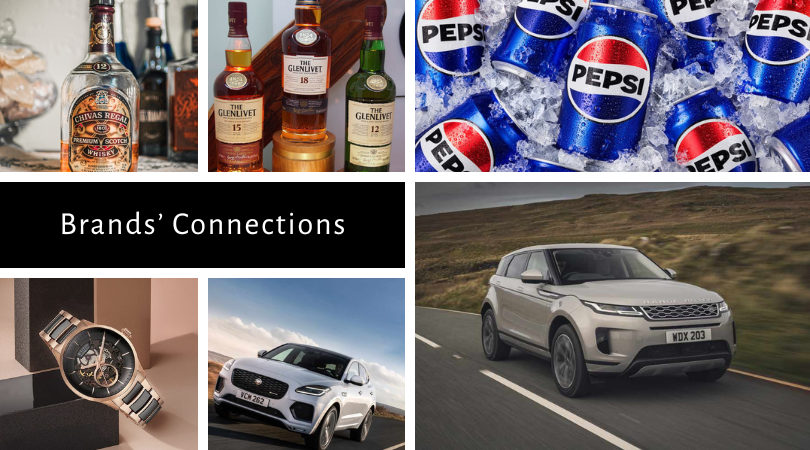
All of these companies fulfill an important need in people’s lives and their products/services and solutions are of the highest standards. The crucial and missing link is perhaps that many of them don’t link their products/brands strongly enough to their corporate brand or company. There are ways in which this can be done and improved, and I had also written a blog post on hardwiring brands into products some time ago, which dealt with the brand’s importance in product development. Whether it’s Titan wristwatches, PepsiCo, JLR and Tata Motors or Pernod Ricard, all companies ought to focus on how to build brands that are better connected with themselves.
Finally, I would say that companies’ senior management need to think more about what role they wish to play in consumers’ lives – whether individuals or other businesses – and how they wish to be of value to them over time. Thinking along these lines at the time of formulating business strategy would help a great deal to start with. Then, ensuring that the products and brands are linked with the company at all the various stages, is how great brands get built.


