

As I write this in Goa, India, Britain is experiencing political turmoil, the kind it hasn’t seen in decades. In fact, it is reported that with Prime Minister, Sir Keir Starmer, stepping down as leader of the Labour Party, UK will soon have its seventh prime minister in ten years. Both the main political parties in Britain have had frequent changes in leadership in recent years and therefore changes in leadership at the helm of the country have been inevitable. Today, the new Prime Minister, Andy Burnham, is likely to be sworn in.
In fact, this might be a good time to also talk about the past ten years, because as it turns out, 2026 marks a decade since the British referendum to leave the EU. We shall look at the economic impact of this a little later. For the time being, the Labour Party which swept back to power two years ago with a landslide victory after 14 years is facing something of a harsh reality check in local elections around the country. From what little I have read, various theories seem to be doing the rounds, but I would like to focus on the British economy since this is one of the main reasons for the disenchantment with Labour.
The fact is that the UK economy has been facing a severe economic slowdown for around two decades. The widely cited Stagnation Nation Report of The Resolution Foundation in 2022 said that the British economy had been experiencing slow productivity growth since the Global Financial Crisis in 2008. I first read about this report in The Economist in 2022, and I wondered if the 2008 Financial Crisis is all there was to it. Unlikely, because Britain, like the rest of the world, also faced two more shocks in the form of the Russian attack on Ukraine as well as the Covid-19 pandemic.
So, why should Britain suffer from low productivity and slow growth in productivity, and why is this persistent since 2008?
The UK government believes Britain’s low productivity growth is due to low levels of business investment for several years. The Resolution Foundation too cite it as one of the main problems, and although I hadn’t read the Stagnation Nation Report earlier, I did so now though not in great detail. I was surprised to see how low investment was in the UK, when I wrote my previous blog post on the EU economy, recommending that EU countries improve their capital investment as well as domestic consumption and look beyond trade for growth.
In an even earlier blog post on the EU and UK economies, I had written that Britain’s economy is very dependent on trade and on external demand as it is a small island economy. And that UK needed to focus on increasing its economic competitiveness by focusing on technology and other high-growth sectors. In this context, I had mentioned the UK government’s new industrial strategy as a good step forward, but that it needed more work to become a full-fledged industrial policy, along with taxation policies and trade and regulatory regimes.
Reasons for low productivity
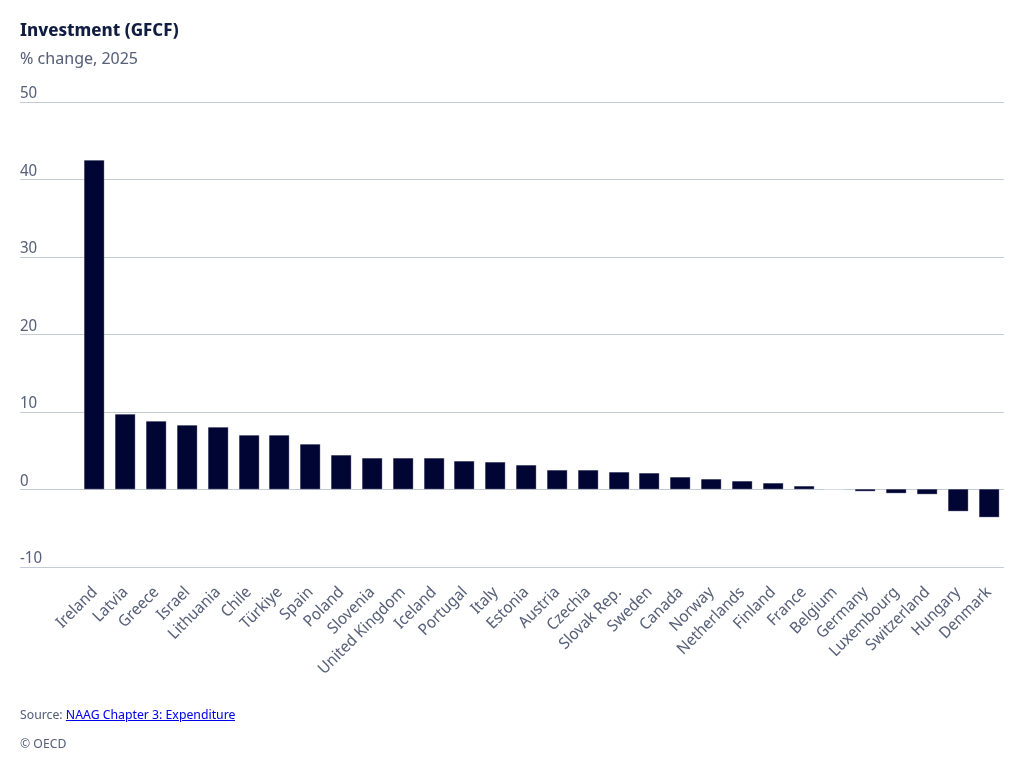
If we look at gross fixed capital formation in the UK in comparison with G7 countries as well as in OECD countries, it tells us that the level of capital investment in Britain is only 19% of GDP in 2025, and had fallen as low as 16% in 2011. This is the lowest among G7 countries and among OECD countries as well and is untenable. If we look at the GFCF (gross fixed capital formation) by sector and asset in the UK from their Office for National Statistics, we find that the total levels of investment in technology (ICT and other technologies) as well as those in intellectual property products are both rather low at around 20% and 26.8% of GFCF respectively for the year in real terms. In comparison the costs of ownership transfer and other building and structures seem to be seeing more investment, and I don’t know how much of this is related to stock market trade as well as mergers and acquisitions. Total GFCF in UK has doubled in real terms over almost a 30-year period, but the average year on year growth is dismally low at around 1.6%. Besides, the growth in general government GFCF over this 30-year period is more than the business investment growth.
I also don’t think it’s just the low level of business investment that is causing low productivity. It could equally be the kind of capital investment taking place in British industry, and each particular industry’s ability to generate greater productivity and output through technology adoption. If we now look at the latest UK productivity figures by section-level industry again from ONS, we find that certain industries began with very high output per hour worked in the late ‘90s but lowered their productivity compared with 2023 as the base year. These are mining and quarrying, electricity, gas, steam and air-conditioning supply, water supply, sewerage and waste management, accommodation and food services, education, human health and social activities, arts, recreation and entertainment as well as other service activities including households as employers! The industries that improved in productivity since 1997 are agriculture, manufacturing, information and communication, financial and insurance activities, professional scientific and technical activities, administration, defence and other support services. This difference is even more apparent when one looks at the output per hour worked at current prices in Britain.
I find this particular sector-based categorisation of industries strange and not very helpful in measuring the effect of business investment through technology in order to improve labour productivity, though I understand that this is how many economists look at industry – through sectoral GVA categorisation – based on economic activity. I think the better way to look at industry is the way industry considers it, by line of business. If we consider Britain’s economy in this manner, I think we all know that an overwhelming share of it lies in the services sector. Within the services sector, some industries such as financial services, legal and accounting, consulting, media and communications, information technology etc. are likely to better improve productivity through the adoption of technology. While others – and I think a considerable part of Britain’s services sector especially by employment – such as retail and wholesale trade, accommodation and food services, travel and leisure as well as education and healthcare are businesses where technology intervention is not likely to generate as great a productivity leap. Therefore, I think it is the composition of Britain’s industry and the share in it of certain types of service businesses that already limits productivity gains from business investment in technology at an economy-wide aggregate level. Resolution Foundation says that the sectoral composition accounts for only a third of the reasons for low productivity, but even a third is significant enough.
Even in manufacturing, Britain has industries such as pharmaceuticals, automobiles, defence and aerospace as well as energy that would respond well to greater business investment in technology. I searched online for the composition of Britain’s total industrial sector by industry, but was unable to find any relevant and useful information, not even on CBI’s website. My sense is that Britain has a preponderance of small to medium service businesses that are in the retail and wholesale trade as well as in food and accommodation services, leisure and hospitality, etc. especially by share of employment and this limits the productivity gains from business investment in technology.
Need for a new industrial strategy
This brings me to the subject of a new industrial policy for Britain, where the country ought to shift focus to more technology-led businesses of the future. The kind that the entire world is trying to shift to, from the old industrial economy. I have written about this already, saying that it will take more than identifying eight high growth and innovation industries for greater business investment in Britain. For starters, some of the eight industries themselves are vague, such as advanced manufacturing, or creative services; to make any headway, the British government needs to get more specific as to which industries they mean exactly, and more importantly, they must consider whether these can serve the international market adequately. Because, as I have written in previous blog posts on the UK economy, the country depends on external demand for growth.
Further, to become full-fledged industrial policy and strategy, UK must also simplify and reform its taxation system as well as its trade and regulatory regime. Together, these three dimensions can combine to form a coherent and relevant industrial policy for Britain for the coming decades. Since I am not from the UK, nor a regular visitor – not for many decades at least – I can only offer broad suggestions for policy reform from India. Looking at all the taxes that businesses in the UK pay, I think it is terribly onerous and can be made more business and investment-friendly. From what I have read online, and in the news, corporation taxes in Britain have been fluctuating between 19% and 25% in recent years. In addition to this, the UK budget talks of pillar 2 taxes and I am surprised that Britain has implemented this minimum global corporate tax, which has been under discussion among G-20 countries for a long time. However, there are the business rates, which I think are hugely problematic and need a complete rethink. I read on UK gov’s website many months ago that business rates were first introduced to replace the old council tax (unpopular in Thatcher’s time). It appears to me that simply shifting the burden to businesses was the easy way out then; as a tax, however, it punishes businesses by imposing a tax on rented commercial property determined by multiplier rates based on location and inflation, on top of rents that businesses already pay and which vary by location and inflation. This is a double-whammy on businesses and strikes me as wrongheaded right from the start.

Reforming business taxes
If this tax is meant to help local councils raise tax revenue, there must be a better and more sensible tax that can replace business rates over the long-term. This is absolutely critical reform that the UK must take up on an urgent basis – looking at the entire system of taxation on businesses both for the national government and for local councils. In fact, the new Modern Industrial Strategy mentions that the special geographic zones set up for the eight industries will also have local council participation. If this is the case, you will probably end up with carve-outs on various taxes that businesses pay in these special zones, adding another layer of complexity to the tax system. Then, are these zones going to be like special economic zones where businesses receive tax and other benefits on the basis of how much they export? If local councils in these zones are able to raise additional tax revenue through business investment, will it not disadvantage other local councils outside of these industrial zones? What can be done to level the playing field, considering that the playing field in Britain is already so terribly tilted in favour of London and the South-east? These are issues to ponder over and the British government must simplify and reform business taxes in a fair-minded and long-term way.
While discussing taxes, I must also mention that the Resolution Foundation writes in their report Beyond Boosterism, about certain peculiarities of the way businesses are taxed in the UK which directly affects their investment in technology. For example, that businesses are encouraged to invest in machinery and equipment that depreciate slowly over time than in information technology which depreciates faster and changes quickly. Within information technology, they write that investment in computer hardware is encouraged over software, for the same reasons of slower depreciation. If true, I think these need to be reconsidered as well, as they directly impact how businesses make capital investments in Britain. I think that if UK wishes businesses to raise their levels of capital investment and in productivity-enhancing technology, they must allow them to expense these within shorter time frames. Especially until 2035 or 2040 for the Modern Industrial Strategy to have its full effect. If this is done, along with all the other simplifications and reforms, I think the UK government can even maintain the corporate tax at 25%.
The other peculiarity that Resolution Foundation mentions is the lack of adequate attention paid to intellectual property products and assets in Britain. It is true that the levels of business investment in intellectual property in the UK are quite low and can improve with the right policies. In fact, if the Modern Industrial Strategy raises investment and innovation in the UK as it aims to, the quantum of intellectual property assets developed in the country should improve. British industry ought to grow its research and innovation spend since the country claims to have the largest concentration of research institutions, and also increase its patent applications. Of course, multinational companies from other countries could also set up base in the UK to benefit from its cutting-edge research and scientific capabilities. The question then arises as to whether the country hosting and conducting such research – in this case, Britain – is adequately remunerated for these innovations and the income they bring.
In the age of technology-led competition between countries and the geopolitics of it as well, such considerations will matter more as years go by and it’s best that these are resolved through an international convention. I am not sure if WIPO has a system currently to resolve these matters. Returning to the subject of business taxes, there are other additional taxes that British businesses have been paying since 2020 which have increased the overall tax burden on industry in 2025-26, as the CBI (Confederation of British Industry) has written about.
International trade and regulations
Finally, we come to trade and regulatory issues that could also impact the new industrial strategy. Britain has signed a number of free trade agreements with several countries, including with India which went into effect on July 15, 2026. However, its largest trading partners are the US and the EU on either side of the Atlantic and here things could be better. Though UK has the lowest of the US tariffs, they affect certain industries particularly adversely, such as pharmaceuticals and the automobile industry, the latter of which still attracts 25% tariffs if I am not mistaken. On the other hand, US investment in Britain must go beyond building data centres and AI; there must be long-term FDI that raises the technological capabilities of the UK, as I have always argued for every investment destination, including my country, India.
With the EU, the Labour government has done well to try and reset relations with the trade bloc, and I hope they can agree on a mutually beneficial trading agreement. With the EU, Britain always had a trade surplus in services and I am not sure if this is still the case after Brexit. It is a fact though that Brexit has done the British economy more harm than good, though in the next couple of decades both the EU and Britain could help each other raise the levels of investment in digital technology and in defence and security, since both regions lag in this area and are trying to improve their competitiveness. And they must try and reduce red-tape, paperwork and streamline processes, including with the help of technology.

Securing Britain’s energy supply
Lastly, the new investments in technology, including in AI, are all going to require vast amounts of energy. Here, Britain has been underinvesting for many years, even though it is shifting to renewables. After the Russia attack on Ukraine and the energy crisis that ensued and the ongoing Iran war, it has become clear that UK needs to do more to secure its energy supplies for households and for industry. I happened to read that Britain doesn’t have adequate storage capacity for energy compared to its European peers and suffered more as a result. I have been reading about the new nuclear energy plants being built in the UK for ages, and I think that it would be a good idea for Britain to explore importing geo-thermal energy from its neighbour Iceland on a long-term basis as yet another way to diversify energy sources and at the same time stay on the clean energy transition path. I think Britain must also stop cushioning households against energy prices forever and look at ways to reduce these prices, perhaps through lowering some of the taxes on fuel. While households are being shielded, British industry is having a hard time running their businesses and media reports that the situation in Britain is so dire as to be causing many companies to relocate to other countries. If true, this is indeed very serious. If Britain is deindustrialising at a time when the government wishes to increase investment and growth, it can only mean that policy actions are not yet aligned with intent.
To conclude, the OBR (Office for Budget Responsibility) has offered its assessment and forecast on the Spring Statement 2026 of the UK Chancellor, in which it says that the context for the next budget will be challenging, as public sector debt and net borrowing have risen alarmingly high with the latter at 5% of UK’s GDP. More importantly, in the context of economic growth and productivity, the OBR writes in its Economic and Fiscal Outlook – March 2026 that real GDP growth in 2026 will be lower than in 2025, at 1.1%, before averaging 1.6% a year from next year until 2030. It also forecasts productivity growth to pick up to 1% in the medium term, as labour supply growth declines from recent highs due to lower net migration and an ageing population.
Time for the UK government to tackle business taxes reform in a holistic and long-term manner and bring together the various elements of UK’s new industrial strategy, for it to work on the ground right across the country.
The featured image at the start of this post of Bletchley in the UK is by Altaf Shah on Pexels

 Peripatetic Perch