

In continuation of my Brandology thinking and work this year, especially that of exploring brands’ connections with companies, I thought I’d turn my mind to fashion brands. Actually, it occurred to me that I haven’t worked on American brands on my blog all these years, save for American Express and Pepsi, and therefore, I thought I must make amends.
After listening to news about Gap Inc’s corporate earnings on CNBC business news for years in India, I decided to put my thoughts down for this brand. Gap Clothing, that is, from Gap Inc, the company; another good opportunity to explore the connections between the clothing brand and the company. I have worn a couple of Gap tops that I bought years ago at a fashion street market on Janpath in New Delhi. They must have been export rejects like the rest of the clothes that sell on Janpath, although these featured the Gap label. Didn’t know that India too is one of the manufacturing centres for Gap Clothing. I bought these more for their lovely summery look and feel in white and pale pink and wore them for many years until I gave them away decades ago after returning to my aged parents’ place in Goa from Chennai.
I must admit that my impressions of Gap Clothing are only from seeing a few advertisements very occasionally in magazines such as Vogue, Cosmopolitan, Harper’s and the like, that I would flip through at my hairdresser’s ages ago in Delhi. These featured men and women wearing Gap denim jeans, paired with white shirts and white summery tops against limbo backgrounds, or empty spaces with just a tall stool, at any rate. I don’t recall seeing any video or TV adverts then, in the days before YouTube and social media. Now, when I visited YouTube to see some of Gap’s adverts, I find that the one recurring theme in most of their video adverts is a choreographed dance and music routine performed by a group of young men and women dressed in Gap attire which is mostly athleisure kind of pants and hoodie sweatshirts or denim. I am led to believe, therefore, that Gap’s advertising mostly lacks an idea.
Listening to how much Gap’s earnings have suffered in recent decades, I think that the brand also lacks a clear and distinctive brand strategy as well as problems with their merchandise. It is true that Gap Clothing has faced stiff competition from fast fashion brands such as H&M, Zara and Uniqlo in recent years, and more specifically from J Crew in America as well as Benetton. Gap Inc is certainly improving its performance in the past few years and this last quarter’s earnings were also good, led by better sales at Gap Clothing, which is good to see.
On Gap Inc’s website, the company talks of the Gap brand always being about bridging the generation gap. I am not so sure that is really the case, as the advertising has always featured young people. Besides, I do not think this is distinctive enough to differentiate Gap from its competitors, especially when the company also has a brand such as Old Navy that addresses the entire family. Let me say here that Gap Inc has four clothing brands: Gap, Old Navy, Banana Republic and Athleta. I have confined my thinking and work to Gap Clothing for now.
I have attempted to differentiate the Gap Clothing brand based on its cultural roots, which are most certainly deeply entrenched in San Francisco and in California. Usually, it is advised that luxury and heritage brands focus on their place of origin as one of the pillars of building their brands. However, in the case of Gap Clothing, it is very much their cultural roots in California that has shaped the Gap brand – and the company – and continues to define it.
Besides, there are clear and distinct advantages in leveraging the California connection for a brand such as Gap Clothing, as I explore in my new brand strategy and campaign ideas for the brand. This, combined with a fashion-maker’s aesthetic and sense – as opposed to a retailer’s – will help Gap Clothing differentiate itself even more from competition. At the moment, it appears that Gap itself operates most of its stores worldwide. I think the company’s focus should be on garment design, styles, good fabrics and tailoring, not on retailing. Gap Inc would realise large savings as well, if it franchised its retailing and concentrated on fashion making. You may read my thoughts on a new brand strategy and campaign ideas for Gap Clothing in the document below.
The TV advert idea for Gap Clothing is in the document above, and although I am not a designer or an art director, I have created layouts for the main brand campaign for Gap Clothing in the print medium, which you can see and read below.
Then, a brand like Gap Clothing will always be launching new product collections for each season, and will need to create specific advertisements for these. Below, I have created three adverts for summer, autumn and denim collections, that also very much stay on the new brand strategy and message.
I have shared my thoughts on the use of media – especially digital and social media – for Gap Clothing in the main strategy and ideas document. And I have also said that Gap Clothing ought to make more premium casual wear in future and drop the hoodie sweatshirts. The focus ought to be on competing better with the likes of J Crew and Benetton, as well as innovating with new designs, new fabrics and with technology.
The real gap that Gap Clothing ought to be about is the California gap in thinking far ahead and leading in pioneering new ways. Time to drop the choreographed dance routines as well. They are so Broadway musical in character and also so much the 1970s and 1980s. Gap must pull ahead or risk falling behind.
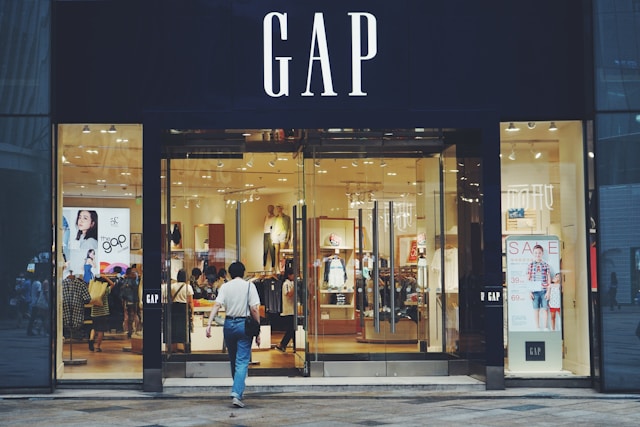
The featured image at the start of this post of a Gap store in Shanghai, is by Lan Deng on Unsplash
The stock images used in the advertising campaigns I have created for Gap Clothing are from Unsplash and Pexels and the Gap logo is from Brands of the World website. I am thankful to all of them.