
Having written a lot already over the years on my blog about the Tata Motors brand as well as JLR and Land Rover and Jaguar brands separately, you might think that I have already said everything that there is to be said on the brand’s strategy. Far from it. I have only gotten started on the nitty-gritty of the strategy, as you shall discover through the rest of this article.
While I had written exploring Tata Motors’ linkage with JLR as the latter’s parent company, and I have also explored JLR’s connections with its brands, Land Rover and Jaguar, I hadn’t fully explored Tata Motors’ connections with its own car sub-brands or car models here in India. And without doing this, one cannot pursue the company’s brand strategy for the future.
So, without further ado, I shall dive into the exploration of Tata Motors’ connections with its car models. Another way of putting it would be to explore how to hardwire the Tata Motors brand into its products, a subject I had written about in a blog post last year. In the meantime, I notice that Tata Motors has gone and rebranded itself as Tata.cars and I am not sure what this even means. I have expressed my reservations on LinkedIn about taking such a step when there is no need to rebrand Tata Motors in my considered opinion.
Instead, I shall begin my exploration of Tata Motors core strengths by looking at the company’s past, because I believe that over decades of making motor vehicles in India, there are many competencies that Tata Motors would have acquired and these are accretive. It doesn’t matter that the company began as a maker of trucks and commercial vehicles including buses, and I don’t think it’s necessary for Tata Motors to wish away its past or dissociate itself with the commercial vehicles category, just because the two divisions have been demerged and are listed as separate companies in India. The two companies still share a common past and an umbilical link, in that sense.
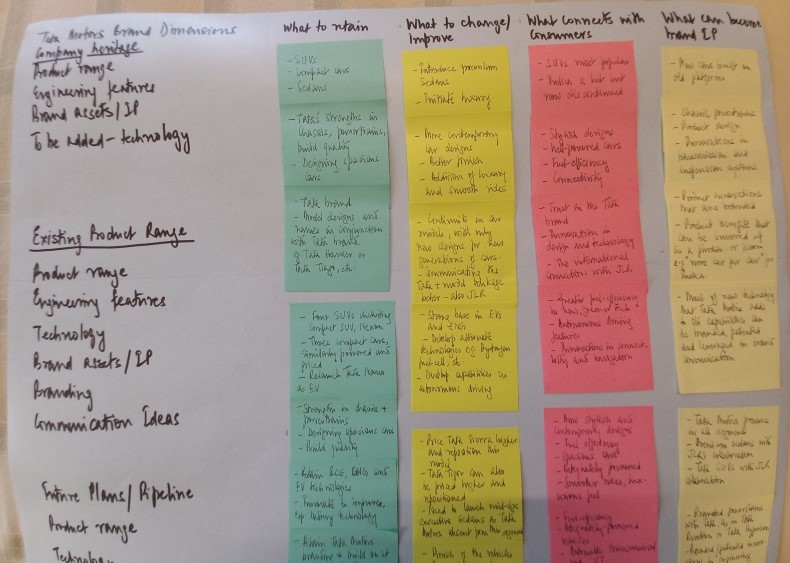
Looking at Tata Motors’ legacy, the company began as a maker of large trucks in India, as the country was fighting for its independence from British colonial rule. To this extent, we would have to say that Tata Motors trucks and buses provided the much-needed transport connectivity required in a newly independent country. This experience gave them expertise in certain technological and engineering areas such as chassis design and engineering, powertrains, build quality of vehicles and even helped them create more spacious cars, when they finally started making passenger vehicles, notably in SUVs such as Tata Safari, Tata Sumo and Tata Sierra. I would say that these are the core strengths of the Tata Motors brand, and it’s now important to see how these translate into competencies in each of the categories of passenger vehicles, which I have tried to capture through a diagram in the document shared below. This means that for each of these car categories, Tata Motors must still build new competencies in addition to the core strengths that it already has, in order to become more competitive in that particular car category. I think that Tata Motors needs to enhance features that allow for smoother drives, as very few Indian car brands are known for luxurious drives. And given that our roads are so pot-holed, any effort in this area of car engineering would be greatly appreciated. It is also an essential requirement for cars in overseas markets, which Tata Motors is surely already addressing.
Ideally, such an exercise as the one I am engaging in should have been undertaken in discussion with the company’s marketing, product development and sales teams, but since I am still unemployed after decades in the advertising industry in India, I have proceeded to do my own thinking and I hope readers will bear with me. What I have tried to do next is to look at various dimensions of Tata Motors’ brand, its heritage, its existing car models, and its future plans, and for each of these, what the company should retain, what it should improve/change, what connects better with customers, and what can be turned into brand assets and intellectual property.
How Tata Motors’ product range helps to build and enhance the brand over time is also important for the company’s leadership and the marketing team to understand. For example, I didn’t see any reason for the company to suddenly jettison their best-selling car models such as Tata Indica and Tata Indigo, when these had helped to create the image and positioning of Tata Motors as a carmaker in India in the first place, and I have written about this earlier on my blog. I think it is from creating the Indica and Indigo Marina, that Tata Motors developed the capability to design spacious cars – not necessarily large cars. And this would have come in handy when designing the Tata Nano. Unfortunately, Tata Nano was a botched marketing and advertising effort, although as I have written before, the Tata Nano would still make a great sub-compact car in CNG and EV variants, provided it is not held to a price, as it was initially at the time of launch.
Therefore, I would urge the folks at Tata Motors to not keep changing their car models so often, or jettison them without understanding how much value they actually add to the company’s expertise and strengths. I have written before about the kind of cars that Tata Motors ought to make, but this time, I shall stay with the company’s existing range. To my mind, the company is too focused on SUVs and understandably so, since customers seem to be preferring them these days. When I looked at the product range, I find that there are three full-fledged SUVs in Tata Safari, Tata Harrier and Tata Sierra which has made a comeback, albeit a very weak one in communication terms. The first two are very similarly powered, with diesel engines of almost identical capacity, and they are priced in the same price band of Rs 1.75 million to Rs 2.4 million! How is a customer supposed to decide between the two? This is where Tata Motors marketing team has to spend more time thinking through their own product range, since it’s possible that product models are cannibalising each other’s market potential. Then, we have competition to think about, so it is always advisable that product models are well-differentiated from each other and from competitive offerings.
I have left out cars such as Tata Curvv and Tata Altroz, as I find the former too sexist and cheap in branding and I am not sure what an SUV Coupe is meant to be, and the latter seems just another vehicle in the compact SUV range, which is what my next point is about. My next observation about the existing product range is that there are smaller or compact SUVs such as Tata Nexon, Tata Punch, Tata Tiago and Tata Tigor, of which the latter three are again too similar in engine power, capacity, and pricing. They need to be differentiated in features and positioning. I did notice an interesting feature of Tata Tiago while going through the product specifications, in that its boot space is twice that of Tata Tigor, which gives the company the opportunity to position it differently from the latter: a compact tourer, for example, for people who travel out of town often.
These are lost opportunities, but Tata Motors can still make amends for lost time and not thinking through the positioning of each new product and how it fits under the overall Tata Motors brand strategy. My next big observation is that Tata Motors doesn’t have any passenger car in the Rs 800,000 – Rs 1.5 million segment which is large and important. This would be the mid-size sedan segment and the only competitor products here are Hyundai Verna, Skoda Slavia and Honda City – the best-selling and oldest sedan brand in this segment and one that I worked on while at Everest Advertising, Delhi decades ago. I think there is definitely a need for Tata Motors to be in this premium, mid-size sedan segment if they can see it as an executive sedan product. It would also open up the market for corporate and institutional buying and allow Tata Motors to address this really important market in a more concerted manner.
This is also where Tata Motors can leverage its collaboration with JLR, to innovate in technology, design and luxury and create a new line of premium executive sedans both for India and overseas markets. Which brings me to the future plans of Tata Motors. While I have no way of guessing what they might be, I am sharing what I think the company ought to be looking at. I think the opportunities of the future are in new fuel technologies, autonomous driving features (if not fully autonomous cars), new materials that make vehicles more powerful and yet more fuel-efficient and the like. I think Tata Motors ought to be spending more time and resources on R&D and innovation and in creating new intellectual property in the future. The company ought to also expand its markets overseas, even as India continues to be the main focus. In all these areas, greater collaboration with JLR and with technology companies, including their own TCS and Tata Technologies, would boost the company’s innovation capacity and its competitiveness immensely.
Brand communication is the other area in which Tata Motors ought to invest for the long-term. This is where even the branding of vehicles matters and I think almost all of Tata Motors’ passenger cars could do with rebranding, as I have written and shared earlier on my blog. Especially when you consider that the Tata Motors’ brand positioning is the car company that encourages people to keep journeying ahead.
And let us not forget, some memorable bits of brand communication from Tata Motors in the past did leave their impression. Such as Tata Indica’s “more car per car”, Tata Sumo’s visual depiction hauling an entire train uphill, as well as Tata Sierra’s “Takes the rough with the smooth” strapline. Time to build on these, register them as brand assets, and build the Tata Motors brand in India and around the world.
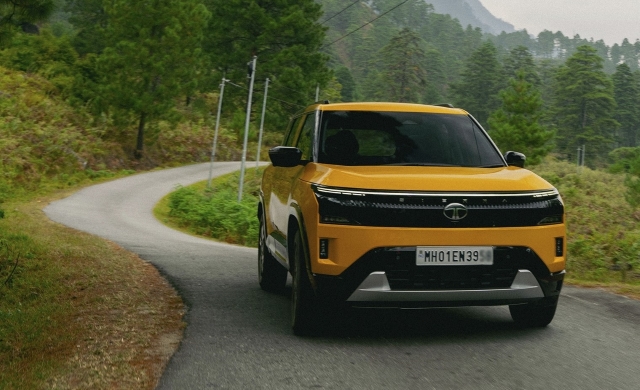
The featured image at the start of this post of the new Tata Sierra is from Tata.cars website and I am grateful to them.


