

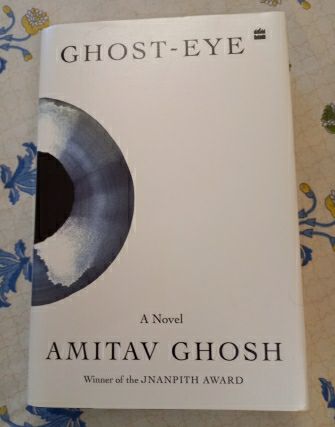
My aged father presented me Ghost-Eye for my birthday last month, and it was after a long time that one was reading a novel by Amitav Ghosh. Actually, it’s not a novel in the real sense of the term, but a strange tale of supernatural proportions. It’s a story that combines reincarnation, superstition, fantasy and psychology with all that modern life has to cope with, including pandemics and climate change. For all that, one expected it to have a powerful message at the end, but unfortunately, Ghost-Eye lacks one.
To start with, the problem could be with the construct of the story: trying to tell a story in two parts that are 50 years apart. Worse, the two parts flit backward and forward, alternating with every chapter, making for a very strange sensation when reading the book. Ghost-Eye has a narrator – which you realise in the second chapter – who is telling us the story about a 3-year-old girl, Varsha Gupta, in 1969 who recalls her past life in the Sundarbans and wants to eat fish. The tension or obstacle is set up in the form of a strictly vegetarian Marwari family in Kolkata that she is born into, and from here on, the story takes many detours. Strangely, Ghosh still refers to the city as Calcutta in the book, not Kolkata and for some reason Sundarban is in the singular. Needless to add, the family is shocked beyond belief and on consulting a psychiatrist, discover that their daughter might be “a case of the reincarnation type” who remembers her previous life when she and her mother caught fish in the Sundarbans and cooked it for themselves as well as for visitors.
The connection that Varsha and the narrator share is the doctor, Shoma Bose, who happens to be the narrator, Dinu or Dinanath’s aunt. Dinu lives in Brooklyn in New York City and travels between his home there and the one in Calcutta. And the story he is narrating about Varsha is the novel that he is writing and the one we are reading. Moreover, he is writing this book at the height of the Covid-19 pandemic, which brings us to the subject of pandemics, climate change as well as the environment. Unfortunately, the novel has no real plot, nor a main protagonist or set of characters. You would think that Varsha Gupta is the main character since this is about her reincarnation or whatever, but then the story becomes so much about the diagnosis of her case that doctors take over the story. Dr Shoma Bose, her husband Dr Monty Bose and a Dr Cathy Booth from the University of Virginia in Charlottesville dominate Dinu’s story through most of the middle section of the book.
I might mention here, that when I came across Dinu or Dinanath and his friend Piya, a marine biologist in the US while reading Ghost-Eye, I was immediately reminded of Amitav Ghosh’s older novel, The Hungry Tide, in which they are the main characters. Except that in that novel, I think Pia was the name if I recall correctly. The Hungry Tide too was set in the Sundarbans and it described life in the Gangetic delta of the Hooghly beautifully, though I must admit that then too I was surprised by the idea that there were creatures like the Gangetic dolphins that swam in these waters. Since I am not an environmentalist, nor an animal activist, I wouldn’t know, and here I must mention that Ghosh really gets carried away with the zoological names of various types of fish. For the most part, the dialogue and conversations between the various characters in Ghost-Eye are realistic, except for Varsha who seems to be too adult already for her tender age of 3 years. And when it comes to discussing various types of fish in the market and which ones to buy for Varsha to taste, exotic zoological names appear all over the pages. For someone who isn’t familiar with even the common names of many of the fish described that Bengalis apparently love, I was quite at sea!
The book also lacks Ghosh’s usual felicity with language, and his evocative descriptions. The journey that Varsha and her father make along with the doctor couple to Sundarbans would have been an ideal opportunity for the author to give us a sense of place with his ability to describe the area as well as tell us how the people felt to be travelling there. But, alas! And if he intended to bring back the two main characters from The Hungry Tide, we don’t know why and I am not sure this was the best way to do it. Apparently, a distant relative of Dinu’s, Nilima Bose, “a legendary social worker” left her NGO, the Badabon Trust, to Piya to manage, and what were Gangetic dolphins in The Hungry Tide become Irrawaddy dolphins in this book.
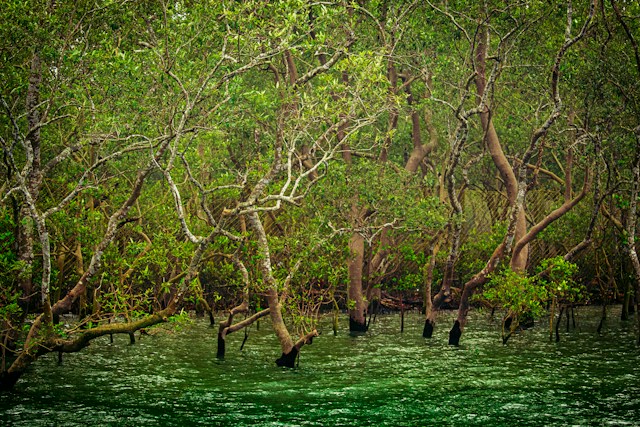
“Having never been to the Sundarban before, Shoma had imagined a forest of tall trees with looping vines and dense undergrowth, but what she saw around her now was nothing like the jungles of her imagination. The trees were short and misshapen, with leathery leaves and strange twisted roots that sat upon the mud like giant spider legs: for Shoma this profusion of gnarled twisted forms was both mesmerizing and menacing.”
Ghost-Eye, the title of the book is a term that Ghosh has invented for people “who see things” that most other people cannot. This emphasis on seeing things reeked of mischief to me and I won’t be surprised if unprofessional PR agency idiot bosses are responsible for this. There is Varsha and there is Dev, a driver and general Man Friday working with the Boses, who both see things; she because she remembers her past life and is influenced by a mysterious dead woman in a red sari, and Dev Thapa (half Burmese and Nepali) who is a follower of some Burmese Sayadaw and is guided by Shindaw Nat because of a childhood experience as an orphan (here we go again with orphans!). Strangely, in Dev’s case, even his eyes are of two different colours making the Ghost-Eye name even more apt, I suppose.
The first time that Dr. Shoma Bose takes Varsha out in her Ambassador car to serve her three types of fish dishes, she asks Varsha how she knows or sees things.
“Varsha pursed her lips in a strangely adult way. ‘Sometimes, I see things. Pictures. I don’t know where they come from. Sometimes they frighten me and I begin to cry.’
‘Why do they frighten you?’
Because sometimes I see dead people. Thousands and thousands of them… floating in the water. Their houses have been washed away… most of the trees too. Only the coconut palms are still standing. The fields are under water and there are dead bodies everywhere.’
… ‘It’s the woman under the river. It’s she who sends the pictures.’
‘What woman?’
‘A young woman, dressed in red, with sindoor in her hair – a bride. She just got married to a man who works on a ship.’
… ‘It’s she who shows me the floods and all the dead people.’
‘When did the flood happen, Varsha?’
‘It hasn’t happened yet, she said, hiccupping, but it will soon.’”
Many will be reminded of Manoj Night Shyamalan’s supernatural thriller film, The Sixth Sense in which a young boy sees dead people. What I found most disconcerting about reading Ghost-Eye are the numerous and extensive excursions into the supernatural realm, which give it a sense of the macabre. Forest spirits, snakes and snake-goddesses, including a Manasa Devi – an Oriya woman with “wild hair and red eyes” – and semi-religious concepts like the Sayadaw at a Burmese Ashram in Calcutta, omens and signs dominate the story, bordering on witchcraft, voodoo and even shamanism. Varsha doesn’t just remember her past life, she sees a flood coming and refers to it in the feminine as a lady.
Incidentally, while I was reading this book, the horrific Nepal floods took place, making it all the more bizarre and eerie. Here again, I suspect unprofessional PR agency scoundrels could be at work. I work in the advertising industry in India and in my recent work for a climate change brand for UNFCCC on my blog, I had written a campaign where the central idea was about nature’s spirits conveying our messages of hope and good wishes to those we care about. There was absolutely nothing to do with forest spirits, cult worship, witchcraft, snakes or anything of the sort, I must clarify.
After reading Ghost-Eye, one wonders about where Amitav Ghosh stands on the issues of environment conservation and climate change, for which he is said to be an active crusader. I haven’t read his non-fiction book, The Great Derangement, which I would like to read some day, but even when he is writing fiction, the stories cannot be so at odds with his own beliefs. One expects consistency of thought and ideas from writers through their works, no matter what form of literature it is.
Ghosh gives in to so much of the supernatural and fanciful ideas in Ghost-Eye that readers may wonder if he himself believes in reincarnation, metempsychosis, and transmigration of souls, including between humans and animals. He almost wants us to start believing in them as well. Dinu, the narrator discovers that he himself was an otter in his previous life, believe it or not! There are several side-plots too which don’t amount to anything, but the one that is definitely worth mentioning is of an energy plant coming up in the Sundarbans, for which young climate activists who are friends of Dinu, the narrator, want Varsha Gupta to create an “irruption”!
Worse, the author puts medical doctors at the centre of the novel, which lends all of the supernatural and weird stuff a certain legitimacy that is clearly misplaced. There is even a Division of Perceptual Studies, as Dinu narrates.
“… now I sat in front of my computer and went down a rabbit-hole, trying to figure out what had become of Professor Booth and the Faculty of Psychology and Neurology at the University of Virginia. After running several searches I learnt that Professor Booth had died many years ago and that her old faculty had reincarnated itself as the Division of Perceptual Studies: apparently it was still considered the world’s leading centre of research on anomalous phenomena, and several members of its faculty, most notably one Professor Jim B Tucker, had continued Dr Ian Stevenson’s work on reincarnation, focusing particularly on North American cases.”
Besides, by putting medical science into the story, the author has robbed it of the chance to be a pure fantasy novel. Ghost-Eye could have been a proper climate change novel as well, but it isn’t. It is not magical realism either, because it isn’t rooted in anything real and compelling from which the story can take an imaginative leap.
Ghost-Eye ends in the most predictable and damp squib way. Boy reunites with the girl who was always meant for him! I leave it to you to guess who the boy and girl might be, but this is certainly not the finest novel we have read from Amitav Ghosh. Then again, since Dinu is the one writing the novel, perhaps Ghosh is forgiven his errors and omissions.
The featured image at the start of this post is of the Sundarbans mangroves by Maitheli Maitra on Unsplash

Post script: I must add that Varsha’s mother and father from her previous life are called Jhorna (meaning waterfall) and Benoy Mondal respectively. Incidentally, one of my old colleagues from Ogilvy Delhi was Benoy Mitra, an art director, who passed away around the end of last year in Delhi from lymphoma.
I must also mention that the unprofessional PR scoundrels have also meddled with one of Amitav Ghosh’s older books, The Sea of Poppies, that was part of the Ibis trilogy of novels, and I have shared a post on LinkedIn about it just yesterday, so you may read what mischief they have been up to with his books, and more generally in book-writing and publishing.
 Peripatetic Perch