

Having just written last month about the state of the global economy, especially the developed major economies, I thought I’d write about how the Global South is faring under the same pressures of geopolitical tensions, war and tariffs. This is the entire region dominated by developing, emerging and low and middle-income countries that even ordinarily are racked by high inflation, high import bills – including of food and oil and gas – and high unemployment.
While major and developed economies have run up huge fiscal deficits in the wake of the Covid-19 pandemic as well as the Ukraine-Russia conflict and the Iran war, and have had to borrow massively for all this public spending, leading to record debt levels, the developing and poorer countries of the Global South already had large fiscal deficits and debt levels relative to their GDP. In fact, during the Covid pandemic, many economists were calling for greater debt-forgiveness and easier terms of repayment for the bulk of poor and developing countries and I remember writing about this then on my blog. These economies were already reeling under large debt obligations, and the larger social spending required in these poorer developing economies has only sent them higher.
What’s more, for around a decade, international aid assistance to these low and middle-income countries has been cut drastically – including through multilateral institutions – leaving them to depend increasingly on market borrowings. Many of these economies, especially those in Africa, Latin America and Asia, have poor infrastructure already both in healthcare and education and are therefore unable to attract investment and generate growth. Many of these economies were dependent on international aid to a great extent and are now left in the lurch.
As it happens, most of these economies also face a demographic crisis in addition to the debt problem. While economies in the developed world have ageing populations and stalling population growth, the story in the poorer and low-income countries is one of population explosion, with rapid growth expected in the next decade and beyond. Therefore, the pressure on these governments to manage their economies in the face of these challenges is immense already, without the added pressures of wars, conflicts and lack of aid as well as investment.
In its Regional Economic Outlook April 2026 for Sub-Saharan Africa, the IMF laid strong emphasis on how the cuts in international aid assistance is going to impact the region. This region depends on foreign aid to the extent of 6.4% of its GDP at a median level, and more than half of it goes to health, education and humanitarian assistance. Around a quarter of the cuts in aid have been at a bilateral level, and due to donor cutbacks, putting immense pressure on these low income and fragile states. This entire region is more dependent on international aid than any other in the world, with ODA (Official Development Assistance) comprising nearly 3% of GDP, with South Sudan alone receiving aid worth 36% of its GDP in 2024. What’s more, only 19% of the aid is provided through the budget, and most of it is delivered through local and international NGOs, which makes the importance of aid in building institutions and capacity as well as delivering social services on a large scale extremely vital.
South Sudan has been witnessing one of the worst ethnic conflicts in recent history, and Sudan is home to millions of displaced poor living in camps, while the Democratic Republic of Congo reels from a raging Ebola epidemic once again, and several African countries also face a ticking demographic bomb with populations likely to grow manifold in the coming decades. All this makes the continent one of the most economically vulnerable regions and dependent on external economic assistance.
Next in terms of dependence on ODA, is the Middle-East and Central Asian region at around 1.5% of GDP, but this is the region right in the middle of the US-Iran conflict. Here countries have to be seen as oil-importing or exporting countries to know the impact of the Iran war on their economies. The IMF Regional Economic Outlook April 2026 for the Middle-East and Central Asian region seems to forecast a halving of GDP for the MENAP (Middle-East, North Africa, Afghanistan and Pakistan) countries in 2026 on an average, with Qatar’s economy seeing a contraction of -8.6% in 2026. Both Iran and Iraq’s economies are estimated to also contract by over -6.5% this year. The Caucasus and Central Asian countries seem to perform slightly better, but even they see slower GDP growth in 2026.
This is where the SCO (Shanghai Cooperation Organisation) is meeting for its annual summit this year at Bishkek, Kyrgyzstan in September 2026. Hopefully the conference will discuss greater economic cooperation within the region, especially on easing some of the oil and commodity pressures, as well as on longer-term trade and investment. India needs to invest in the Central Asian region and secure its energy supply on a longer-term basis, with perhaps all of South Asia benefitting as well, as I have been writing on my blog. India’s latest GDP for Q1 of FY27, came in at a surprising 7.8%, with broad-based growth across all sectors and with private consumption and gross fixed asset formation both growing healthily over the previous year. However, this doesn’t mean that we can be sanguine about economic growth, especially with severe vulnerabilities on the external front – including our oil import bills – and on the job creation front at home. The latter is proving to be our Achilles heel, and a long-term challenge that we need to tackle head-on soon. India is regarded as a land of considerable skill and talent according to Boston Consulting Group participating at the Economic Times World Leaders Forum. But when we look at the millions of educated without jobs in the country, it can only be a drag on the country’s growth and a wasting of human capital. The Indian economy, for all its growth, still exhibits many signs of a poor, developing country, not least the large informal economy that we continue to accept and tolerate.
When we look at Latin America, many countries there too suffer from problems of high debt, inflation, budget deficits and dependence on commodity exports. In the IMF Regional Economic Outlook for the Western Hemisphere, most of the poor and developing countries are forecast to eke out GDP growth in 2026, despite the Iran war shock and high inflation, but there is definitely a slowdown. Besides, most of the Latin American economies face difficult policy choices in public spending as fiscal policy space is limited for most of these economies. Surprisingly, Venezuela is estimated to grow faster this year, and one wonders if the IMF attributes this to America’s wholesale intervention in the running of the country.
The East Asia and South-east Asia regions seem to be doing well, thanks to their technology industries that are part of global supply chains, but these countries are most vulnerable to the oil and energy shock arising from the Iran war, as I had written earlier. The IMF Regional Economic Outlook April 2026 for Asia and the Pacific also writes that although these economies are likely to grow and do reasonably well under the circumstances of high energy prices and lack of adequate supply, governments will be fiscally constrained to offer large subsidies and should in fact, resist such temptation.
I also tried reading World Bank’s Regional Economic Updates, but they seem to be viewing the regions through an industrial policy perspective and I wondered why. Surely, there is more to economic development than just industrial policy, even if many of the poorer and developing economies need to industrialise at a faster pace than they have managed in previous decades. Some of the report content was strange, like the currency gains in Sub-Saharan Africa and a weaker dollar in 2026, and I wondered, really? I don’t follow currencies that closely, but I doubt that African currencies were gaining against the US dollar this year. Besides, most of the reports’ executive summaries just weren’t summaries, especially the one on South Asia, where it even said that India’s recent FTAs with UK and EU will help consumers in rural India! I suspect unprofessional PR agency idiot bosses meddling here as well as with the IMF big-time, including with fonts, colours and chapters!
With Trump’s “Donroe Doctrine” at work as far as the Americas are concerned, I suppose we can expect more meddling and interference in the region. He has vowed to acquire a fifth of Venezuela’s oil assets, though these seem to be assets held in reserve. Oil industry experts say that Venezuela’s underground oil reserves are of the “heavy crude” kind, that American oil companies cannot immediately tap into and refine, no matter what Trump might wish for.
Also in September is the BRICS summit being hosted by India this time in New Delhi, where Brazil will surely explore greater trade and cooperation with the rest of the developing economies that are members of this economic grouping. Many of the issues that BRICS addresses are to do with economic development and development finance. In recent years, member countries have also explored ways to settle international trade between them in other local currencies, because the US dollar has been weaponised to such a great extent. The BRICS grouping has been expanded to include many more countries and this move too strikes me as unprofessional PR agency meddling to cover up their nonsense.
Anyway, at both these conferences, efforts must be made to increase South-South economic cooperation, trade and investment. The three large countries and economies that are part of both these groupings – China, India and Russia – must take the lead in advancing economic ties in the Global South, though with one of them engaged in a long and protracted war in Europe, it is hard to say how much it will be able to influence international economic matters.
On climate change and AI as well as other digital technology, India and China ought to share their technologies more widely with other countries of the Global South and push for greater innovation. As it is, it is reported that renewable energy is attracting huge investments in many African countries and Latin America too is doing its bit with renewables as well as bio-fuels. So, even as America opts for an America First policy, hopefully, countries such as Canada, UK, EU countries as well as Japan will continue to invest and do business with the rest of the world. Through the debt and demography crises, the world still needs to pull through.
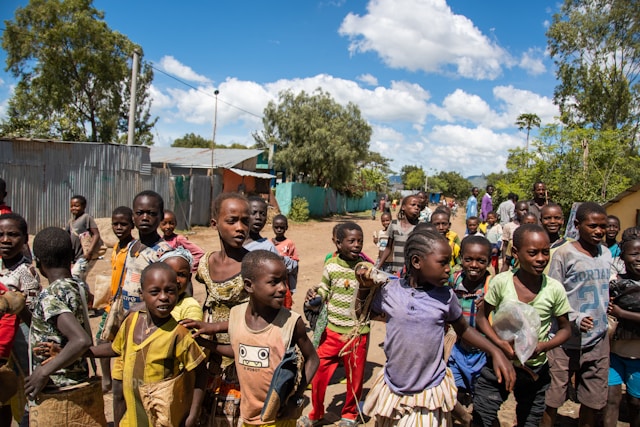
The featured image at the start of this post of children in Ethopia after school is by Taylor Flowe on Unsplash

Post script: I would have liked to share charts from World Bank or IMF on government debt as share of GDP in poor and developing countries, but I am shocked that not only is data for many of these countries not available on IMF’s Datamapper website, the World Bank government debt page features only a map with no data. No prizes for guessing which unprofessional scoundrels might be meddling at these organisations!
I have cited the Regional Economic Outlooks of April this year, and one is looking forward to the next editions of these which should be released in October 2026.
I had written a blog post about the African continent way back in 2019, when I had shared some economic data and charts from the World Bank website, though these were not the poorest countries that I had considered then. You might still wish to read it, if you haven’t already.

