


After my two articles earlier this year on the global economy, I think it is time to reassess the economic situation that prevails around the world and what can be done about it. I don’t think any discussion on the global economy can take place right now without US tariffs, geopolitical tensions and the Iran war being central to the issue. These are not only affecting global trade and economies everywhere, they are impacting economic ties between countries and how and where businesses invest. In addition, we have the issues of climate change and AI investments that affect the direction of economic growth as well.
US tariffs and geopolitical tensions, including the ones from conflicts and wars, tend to feed into each other and create a set of barriers to economic growth, trade, investment, job creation and people’s lives. These are bad policies and force governments into further bad policies such as expansionary fiscal policies in order to protect the lives of masses from economic shocks, as well as larger defence spending on account of heightened political and military tensions. The tendency of governments in such economically challenging times is also to lower taxes on businesses and on individuals to boost investment and provide relief, respectively. This worsens the fiscal balance and forces governments to borrow more in order to manage their total spending.
If you read the January 2026 World Economic Update from IMF that I cited in my blog post you will find that the four risks that the IMF update mentioned are still very much with us: high debt levels, fiscal profligacy, geopolitical tensions and the probable AI investment bubble. The first two, high debt levels and fiscal profligacy are the ones that need urgent attention. Public debt levels have never been higher and they are still rising, because of governments needing to borrow more for social spending, subsidies, infrastructure spending, entitlements, and of course, higher defence spending. And this trend is most accentuated in advanced and major economies.
According to the IMF April 2026 Fiscal Monitor, global public debt rose to just under 94% of global GDP in 2025 and is set to reach 100% of GDP by 2029, a year earlier than previously thought. According to this Reuters article citing an IIF report (International Institute of Finance), government spending lifted global public debt to a record US $348 trillion in 2025 and it’s expected to be even higher this year. According to the OECD Global Debt Report 2026, global debt is expected to rise by US $29 trillion in 2026, and 78% of borrowing by OECD countries this year will go into refinancing existing debt.
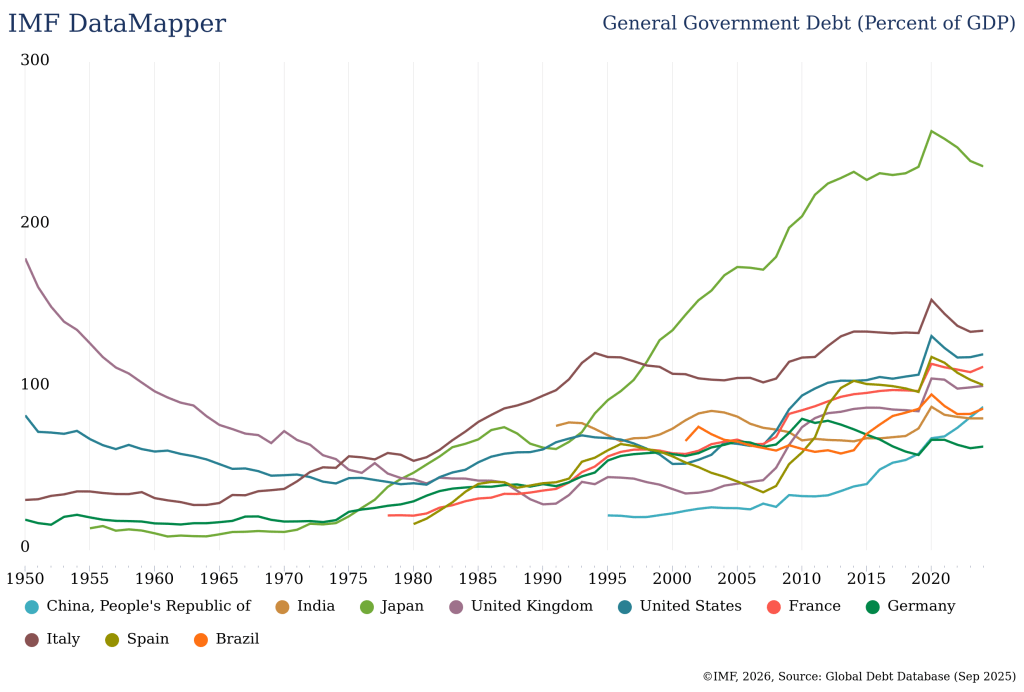
I was surprised to read in the IMF April 2026 Fiscal Monitor that a significant portion of public debt in the world’s major economies is now held by highly leveraged non-bank private financial institutions such as hedge funds and that they are demanding a higher interest rate for the borrowing by governments. Therefore, it is not just the levels of public debt, but the higher servicing costs of the debt as well, as yields rise. This is most pronounced in the longer-term government securities such as 10-year and 30-year bonds, because of plenty of new issuances of debt as well as the refinancing of shorter-term debt by governments. This was witnessed recently in the US, when 10-year bond yields spiked to around 4.7% and the 30-year bond yield was well above 5%. The US Treasury intervened in an unusual move to lower the 30-year yields, by buying back a lot of US’ 30-year debt, but to no avail. Interest rates rose once again and are holding steady above 5%.
There is a new peculiarity to government debt in most major and advanced economies: governments are issuing more of short-term debt in order to refinance and manage their debt better. This is leading to longer-term bond yields rising significantly. Markets are demanding more as the cost of borrowing, because governments have been running up huge fiscal deficits in the past many years, as a result of fiscal stimulus and other measures during the Covid-19 pandemic. Then came the Ukraine-Russia war and the energy crisis, which led governments to once again pursue accommodative policies and subsidise consumption of energy. There are also attempts by countries such as US, China and Europe to pump-prime growth through infrastructure spending – including in technology – that is leading to fiscal deficits remaining elevated. Then, there is also the need to increase defence spending, as wars and conflicts spread, and new threats to security emerge from mostly illiberal democracies and also rogue states.
It is a self-fulfilling prophecy, that nations engage in economic and even military warfare, putting more pressure on governments to spend more money that they do not have, on alleviating the consequences of these very wars and conflicts and then also spend more on defence, setting off an arms race through the world. This seems to me wrongheaded policymaking and besides not achieving very much, actually worsens the economic conditions for millions of people who are just trying to make a living.
Tariffs, wars and geopolitical tensions are also impacting business sentiment and investment levels across countries. This is seriously affecting supply chains and the prices of energy as well as those of several commodities. All of this raises the prospects of higher inflation and has the potential to slow down economic activity considerably, bringing on what is called stagflation – high inflation coupled with slow growth. This is the last thing any economy needs right now and anyway, all of this rising or persistent inflation puts pressure on central banks who were until recently in the rate-cutting cycle as inflation was moderating. No longer. The recent Iran war and the entire Middle-east problem that has been created by the US and Israel is taking a huge toll on the world, and there seems to be no sign of it ending anytime soon. In fact, the US Treasury Secretary addressed a press conference to outline US’ economic sanctions programme designed to cripple Iran’s economy further. I don’t think this will achieve anything in resolving the conflict which needs to be brought to an end through talks and diplomacy, not militarily, nor through further economic sanctions. The US doesn’t seem to worry or care about the GCC countries in the region that have been the target of military attacks from the Iranians, and I am sorry to say, neither are the GCC countries able to impress upon the US the need to stop the attacks on Iran. So many countries’ economies are being made to suffer because the US is on a self-destructive path trying to assert its waning supremacy.
All this has huge economic costs. US’ public debt has just gone through the roof at US $40 trillion! With the budget deficit at around 6% of GDP, is it any surprise that US bond yields are high? The other important consideration is that private business investment has been weak around the world, and this shouldn’t surprise us either. With the business environment being uncertain, with high volatility and increased geopolitical risks, private investment is holding back in a wait and watch mode. With the exception of AI, that is, which has seen record amounts of capex and it’s reported that this will only increase through the rest of this year and the next. I think AI investment is overdone, when what is needed is better regulation of the industry so that AI can deliver meaningful benefits in certain select areas. Its use in defence also needs to be closely regulated.
India finds itself in a spot of bother right now. Because we don’t have the kinds of LLM capabilities in AI, nor in semi-conductor manufacture as yet, we are said to be suffering as a market in attracting FDI. I would say that rather than be motivated by FOMO, we should hunker down and focus on developing capabilities in more humane AI that enhances human capital and can make a significant difference in critical areas such as pharmaceuticals, healthcare, cyber-security, clean energy, etc. According to the OECD, the capex plans of AI companies are also having a huge effect on the corporate bond market, when they had been raising money earlier through equity markets and private credit. One has to question the sense in so much private capital being funnelled into unprofitable AI-related investments, when there are better, more productive and useful options available.
Clean energy and climate change mitigation, for example. I have been writing that clean energy transition has suffered a setback in recent years, not least because of all the investment going into AI. We have also seen the incidence of climate-related disasters spike at an alarming rate in the past couple of years, and 2026 will perhaps go down as the worst year on record as far as wildfires, floods and earthquakes are concerned. Lack of adequate attention on this extremely critical aspect of life, means that governments end up spending more on disaster-management as well. This is another unnecessary area of public spending and private investment rebuilding wrecked infrastructure and human livelihoods, post facto – and often without insurance or reinsurance – that can be minimized if we invested enough in adapting and mitigating climate change. ASIS International writes that global natural disaster damage in 2025 was to the tune of US$ 224 billion, while the insured damages for just the first half of 2026 is already US $42 billion according to Swiss Re. What’s more, ASIS cites Munich Re in saying that only US$ 108 billion of last year’s damage was insured.
Just to give you an idea of the kind of spending involved in post-disaster management and rebuilding lives and infrastructure, the UNDRR (United Nations Office for Disaster Risk Reduction) estimates that annual climate related disaster management spending globally is now US$ 2.29 trillion. Right now, the world’s two largest economies are moving in opposite directions on climate change: the US is cutting back on green energy investments and environmental regulation, while China is pouring in more money into clean energy transition. Both are heavy polluters, but one is taking the right steps to remedy the situation, while the other is on the wrong side of history and economics. The upcoming COP31 Summit in Antalya, Turkey in November this year will test major economies’ commitments to meeting their NDCs and their other climate-related targets.
Countries will probably find every excuse to not meet their targets or to push them further into the future, on the grounds that their economies are facing too many headwinds right now because of economic slowdown, higher energy prices and higher inflation as well as large fiscal deficits and debt mountains. Which we have to agree is true to a great extent, but only because some countries’ leaders are pursuing crazy and dangerous policies in order to upend the world economic order and create chaos everywhere.
And thanks to leaders like them, we have a strange situation around the world today: private wealth has soared in the past decade and more – not to mention Trump’s own wealth – while governments stare down huge holes in their finances and budgets. Even stranger is the fact that governments are increasingly depending on private wealth to lend them money, when that money could be put to better and more productive use elsewhere in the economy, and I don’t mean AI. In new job-creating industries and in tackling climate change. Even with all the generous tax breaks for corporates in many countries around the world, including mine of India, private investment hasn’t increased to the extent needed and desired.
In this high tariff, high inflation, high debt and general high-jinks scenario, how should central banks make monetary policy is what this year’s Jackson Hole Summit of central bankers and economists should have been about. Instead of the rather strange “Financial innovation: Implications for payments and policy” theme which seems to be hugely influenced by unprofessional PR agency idiot bosses from India. In order to meddle in my career in advertising and brand communications which they have wrecked, and in order to cover up their unprofessional nonsense at work, for which they should be booted out of the industry.
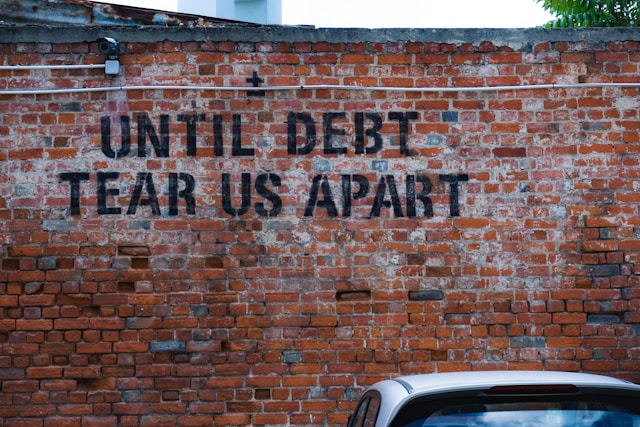
The featured image at the start of this post is by Rocio Muga on Unsplash

 Peripatetic Perch