

I have been writing on the travails of the advertising industry on my blog for the past couple of years at least. These are based on my observations from the outside, since my career in advertising in India was wrecked over two decades ago by unprofessional organisations. These problems have now reached an existential crisis for the industry, as advertising conglomerates are either consolidating – such as Omnicom and IPG – or imploding like WPP. One hopes WPP will not actually implode even if that is the sense one gets from all that one is reading about the holding company in recent months and years.
It all depends on the strategy that WPP pursues from now on, under a new leadership, not just for the next couple of years but for the future. We all know what has gone wrong with our industry, so I will not dwell too much on the subject except list them here for the benefit of those not from the advertising industry.
- Agencies pursuing a 15% commission remuneration structure without questioning or remedying it
- Large advertisers seeing advertising mainly as a media cost arbitrage business and forcing agencies to split creative and media, so that they can buy media in bulk and buy clout
- Creative agencies getting short shrift as their fee structures come under pressure, putting even more pressure on hiring good talent
- Clients rushing after digital technology to boost short-term sales and forgetting the fundamentals of advertising and marketing
- Agencies hiring fresh and junior talent who are digital-savvy but are not trained in the fundamentals of advertising and marketing
- Agencies reduced to vendors and suppliers in the zero-sum game of digital marketing, sales funnel, digital as distribution channel, and now AI in content creation
What can stop this downward cycle and start a new growth path for the advertising industry?
Many say that the business model is broken, and they attribute it mainly to the technology disruption that we have witnessed over the past decade or more. I do not entirely agree. I think the business model was weak to start with, and it has to do with our remuneration system with client organisations. As I have written before on my blog, agencies were being paid on the basis of advertisements being placed in media – 15% commission – when there were at least three separate functions in agencies working on any piece of business: strategy, creative and media. These were largely going unpaid, especially strategy and creative. Even in the days before account planning came into existence, account management was doing the work of strategic thinking – or were at least expected to do so – but advertising agencies were not being remunerated for expertise or skills, in any of the agency functions.
Technology disruption only made it worse, or made it obvious to us for the first time that agencies were giving away their talent, skills and expertise for free all these decades while companies were growing, building brands, globalizing, and paying their shareholders well. Technology in the form of the internet, followed by social and digital media made it possible for advertisers to address consumers in a more direct, targeted and personalized way and tech companies sold them the dream of immediate sales, discount offers and what have you to clinch the deal.
I think technology is only a tool that helps advertisers reach consumers more effectively, but it doesn’t change the fundamentals of marketing or advertising in any significant way. Which is why I have also written about how digital marketing can combine the best of direct response and sales funnel, when the industry has been going in the direction of only sales funnel, ecommerce and now distribution channel. Meaningful connection and long-term engagement with customers have been sacrificed for short-term sales boost, that too prompted by price-offs and discounts.
Now that our entire industry has been forced to move in the direction that the tech giants, social media companies and ecommerce companies want to take us, we have to ask ourselves what are we in this business for. I believe even client organisations need to ask themselves what they are in business for, and if marketing is still in charge of delivering the goods. If yes, then advertising agencies ought to be reassured that as long as companies are still making and selling products and services, our job is to help find them customers, help in retaining them and build on the relationship that companies have with their consumers. So that ultimately our clients can innovate, compete better and win in the marketplace.
Next, we have to think about how advertising agencies wish to position themselves in the industry, considering that the fundamentals of traditional marketing and advertising are still relevant in our work and yet we have to work with technology to deliver some of the marketing solutions. There is AI now in content creation, and in media, but the expertise in how to combine all our knowledge and understanding of how advertising and marketing works still resides in human beings. And it resides in some of the older, more experienced talent in our industry – both on the agency side as well as on the client side.
Therefore, advertising agency leaders have to think ahead and anticipate better what companies might need tomorrow in terms of advertising and marketing services and plan their strategies accordingly. To share some of my thinking on the subject, I have prepared a mapping of our industry as it exists today. I have plotted the map along the lines of what I think will become increasingly important and fundamental to our business: traditional advertising and marketing vs digital advertising and marketing at two ends of the spectrum along the y-axis. And upstream vs downstream on the x-axis.
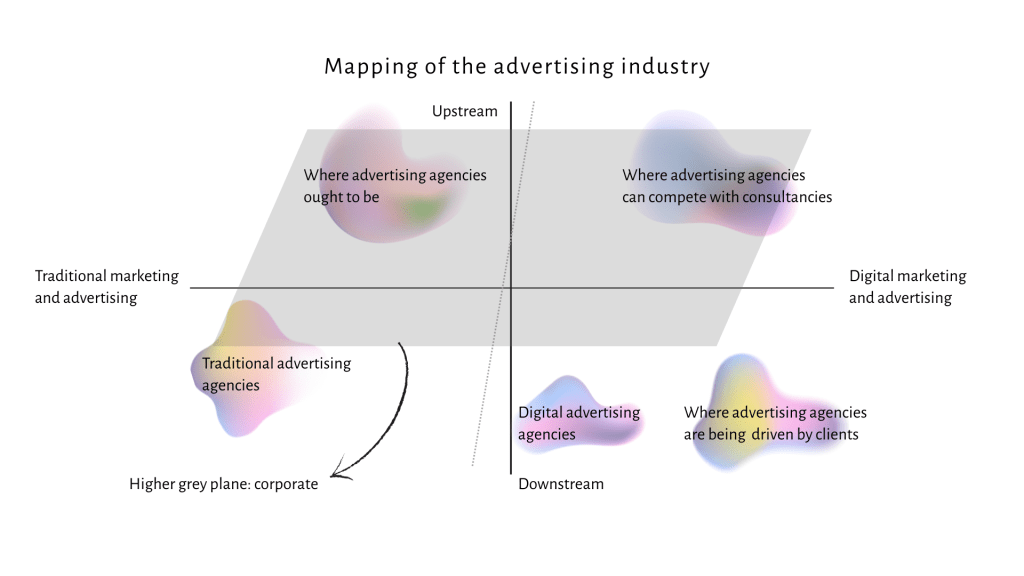
It is my firm belief that our industry has been operating for far too long in the downstream space, which explains the weak business model we have always had. I think the way out for the entire industry is to move into the upstream quadrants. The question is where in the spectrum of advertising and marketing does an agency wish to be. If we move towards the digital space, we will be giving up even more of our core business strengths and moving even farther away from the fundamental principles of advertising and marketing, which are already waning in the industry unfortunately. The space in the digital advertising and marketing end of the spectrum is also increasingly dominated by management and technology consultancies such as Accenture and Deloitte, and we would be hard-pressed to compete with them unless of course an agency wishes to change its business entirely and vacate the advertising and marketing space. Some of what Publicis Groupe is attempting gives me the impression that they might be considering this, though I could be wrong.
Now that we can see the lay of the land within our industry, it is for specific agency conglomerates to work on a long-term strategy for their businesses and their group agencies. I have put down my thoughts on a possible strategy for WPP, having worked in a few WPP agencies in India ages ago, most importantly Ogilvy in their Delhi office. I have kept in mind the past history of the holding company and its group companies, because as I say in the document, holding companies are nothing without their group agencies. You may read my thoughts on the advertising industry and strategy recommendations for WPP in the document below.
There is no industry that is not being impacted by technology, and each one is having to chart out its course for the future based on taking what’s beneficial from technology and incorporating it into their company’s operations as they adapt to the future. So is it with the advertising industry and with the marketing function in companies. Instead of being blindsided by technology and rushing madly to adopt the next shiny thing it promises, agency leaders need to think long-term and about how it will impact their business. Does it change the fundamentals of both our business and clients’ businesses in any material way? If so, how should we be adapting to change while still staying true to the core of our business and our agency’s positioning in the industry.
When I see agencies and clients chase digital technology, AI, and the internet, I think to myself: that is not our business. Our business is in delivering the best advertising and marketing solutions to our clients so they grow strong. And so, I will be concluding this piece with another observation and lament of mine. In this mad rush to digital and AI, I fear that both agencies and clients are losing their grasp of the fundamentals of advertising and marketing. And because advertising agencies have been pushed to hiring younger talent and freshers, they will soon face a huge knowledge vacuum within their organisations. Soon, there will be nobody in agencies who knows or understands the principles of marketing and how advertising works, if it hasn’t already happened. Ditto for client organisations.

In fact, I would go so far as to say that many clients could be hastening this erosion of knowledge and expertise by constantly demanding only digital, or only quick turnarounds, etc. And it ought to be up to advertising agencies to educate, guide and mentor clients, especially their young marketing teams to concentrate on what’s truly important. If only agencies had that kind of expertise and skill, honed by years of experience.
Therefore, advertising agency leaders also have to think about how to preserve old knowledge about advertising and marketing principles and also pass them on. This was one of the reasons I wrote a blog post asking for advertising to be saved.
This, even as agencies acquire and create new knowledge. We are in the knowledge business, by the way, but we are awful at building agency brands the same way we do for client companies, as I have also written before. I think it is also up to client organisations and management schools to continue to focus on the fundamental principles of advertising and marketing, so that we do not lose this valuable knowledge in the rush to embrace technology and AI.

Post script: My blog post and the strategy document were written, uploaded and scheduled days/weeks before the Omnicom-IPG merger was completed, and the Omnicom website has been updated since. Now, Omnicom says that they are the world’s leading marketing and sales company.
Also, as I have already shared in a LinkedIn post, unprofessional PR agency idiot bosses from India have made sure that my LinkedIn address at the end of the strategy document doesn’t convert into a link. This might be because they have been trying their best to hijack my work, career and life after wrecking it, and are planning to start a business with it and with my blog! I have already said that I have never been an entrepreneur and do not intend to start any business with anyone, least of all these scoundrels. I will have them and their cronies in RK Swamy/BBDO booted out of the industry.
 Peripatetic Perch