


With all the excessive focus on technology in the times that we live in, it’s easy for companies to lose sight of brands, and consumer connection. These days particularly AI is the focus of so much attention, that I fear at least my industry of advertising and brand communications is getting carried away by all the hype. From what I saw on LinkedIn at the time of the Cannes Advertising Festival this year and read in media reports about it, AI seemed to be the only topic of discussion on the French Riviera. WPP, the world’s largest advertising and marketing communications conglomerate has even announced a partnership with Nvidia on AI and the bosses of the two companies were in discussion at Cannes, which I couldn’t watch but would like to, someday.
I wonder if partnerships of this kind will mushroom in future, because if agencies don’t tie up with these AI and tech platforms or chip companies, clients will! I suspect it is some of this fear that is fuelling the mad rush to partner with tech giants. Remember, it was not so long ago that the advent of digital advertising and marketing sent advertising agencies scurrying to acquire digital agencies who had expertise in this new and emerging area. And guess what? Client organisations were in-housing digital capabilities, thinking they could do a better job than communications firms. Then, we also had technology and consulting companies such as Accenture and Deloitte setting up digital agencies.
I have been thinking about all this for a while and in this piece of mine, would like to bring agencies’ and client companies’ focus back to a very fundamental issue. What is the role of technology and how should we all be using it to grow our businesses and build brands?
It is not merely digital and AI technology capabilities that have distracted us from our core purpose and tasks, technological innovation by companies is doing the same. Companies at the forefront of tech innovation especially in industries that depend on it such as consumer electronics, automobiles and information technology itself seem to think that the technology innovation alone is enough and that there is no need to focus on building a brand and for brand communication. If one looks at brand valuation rankings globally, there too tech companies lead the rankings today, when in past decades such rankings were dominated by consumer products companies.
A sign of the times, perhaps. It tells us how much technology rules our lives. It is also due to the fact that many of these brand valuations assign too much weightage to market capitalisation and tech being investors’ darling, this reflects in the higher rankings for tech brands. If we were to shift focus from investors back to consumers and customers which is where our attention ought to be, what does it look like? Remember, no customer, no sale, and no growth for businesses.
Technology is important at the start
Don’t get me wrong. Technology, especially in the sense of a product innovation is extremely important when a new product is being launched by a company, or is being improved for a relaunch. Innovation is at the core of a product’s success as a brand, and contributes most to building a brand, and growing a company. And when I say innovation, I also include process innovations and any other that helps to make the product a superior one to competition. Therefore, when I use the term technological innovation, I mean it in the widest sense possible.
But, let’s be real. How many innovations are so life-changing or industry-transforming, that we can allow ourselves to get carried away on the basis of a technological innovation alone? Through most of the product lifecycle, innovations tend to be small improvements, incremental in nature that go to making the product function better and help consumers derive greater value from using it. Most of the time, companies are trying to improve products for consumers, and staying ahead of competition. So, what are they really doing? Improving and strengthening their connection and relationship with customers, which is what brands are all about.
Take Apple’s iPhone product and the technological innovation behind it. It was so unique and life-changing at the time that in one stroke it transformed the mobile communications industry in 2007. The iPhone continues to provide most of the revenue and profit for Apple, but its handset sales have fallen from their highs in 2015 or have stayed flat as you can see in the chart below. Besides, thanks to the Android operating system launched by Google around the same time, many companies in the consumer electronics industry launched smartphones, triggered no doubt by the success of the iPhone initially. The global smartphone industry exploded with growth, and nowhere more than in China, the world’s largest mobile phone market. Today, Samsung is the world’s largest smartphone brand, with a 21.6% volume share, followed by Apple at 18.8% in 2022, according to Statista. Huawei had a 14.6% share of the smartphone market in 2020.

Not only is the smartphone ubiquitous around the world today, iPhone users have stopped upgrading their handsets every year as they did in the initial few years. That’s mainly because Apple hasn’t been able to follow through with significant innovations in subsequent years. At the same time, however, Apple has been focusing on services that enhance the customer experience of an iPhone and deliver greater value. They are building and strengthening their relationship with customers and building their brand.
Therefore, technology and innovation, while extremely important at the beginning because they give the company and the brand a huge head-start over competition, provide diminishing returns in later years unless the company can sustain the quality and pace of innovation, which is nigh impossible. In fact, from what I have noticed in tech-intensive industries, sales and revenue growth start to plateau or slow somewhere around the 8th-10th year after the innovation, as I have tried to depict in the chart below. It needs brand-building measures, including brand comunication, to sustain the growth trajectory throughout.
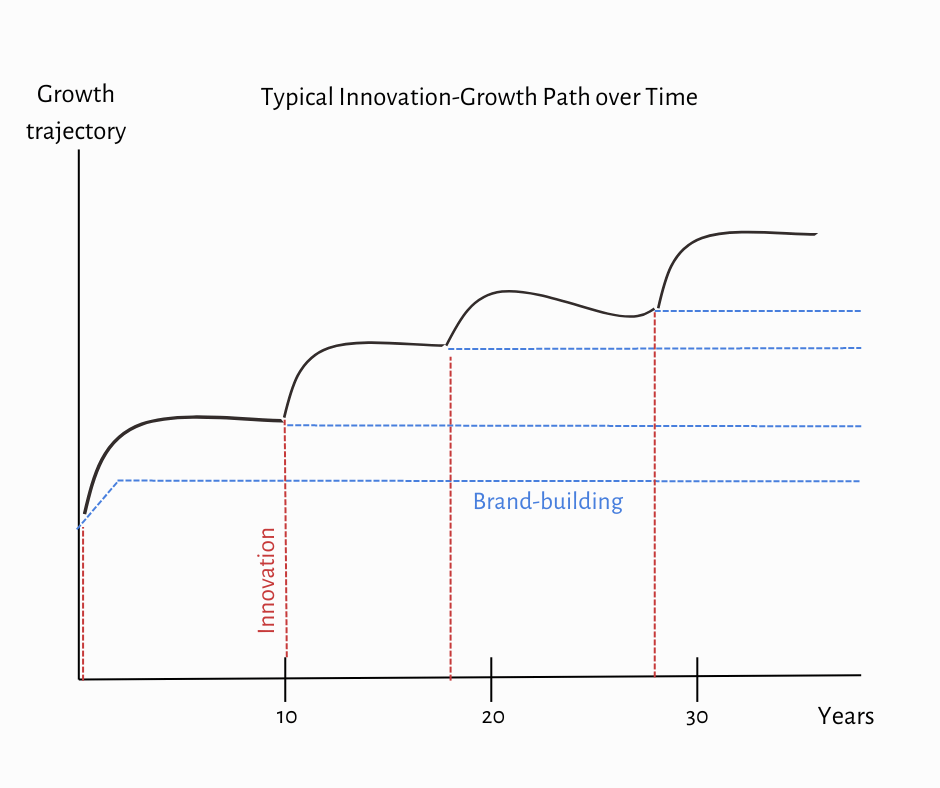
Technology is always playing catch-up
If we stay with the smartphone industry for just a little longer, the mainstay of Apple’s early success was China. Not merely in manufacturing iPhones for the entire world, but as an important market as well. Today, China is a slowing market for Apple, not least because Chinese customers have so many options among Chinese brands that are innovating rapidly and introducing features that matter to customers.
That’s the thing with technology. Once launched, it can be replicated easily and competitors, while benefiting from the initial innovation, tend to take larger shares of the growing market. Forcing the original innovator to go back and innovate once again, in order to catch up and get a lead over the competition. When technology ceases to be the key differentiator, it is the brand’s connection with customers that companies rely on.

Let’s look at the automobile industry and see what new battery electric technology has done to the passenger vehicle segment. Tesla being the first luxury EV sedan has had a huge head-start over its competitors, both in its home market, the US, and globally. In recent years, Tesla has also introduced lower-priced models such as Tesla 3, in order to grow its market and is in that sense, no longer a luxury EV maker. I am not sure what the company’s strategy is, but it seems to me that Tesla is now chasing volumes by slashing prices drastically in the US, as competitors such as Ford and GM also introduce their EV models. Tesla has later raised prices slightly in the US, though most models are still cheaper than before the start of the year. The IRA (Inflation Reduction Act) also could have prompted this move, as it effectively renews Tesla’s eligibility for new EV subsidies, which it had exhausted earlier. This is going to hurt its luxury EV brand image even more and customers, faced with many choices in the market, will begin to question Tesla’s expertise in EVs even though Tesla uses its own EV battery technology.
What compounds the problem is that once again, China is Tesla’s biggest market. It is so important to Tesla’s future that the company has built a huge giga-factory in Shanghai. However, China is not merely the world’s largest car market, it is the world’s largest electric vehicle market. And China dominates the EV battery technology industry, with few if any competitors. And some of these, such as BYD, are also EV makers, along with others such as SAIC-GM-Wuling and Nio. These are already some of the largest selling EVs in China and are said to be doing extremely well in overseas markets as well according to The Economist.
In the 15 years of Tesla’s existence, it has cumulative sales of 4 million EVs globally. 2021 and 2022 have been the best years for EVs globally, doubling in both years, according to Statista. And you can see that Tesla has been the beneficiary of some of that growth with around 936,000 and 1.3 million EVs sold in those two years, respectively. In fact, the innovation-growth path has been quite different for Tesla, with a slow start and the highest growth coming in the later years. However, competition from Chinese EVs is hot on its heels. In 2021, BYD Auto sold 320,810 EVs and SAIC-GM-Wuling sold 424,350 EVs in China alone, according to Statista. And in 2022, BYD with 1.86 million units became the world’s largest-selling EV brand worldwide.

Technology changes, brands provide stability
Staying with the automobile industry, we can go back to the turn of the millennium and see a similar change of technology disrupt the passenger vehicle segment. This was when Toyota introduced the world’s first hybrid-electric vehicle, Toyota Prius, as a way to cut down on fossil-fuel consumption and shift to cleaner energy. Recognising that it was too early in the late 1990s to shift to fully electric vehicles, Toyota created the Prius to be a stepping stone to the fully electric age, and it has been hugely successful.
If you ask me, India should have ushered in hybrid-electric cars a couple of decades ago. Anyway, from Toyota’s website, it appears that Toyota Prius and other hybrid models of theirs had sold 10 million units globally by 2017 and crossed 15 million units in 2020. According to Statista, between 2020 and 2021, Toyota HEVs (Hybrid Electric Vehicles) grew from 1.95 million to 2.48 million. And in 2022 alone, Toyota HEVs sold 2.6 million units worldwide. What’s more, the Company has also gone into fully electric passenger cars, and intends to target 1.5 million EVs globally by 2026, according to this article from CNBC.
This to me, illustrates the power of a brand. Toyota known as a byword for reliability is the automotive brand behind each of these new technologies and no matter what technology phase we might be in, it is the automotive brand that provides stability to the company’s business strategy long-term. If we have here an example of a car company that is positioned on reliability, adopting and introducing new technologies, there are also carmakers who have gone into EVs without being able to connect it to their brands. We shall discuss BMW and Mercedes-Benz next.
The technology-brands-customer connection
While Tesla and Chinese EV brands are relatively new in the automobile industry, they need to quickly focus on building clear business and brand strategies, in order to differentiate themselves from competition and stay ahead.
However, there are some established and iconic luxury car brands that have dominated the industry with ICE (internal combustion engine) technology for decades, but are having trouble adjusting to today’s customer. Two German marques, BMW and Mercedes-Benz come to mind. As brands they are the anti-theses of each other, as differentiated and distinctively positioned as they have been. In recent years, they seem to be losing their differentiated brand image and ever since they have both embraced EV technology, the confusion just gets worse.
BMW was the earlier adopter of EV technology with its i-branded models and variants, i standing for intelligent and electric, I suppose. They have more fully electric models than Mercedes-Benz it appears from looking at both companies’ websites. Mercedes-Benz was not only late to enter China, the largest luxury car market in the world, they were also late to introduce EVs. Their EVs are EQ-branded to mean electric quotient, I think.
In the shift to electric, I think BMW will have an easier time of it, as the brand already has a more contemporary image. However, BMW still needs to position itself distinctively and I don’t think joy or sheer driving pleasure sums up the brand adequately. BMW – the ultimate driving machine was the best creative expression of the brand positioning in my opinion and the company ought to go back to it. BMW is not merely contemporary it has stronger associations with technology and I think that is why the brand could claim to be the ultimate driving machine.

As far as Mercedes-Benz is concerned, the brand is classical in image, and is all about engineering and craftsmanship. Mercedes-Benz invented the motor car, but has aged considerably and needs to connect better with today’s customer. They have tried upping their AMG credentials which is a good move, but as I have written before, they need to use AMG-badging carefully and not apply it indiscriminately across all models. Mercedes-Benz needs to first develop a new brand strategy and positioning for itself, because the old strapline (which is derived from brand positioning) of the best-engineered car in the world no longer appeals in today’s environment.
Finally, both BMW and Mercedes-Benz must connect their brand positioning to new motoring technologies and customer’s requirements from motoring. Whether their EVs are i-branded or EQ-branded makes little difference; what matters to customers is the main automotive brand behind these cars.
If we now turn our attention to the tech industry, it is shocking how little tech companies think about their brand. IBM’s latest “Let’s Create” advertising that I saw on TV news and shared on LinkedIn is not what I or most people think about the Company. IBM is the tech company that provides technology solutions to solve the world’s most pressing problems, and I had put down my thoughts on the IBM brand ages ago which has also been lost to termites.
In India, we have our own tech companies that are a source of competitive strength to the country as an industry. At a company level, it is a different story; none of them think it necessary to build their brand strategies and communicate what their brand stands for. It is also not surprising, therefore, that all large Indian tech companies are involved in the same kind of work, and are perceived to be the same or similar in many ways. I wonder why that is. Is competition within the industry not fierce enough to force them to think about brand strategy and how to differentiate themselves?
And if we look at social media and internet companies, the sameness is inescapable. Twitter rebranding itself to X is just the latest gimmick in the tech world.
To sum up, technology and innovation is the driving force behind brands and differentiation. And while it can provide a huge impetus to product development and business growth, it delivers even greater results when combined with consumer-connection to create brands.
Think of technological innovation as the sharp burst of energy required to propel your product into a brand. Then, think of brand connect with customers as the stable, long-term journey that sustains and grows your business.

 Peripatetic Perch