

I last wrote about Europe’s economy about five months ago and I had said that the EU needs to come to grips with the geo-economic challenges that it faces. In that piece, I had focused on the deep dependencies that Europe has developed with large powers such as the US and Russia, and perhaps also with China more recently. I think that they need to overcome these dependencies and develop strong domestic capacities, especially in light of the Mario Draghi Report on improving Europe’s competitiveness and the need for reforms.
Unfortunately, with the Ukraine-Russia war right on their doorstep and the US-Iran war as well, Europe is going to be facing higher inflation, pressure on the energy front, and low levels of business investment once again. As it is, most of the larger European economies have run up large fiscal deficits from the Covid-19 pandemic years and the Ukraine-Russia conflict, and also have mountains of debt already. These make economic reforms necessary and an imperative across the EU, though the appetite for it might be waning.
For one thing, the EU’s largest economies, Germany and France, are both caught in the midst of electoral cycles and also face considerable opposition to their respective budgets. More importantly, the rise of the far-right in both countries poses huge challenges for the incumbent governments and for their economic reform plans. The room for policy manoeuvre is already limited, with fiscal deficits and debt at all-time highs, and therefore parties on the left and the right of the political spectrum are faced with the same hard choices. This ought to settle the argument in favour of reforms, but when you consider the populism that has crept in in recent decades, both the political left and the right espouse the same or similar policies. In a paradoxical way then, although many European countries too are highly polarised, the lack of an ideological core in both the left and right-leaning parties forces them to seek the easiest route to winning elections: populism and fear-mongering.
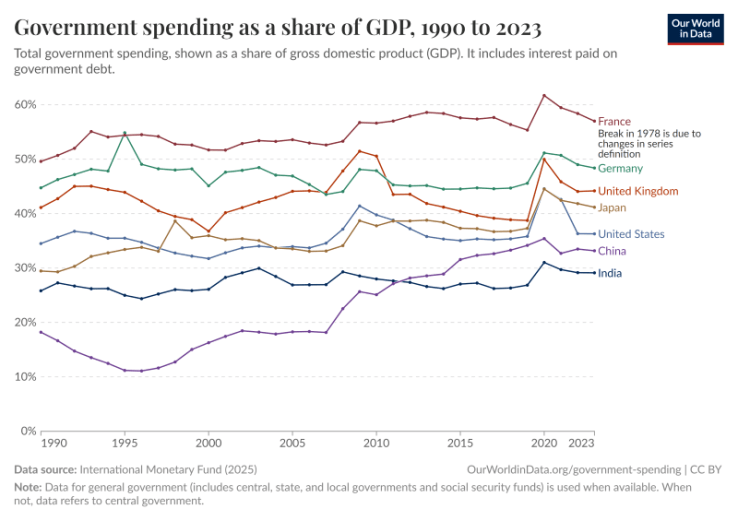
That Europe seriously needs entitlement reforms has been well-known for a few decades now. Yet countries’ governments and leaders struggle to communicate and persuade the public of the need for reforms. In France, particularly, people take to the streets in protest at the drop of a hat from what one has been reading and following in the news from India for years. The protests against the planned pension reform a few years ago meant that they had to be shelved, although I believe they may be back on the agenda now given how out-of-options the country is, having breached several of the EU rules. Apparently, the French budget is again the subject of disagreement, which shows how economics is hostage to politics. This as the country prepares to go to presidential elections in 2027 and since Marine le Pen has been cleared by the courts to contest next year’s elections despite being convicted in a corruption scandal, the far-right party that has long waited in the wings could finally have its candidate as President of France. They might even pat themselves on their backs that they have a woman as President of the Fifth Republic at last! At the moment at least, I read that Marine le Pen is of the view that France needs to cut its public spending, so this should be some consolation to the incumbent government. I hope they can trim their social spending as it is the largest of any OECD country and they can ill-afford it. On the other hand, France needs to invest in upgrading infrastructure, in technology and in defence.
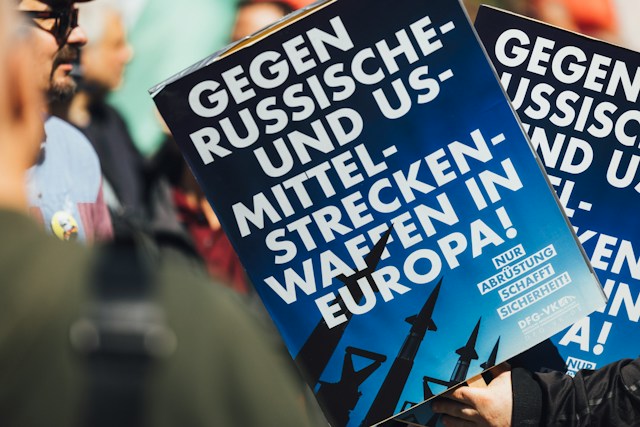
In Germany, the situation is quite similar in many ways, even though Germany has not been as fiscally profligate and doesn’t have debt that is out of control. However, this is where the dependency story plays out in full; Germany was too dependent on cheap Russian gas that fuelled its old industrial economy that was beginning to lose relevance in today’s world. Pivoting to the new industrial economy meant that Germany would have to invest in new capabilities, in digital technology, in renewables and clean energy, etc. With a rapidly ageing demographic, Germany needs to invest far more in technology to improve productivity and also in hiring skilled people from around the world. Unfortunately, the reopening of the Chinese economy – to which Germany had very large exposure at the time through exports – didn’t go according to plan and the huge China export market dried up. Today, it is reported that Germany’s dependence on China has turned the other way, and that it imports more goods on a net basis than it exports to China.
Germany also faces the rapid rise of the far-right in the form of AFD that is particularly strong in the eastern parts of the country. From what I recall reading in The Economist decades ago, the party was formed by a group of economists who believed that Germany had a better future outside of the Euro, but soon AFD was known more for taking up the issues of the disillusioned in East Germany, including lack of jobs and anti-immigration. AFD has made remarkable progress in the past decade and more and has been gaining seats in provincial local elections, including its stunning victory in the most recent local elections held in Germany. One gets the sense that Germany’s electorate is also getting more polarised and the centre-right CDU is finding it hard to make economic policies from the centre.
From what I have read, Germany is planning to press ahead with its reform plan having won a big victory in the easing of the debt-brake conditions that was holding it back. The country is also proposing a pension reform of sorts, along with raising the retirement age, investments in technology and infrastructure and also raising the income tax rates for the highest slab from 45% to 47%, while lower income groups might see some tax relief. I don’t see what opposition the AFD can have to this budget, but it appears that the party has now shifted its campaign rhetoric to the cultural and social spheres, which makes it an even bigger threat especially if it is along Nazi ideas of German greatness and purity. And while this approach might work as long as they are campaigning and mobilizing support for elections, they will find it extremely hard to govern should they win power from such an extreme far-right position. The same goes for National Rally and Marine le Pen in France who I don’t think have any experience of actually governing a province or region yet. On the fiscal front, both these far-right parties and those in other countries would probably support higher spending on defence, but would oppose higher taxes.
There have been some reversals of the ascendancy of the far-right in Europe, most notably in Poland and Hungary, and while this might bring some relief, there is no disputing the fact that the far-right is still growing across Europe. Their views are shaped more by worsening economic conditions in certain areas, globalization and anti-immigration than by any ideological basis in economic thought. Austria just about managed a coalition government last year that kept the far-right party, FPO, out of the government for now. And this corroborates what I am saying in this piece: that the far-right is on the ascendant across Europe and unless countries find a long-term way to reduce support for such far-right parties, they will always be a thorn in the side of politics and governance.
The bigger danger with far-right politics is not merely their corrosive and divisive domestic politics; they can be and often are exploited by rival countries and powers for greater influence. It is hardly surprising that most of the far-right parties in European countries are pro-Russia, a country that Europe is fighting against to protect Ukraine. Similarly, America especially under Trump, is a big supporter of far-right parties across Europe and also in the UK. Europe’s dependencies come into focus yet again, this time in the political arena.
For now, Europe seems to be growing reasonably well economically. We should be getting the GDP growth rates for the Euro area as well as the EU for the third quarter of 2026 soon, and the GDP growth figures for the second quarter suggest fairly alright performance. The Euro Area grew at 0.6% and the wider EU by 0.7% in the second quarter of 2026. I have no idea why the figures are being reported in volume, though. The year-on-year GDP growth numbers at 1.2% and 1.4% respectively are stronger, perhaps because of a base effect. That said, the growth came mainly on the back of good exports and lower imports, followed by modest growth in personal consumption. Fixed capital formation was disappointing with almost no growth, especially in the Euro Area when this is what Europe needs more of. The US tariffs might have come into play and yet European exports led the economic growth; one wonders whether Europe has managed to diversify its exports away from the US sufficiently for it to not feel the tariff pressure.
I also noticed that the pace of employment growth in Europe has slowed considerably in the EU between 2023 and now. Or is it that Covid-era job-supporting programmes across the EU are still in the process of being unwound? Strangely, I was served economic data for the retail trade in EU, when I was looking for retail sales to better gauge personal consumption. Besides, these were also in volume terms and not very useful in indicating any particular trend in consumption/sales, for example how higher energy prices were impacting sales of automobiles, and also the growth of discretionary purchases vis-à-vis consumer staples. Anyway, it appears that retail trade volumes in July 2026 were down by -0.6% in the Euro area and by -0.4% in the EU on a sequential basis. On a year-on-year basis, both were higher by 0.6% and 1.0% respectively.
On the subject of prices, CPI is still rising in the Euro area and across the EU at 3.2% and 3.4% respectively in August 2026, led by energy prices and services inflation. The ECB has rightly taken the decision to raise interest rates at its last meeting in September 2026 and may have to stay on this path should inflation continue to rise or stay stubborn. With the wars showing no signs of ending, there is the possibility that CPI will rise not only in Europe but in many countries across the world and central banks everywhere will have to raise rates to cool inflation down, rather than risk stagflation.
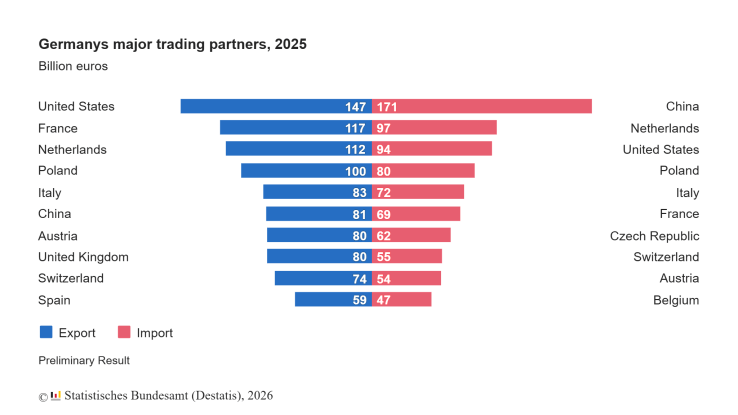
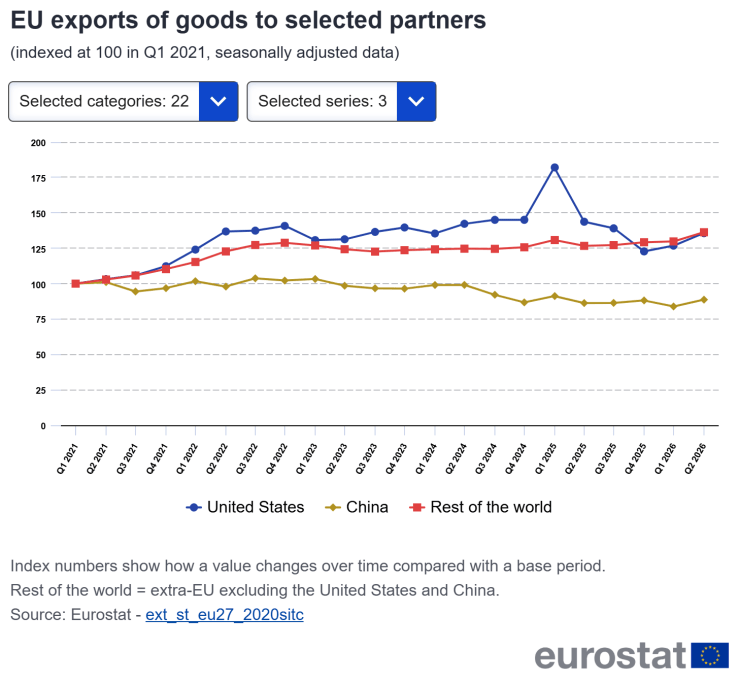
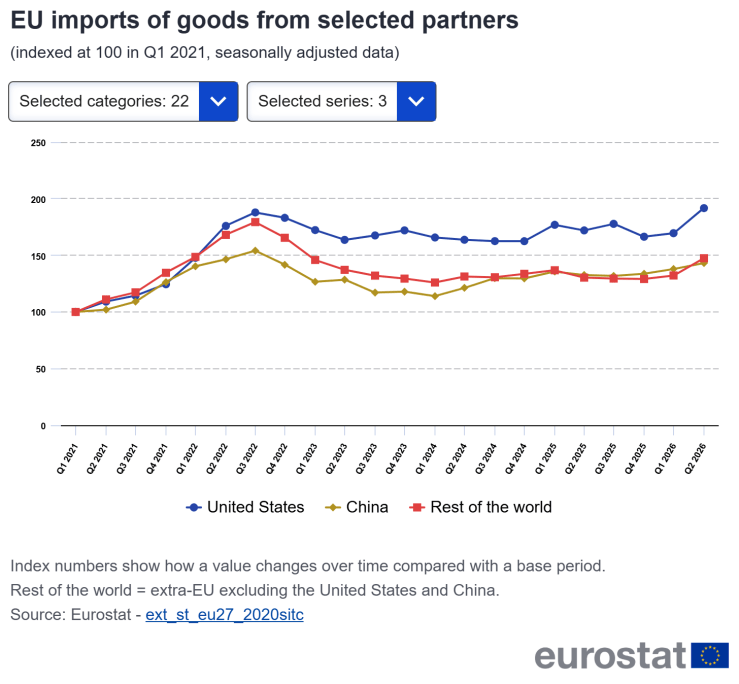
The US tariffs, albeit lowered, are having an effect on European trade with the country. For the first seven months of 2026, the trade deficit in goods trade between the two countries/economic blocs is US$ 53.9 billion according to the US Census Bureau, much lower than US$ 160.1 billion for the same period in 2025. I notice that this is because the US is maintaining its monthly exports of goods at the same level, but imports from the EU are at lower levels. The European Commission data on EU-US trade is a little more detailed and nuanced, and while the EU goods trade balance with the US has fallen to US$ 29 billion in Q2 2026 from a high of US$ 80 billion in Q1 2025, it would be wrong to make the comparison because Q1 of 2025 was when all countries were trying to frontload exports in order to beat the Trump tariffs. More encouraging is that the EU has been able to maintain and even improve its trade balance with the US in chemicals and related products, machinery and vehicles as well as other manufactured goods, between 2021 and now. This is in value terms, of course, and one will have to see how much EU exports to the US have suffered, if at all, in volume terms.
EU’s goods trade balance with the US is also impacted hugely by its imports of energy from America in the wake of the Ukraine-Russia conflict. And this dependence is likely to continue for a while, even as the EU shifts to cleaner energy and also diversifies its oil and gas imports. What is interesting to see is EU’s goods trade with China and compare it with the US. We can see from the European Commission that EU goods exports to China have reduced while those to the rest of the world have grown. At the same time, EU’s imports from China have been growing and are almost at the same level as those from the rest of the world. This too could be a source of angst for the far-right political parties going forward.
While GFCF hasn’t grown in Q2 of 2026 in the Euro area, it has grown by 0.1% in the EU, and it appears that fixed capital formation contributes more to GDP growth in the EU countries than in the Euro Area. At the same time, the European stock markets have done quite well through last year and this one as well. This, when Europe doesn’t have great AI capabilities to participate in the AI trade which is the only sector fuelling global stock markets besides energy. Strangely, it turns out that Europe is benefitting from overseas investors who are looking to reduce volatility in their investments and Europe offers options besides AI in finance, energy, industrials, defence and infrastructure, according to Goldman Sachs. In addition, corporate earnings in Europe were quite strong in Q2 of 2026 and one hopes they can keep up the momentum.
European economies need to also attract long-term FDI with technology transfer in critical new areas such as AI, quantum computing, defence, digital technology and bio-tech as well as clean tech. This, along with reskilling people, would help them pivot to the new economy more effectively and prepare them for the future. Plenty of economic reforms and investment ideas should be on the anvil, enough to keep the political far-right quiet for the time-being. Meanwhile, hopefully Europe will find its centre and channel its people there before 2029 when the next EU parliament elections take place.
The featured image of the European flag being projected on a building in Berlin is by Maximal Focus on Unsplash