

When I last wrote about the European economy six months ago, I had said that the EU must look beyond trade for economic growth and that there is ample room to increase domestic consumption as well as investment across EU member countries. I had also written about how many of the countries in the continent need to reform their entitlement systems and reduce their social spending over the medium term. All this would, of course, mean that European economies have to build more capacity in the private sector and depend less on the state, even though most of them follow a social democratic form of government.
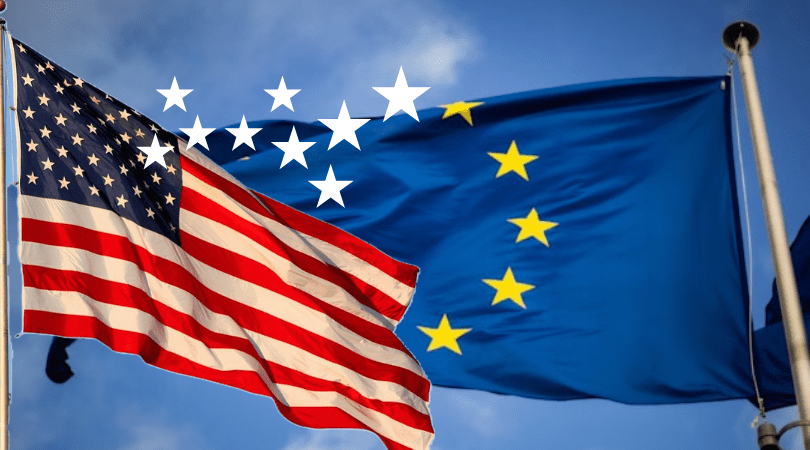
It isn’t only about economic growth. The past many months have brought some more geo-economic challenges for EU into sharper focus. Much of this is because of the long and ongoing war between Ukraine and Russia, as well as the US tariffs, and now we also have the US-Israel war with Iran to deal with. Relations between EU and the US, old and traditional allies are strained and while some of this was expected with Trump in office, there is a new reality that Europe needs to wake up to. The new geo-economic challenges for the EU are most obvious in the form of the current energy crisis, as well as reduced trade on account of the tariffs imposed by the US, Europe’s largest trading partner.
Energy prices are soaring across the world, thanks to the Iran war and the Strait of Hormuz being closed, and it’s no different in Europe. While Europe doesn’t face shortage of oil and gas supplies since it imports most of it from the US now, there is the problem of higher prices and energy dependence on large economic powers. If in the past, the EU imported largely from Russia, it now does so from the US. And as I have warned earlier, Trump is likely to use US energy supply to Europe as a bargaining chip in arm-twisting Europe any time he needs to. This is because times have changed and Trump is busy dismantling the old economic world order that existed, as I have also written on my blog.
Next, we have European companies and countries coping with the US tariffs imposed by Trump. Even with the reduced tariffs and the IEEPA tariffs gone, there is still considerable pressure on businesses. European exports to the US have slowed through all of 2025 on account of Trump’s tariffs, and the slowdown sharpened in the first two months of 2026 according to Reuters. Of course, this is possibly because of the high base of the first few months of 2025 when US importers frontloaded their imports in order to beat the tariffs. However, the fact that US imports from the EU slowed through 2025 in a number of categories is evidence of the fact that the tariffs are reducing trade between EU and the US, though it’s early days still and EU’s surplus in goods trade with the US narrowed as a result according to the EU. The industries most impacted were automobiles, chemicals, pharmaceuticals, machinery and the like from across Europe. Even as Europe tries to diversify exports, it hints at a trade dependence between the EU and the US as well.
In fact, the geo-economic challenges I see for Europe are in the form of deep dependencies that the continent must try and address soon. These assume greater importance not only because of strained relations with the US and the changing world economic order, they are also because the world economy is itself changing rapidly, demanding new capabilities and Europe needs to step up. The four great dependencies that the EU suffers from are
- Energy
- Technology
- Capital investment
- Defence and security
In Mario Draghi’s report on EU competitiveness, many of these issues are taken up and dealt with in detail. However, Draghi sees them as weaknesses that Europe must address and he tends to view the entire EU competitiveness issue in comparison with the US. My initial reaction to reading it then was “Why is the EU being constantly compared with US, when the EU needs to do all this for its own sake anyway?”
The big ideas emerging from that document were a unified capital market, setting up a huge technology research and innovation fund and a defence and security framework for the EU. I am not sure how much progress has been made on each of these big decisions.
In my opinion, EU’s big dependencies point to something deeper that the continent needs to acknowledge and address quickly as they are at the core of today’s new economic reality. I am now making my argument from a different standpoint: EU’s deep dependencies need to be turned into capacity-building and self-reliance as much as possible. These are not merely competitiveness issues anymore; they are central to whether Europe is capable and ready to go into the future, powered by its own strengths in energy, information and digital technology, capital formation, and defence. It is about whether Europe can hold its own in the new economy of the future, without having to rely too much on other world powers such as US and Russia, or even China in the decades to come.
The one area in which European countries have moved forward in terms of enhancing their capacity is in defence production. This was warranted in the context of the Ukraine-Russia conflict as well as Trump forcing NATO member countries to increase their defence spending to 5% of their GDP. This will give EU economies a short-term boost to economic growth, but in the context of the Iran war, they also have to be watchful about government spending as well as energy consumption. Higher energy demand is anticipated to also meet the needs of the AI industry and the building of data centres. All this will put more pressure on Europe’s energy consumption and costs.
Europe needs to start acting soon on reducing its dependence on fossil-fuels, even if it is impossible to avoid them altogether, what with the AI demands. The EU used to lead in decarbonization and clean-energy areas, with its emissions-trading system developed decades ago, and is now a keen adopter of EVs and renewables. However, countries in Europe need to do more to reduce dependence on coal and lignite and shift faster to renewables, including nuclear energy and clean hydrogen. France, the leader in nuclear energy in Europe can certainly help other nations build their nuclear energy infrastructure. It is still early days to judge the efficacy of CBAM and how its working, but at a time when even European countries are pushing back their net-zero climate change commitments, CBAM seems excessive and punishing on trade. I have been arguing on my blog for a tweaking of CBAM to arrive at a new tariff formula that can be applied globally – on G20 countries to start with – that helps countries share the decarbonization burden on traded merchandise.
Coming to the technology dependence of the EU on the US, it is perhaps where European economies are the weakest and that’s why even Mario Draghi’s report dwelt a great deal on digital technology innovation. Of course, he was comparing the EU to the US, and in this case perhaps it does make sense to compare the two economies if it helps highlight how much the EU lags in this area and also helps EU countries benchmark their progress against the US. To boost digital technology research and innovation, Draghi had recommended that the EU spend €750-800 billion annually. He also mentioned the need for a stronger capital market and venture capital system in Europe to be able to fund Europe’s digital technology investments and innovation. In addition, I think that in order to expedite matters in implementation, the EU can pursue technology innovation in the following ways:
- Individual EU member countries take the initiative to focus on incentivising digital technology innovation and investments in their own countries. Depending on the success of these tech ventures, the EU rewards the achieving countries with a larger allocation from its budget for the specific purpose of investment in digital technology infrastructure.
- The second way would be for all of EU to come together and create a new organisation charged with spearheading the digital technology investment and operations drive, similar to how EADS was set up to build Europe’s capabilities in aerospace and defence decades ago. This could once again be a partnership between governments of the larger EU economies and private sector companies such as SAP, ASML, Mistral, etc. They don’t all have to be tech companies, but it would help to have some of the best tech minds participating in the venture.
The last suggestion of setting up an EADS-like company to focus on pan-Europe digital technology innovation and operations would clearly signal to the rest of the world that the EU means business, help move things forward faster and also help attract private capital. These various ways of boosting digital technology innovation and investment in Europe are not alternatives with either/or options, but can all be pursued simultaneously. The EU digital technology innovation fund ought to also be linked to academia and universities pursuing higher research in digital technology.
Digital technology being the weakest link in Europe’s growth plans is a serious hazard at a time when the world is progressing rapidly towards a future where digital technology, clean energy and climate change as well as capital – including of the intellectual property kind – are going to power industry and our lives. On the need for a stronger and more unified capital market in Europe, there is no doubt that this is an imperative. The venture capital industry is also a huge requirement in Europe and the EU must do more to encourage its development.
The important thing to note, however, is that in the case of digital technology capital investment will not necessarily flow to countries with low labour costs, but to those countries that have people with higher skills. This is an important dynamic for EU leaders to fully understand, especially when they are looking to link industry with academic and research institutions or when they are planning tax policies to attract investment, especially when people, capital and goods move freely inside the single market.
Another important aspect to remember is that because the EU – and the Euro Area for that matter – doesn’t have a fiscal union, it will be up to individual member countries to frame their own taxation policies including on things like capital gains and the like which could hugely influence where capital investment goes. That said, technology is an area that the EU must focus on with a war-footing, and find ways to create consensus between member countries.
In fact, I would say that technology and energy ought to be the highest priority areas for the EU and they should seek to reduce dependence on other powers in both these areas as much as possible. In this regard, I wonder if it makes sense for the EU to also consider fracking as a technology now; Europe was opposed to it for environmental reasons decades ago. Without seriously examining the scientific evidence, perhaps Europe should not close its mind to this possible route to energy independence. Reducing dependence does not mean that the EU will stop engaging with the US or any other country, nor that it will suddenly turn protectionist; it just means that it must take a more clear-eyed and pragmatic approach to building its own capabilities and capacity domestically.
For an economic region that has relied on the goodwill and the economic as well as military assistance of its old allies across the Atlantic, from the days of the Wars and the Marshall Plan, this would be a bold step forward. The world has moved on from those days and Europe too needs to keep its sights firmly on the future of its people. Most of all, reducing dependence would require a significant shift in mindset among Europe’s leaders and its 400 million people.