

As corporate earnings stream in for Q1 FY27 they seem to be suggesting that revenue growth is good, albeit weakening, and that margins are under pressure. This is hardly surprising since most companies do not seem to have responded to rising prices of inputs and commodities with price increases. Therefore, margins are under pressure, though some companies have engaged in cutting expenses, it appears, and have therefore managed to grow profits healthily. Of course, the picture varies by industry and since earnings are still flowing in, we can look at the tech industry and banks first.
The tech industry in India has posted muted earnings for the most part and the reasons cited are that clients are going slow on projects. I think that because most of the international client spends are going towards AI, Indian IT companies might be suffering and that pricing power is also weak. In contrast, IT stocks are seeing buying, in the context of AI stocks’ correction and sell-off recently. Indian banks on the other hand have posted a reasonably good set of earnings, with the exception of a few such as HDFC Bank that were rather weak. The media has been reporting that bank credit is growing once again, and is now growing faster than deposits. It is reported that with corporate bonds becoming more expensive, large companies too are turning to bank loans to grow their businesses. Asset quality seems to be improving, especially among the PSU banks, while private sector banks might be seeing some worsening and they ought to watch this carefully in the quarters ahead. Among CPG companies that have reported so far, the earnings seemed to suggest that consumer demand is still good, although some like HUL have undertaken price increases because of rising commodity costs and others such as Tata Consumer Products Ltd haven’t yet done so. The Indian car industry too has declared its earnings and both Maruti and Mahindra & Mahindra posted a good set of earnings for the quarter. One will be waiting for Tata Motors’ earnings now, but it appears that higher fuel prices is impacting the decisions of customers in India and many are preferring EVs.

In fact, with the Iran war continuing, fuel and other commodity supplies, as well as prices are going to be adversely impacted for many more months. Shipping and insurance costs too are said to have spiked considerably since the war began earlier this year. These affect companies around the world and if we look at corporate earnings of companies in the US, UK and Europe as well, we can see that a similar pattern emerges. Of good to muted revenue growth, margins coming under pressure, but profit growth still remaining healthy for the larger companies because of better cost management. Of course, the US tech giants have been posting stellar earnings thanks to their advertising revenue and cloud businesses, despite massive capex in AI infrastructure. And the other industry posting great earnings is of course, oil and gas, across western economies. US banks also performed quite well, mostly on trading revenue as well as other parts of their business.
It appears to me, therefore, that business-facing industries are likely to weather the storm better than consumer-facing ones. Higher input costs and higher prices on account of tariffs in the US, if passed on fully, will affect a certain segment of consumers more than others. That said, surprisingly both Delta Airlines and United Airlines posted a good set of earnings for their Q2 of 2026, despite rising ATF prices and other costs. In fact, the United Airlines chief said on CNBC that although they had raised airfares, they still haven’t gone back to pre-Covid levels! What’s more, both airlines are still seeing good demand for air travel, across business and leisure. In comparison, India’s largest airline Indigo went into the red this June quarter from a solid profit last year, and this was largely attributed to high ATF prices. Perhaps they didn’t pass on all of it in higher fares to travellers, even though revenue rose. It’s possible that airlines in India still do not hedge on fuel purchases the way their peers do in the West and elsewhere.
Corporate earnings in China and East Asia too have been good on the back of certain industries such as semiconductors, EVs, batteries and the like. It was reported, though, that industrial profits in China grew at the slowest pace in May and June 2026, thanks to easing energy prices. All the growth in China is thanks to exports since domestic consumption in the country is still very weak. Similarly, across East Asia, corporate earnings are being driven by AI demand and chip manufacturers’ earnings in Taiwan and South Korea respectively.
The main focus of this article is to look at why business investment still remains so weak in most major economies, despite healthy profit growth. There has been low business investment in most economies except for the US, where unprecedented amounts are being poured into AI development. This is a more recent phenomenon and is boosting US GDP figures, but for years, we have been reading about many large companies sitting on massive cash piles for years, and not deploying them adequately.
Why is this low business investment occurring, despite good profits? This, when companies also report good to stable consumer demand across most industries. If we look at capacity utilisation rates in manufacturing across time, we find that generally speaking these have fallen from the high 80% plus levels in the 1980s to around the low-to-mid 70% levels in most large economies, as you can see in the US Fred charts below. Of course, these vary by industry as well, and I am sure the capacity utilization rates in the chips industry right now must be very high, probably around the 90% levels!
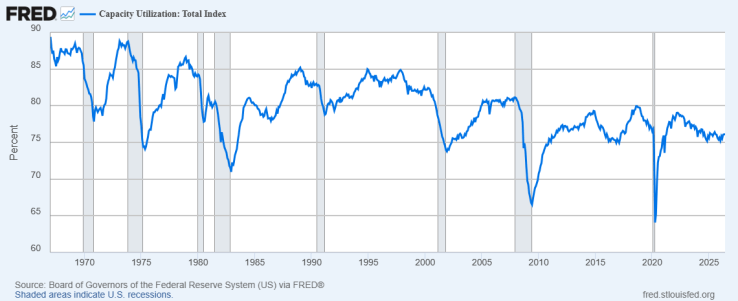
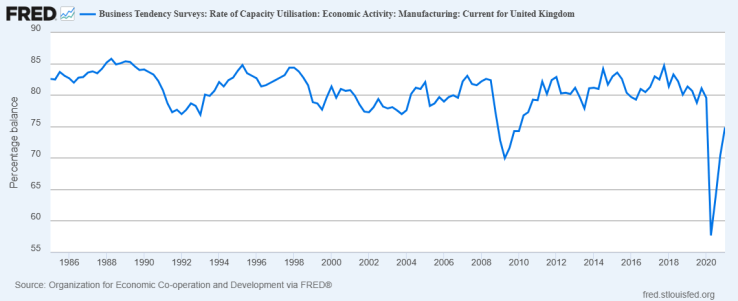

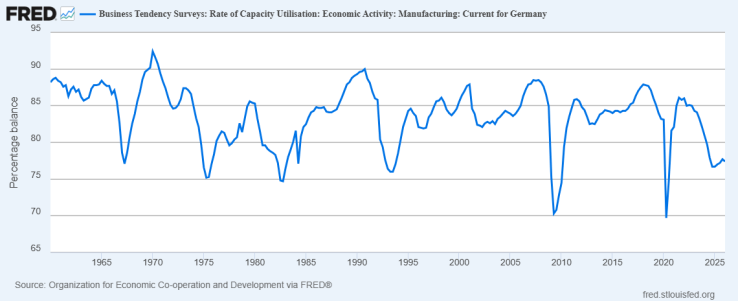
Why should industrial or manufacturing capacity utilisation rates be so persistently low? On considering possible causes such as lower consumption demand, or greater competition, I think that these can be ruled out since consumption demand is higher now than in previous decades thanks in part to global markets, and also because there isn’t evidence of greater competition except between countries. Otherwise, we are seeing greater concentration of market power, in fact.
In India, the latest RBI figures for capacity utilisation in manufacturing are for Q3 FY26 which saw an increase to 75.6% from 74.3% in Q2 FY26. Year on year, the increase in capacity utilization was only 20 basis points. According to another survey by FICCI on capacity utilization that is more recent and reported by The Economic Times, it fell to around 72% in Q1 FY27, and remained unchanged from the previous quarter. This is in the wake of the Iran war and problems in the Middle-East. However, what I find even more striking is that in a reasonably good capacity utilization quarter such Q3 FY26 was, capacity utilisation was highest in certain core industries at 79% but was rather low for cars and car parts at 65%! Why this should be so, when car sales and exports are zooming in India, is anybody’s guess.
I think there could be various other reasons for this low investment phenomenon. First, there could be less investment in fixed assets such as new or expanding production capacity, and more in capital markets. Private sector could be finding greater returns on investment in the stock markets than in investing in capacity expansion. I haven’t had the chance to look at corporate earnings of companies in detail on their websites to see the extent of “other income”, which would tell us how much companies are investing in the capital markets and other assets.
Another reason could be low investment in innovation of the R&D kind. This could be truer of economies such as India, UK and the EU. I would think that countries like the US and China are perhaps still spending hugely on innovation, even if it is all in AI and AI-related business activity. Instead, companies sitting on huge profit piles have been buying back more of their company’s stock and rewarding shareholders generously. This is a huge trend lasting well over a decade and it has spread across the world, including in India. In India, according to a media report, share buybacks were to the tune of Rs 191.75 billion in 2025, and this year they have already crossed Rs 250 billion. This, despite the Indian finance minister, Nirmala Sitharaman, announcing in this year’s budget a higher tax on shareholders to discourage frequent share buybacks.
There is another place that private investment could be going, besides going to overseas markets. On looking at GFCF (gross fixed capital formation) figures for many economies, I find that NPISH (non-profit institutions serving households) accounts for a significant share, even the largest share in many countries. These are mainly charitable institutions from educational and healthcare to even places of religious worship and community development. I think these would be funded largely by private sector investments and donations, and the main reasons for doing so would be to save on taxes, as well as to strengthen capacity in areas where the state has failed or doesn’t operate. In the case of India, for example, the private sector has entered the education and healthcare sectors in a massive way over the past few decades, precisely because the state hasn’t been doing enough. This cannot be considered business investment, but it is another area competing for private sector capital.
Speaking of which, I wonder why it is that we don’t look at capacity utilisation in the services sector, considering these constitute an important part of most emerging and developed economies, accounting for more than half of economic activity. Besides, services industries attract large amounts of private sector investment and therefore, there must be a way to measure their capacity utilisation. It is not that services such as airlines or hotels or railways don’t measure capacity utilisation; they just have their own ways of measuring it. We need to develop a way to capture services sector’s operating capacity across a broad swathe of industries from banking and finance and technology to telecom, utilities, construction, media and entertainment, communications, transport, etc.
Finally, of course, there is the fact that most of the private sector – especially multinational companies – invest in several other markets besides their home country. Globalisation was the result of this massive search for international markets and international production facilities way back in the 1990s. Despite the calls for deglobalisation by some political leaders and rising geopolitical tensions, there is no denying that the world is still too interconnected economically. In recent decades, we have seen many Indian companies expand their businesses globally and in the past three years or so, this trend has accelerated once again.
This brings me to another aspect of globalisation. Because of the new manufacturing model involving global supply chains, could it be possible that this fragmentation or atomisation of manufacturing is responsible for lowering capacity utilisation rates from the 1980s down to the present day? Either way, there is still no getting around the fact that creating new capacity or adding capacity ought to be the most rewarding business and economic activity in any country.
The world needs more productive investment in creating new businesses and expanding existing ones. Including creating new industries altogether. With millions unemployed in developing economies such as India and with AI threatening to disrupt and take away more jobs, the private sector must step forward with the most relevant business ideas for our age. As well as the capital with which to fuel growth, to raise living standards, and to make economies more prosperous and thriving.
There has never been more private wealth created and amassed than in the past couple of decades. This is also not the time to complain about high taxes or interest rates. In most of the developed and emerging world, corporate taxes have never been lower and the cost of capital as well. It’s time companies opened their purse strings not just to enrich themselves in the capital markets, but to innovate and make the world a thriving bustling workplace fit for tomorrow.
Somewhere in this large, grand scheme of things, I see new product ideas and brands playing their part in improving lives.
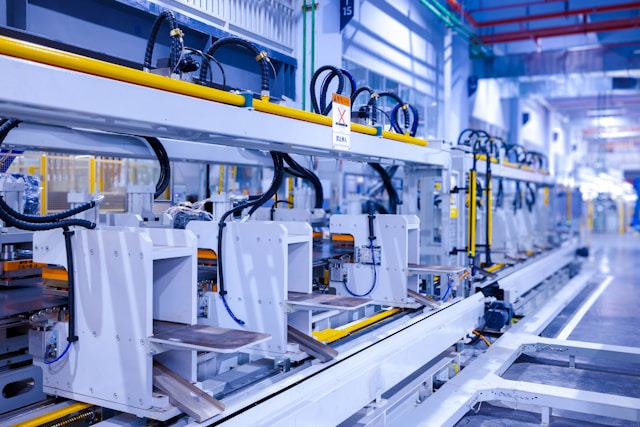
The featured image at the start of this post is by Homa Appliances on Unsplash