

As many of you who have been reading my blog might know by now, I continue to be an AI sceptic. Not because I cannot see its real value and its powers, but because of the way AI is being pursued and deployed around the world. The stock-market sell-off on tech stocks globally earlier this month brought home the apprehensions and fears regarding the power of AI to eliminate most middle-management jobs. Business news channels and market experts put it down to a new version of Anthropic’s AI bot, Claude, that is capable of performing most tasks and managing entire work flows, across a wide spectrum of functions at enterprise level.
These AI jitters are bound to stay with us, even if tech experts say the fears are overblown and others say that the fears are legitimate and genuine. With my limited understanding of AI, I think the threat to software might be coming from the fact that most of today’s AI LLMs are based on natural language processing which the machines have been trained on. Therefore the need to write software in special computer languages is minimised. Perhaps this is why AI cheerleaders have also been going around saying that in today’s world, everyone can be a programmer or code-writer! If this reasoning of mine is correct – albeit at a simplistic level – then it means that the AI disruption to even the software industry is real. It also means that the Indian IT industry which is entirely software-based and has yet to move up the value chain in AI development, is facing headwinds. The sell-off arising from AI fears have also spread to other industries as real-estate stocks were next in line to collapse, because demand for office space is expected to shrink considerably, according to those in the sector. The thought that went through my mind was, well, repurpose office space to data centres as plenty of those will be required!
My cynical view aside, I think it’s time for us in India to rethink some of the AI business models that are being put out by the West, especially America, and China, as they engage in a fierce eco-tech war for supremacy. It is fitting that India should be organizing a global AI Impact Summit at such a time. Global political and business leaders, including those from multilateral institutions, are gathered in Delhi for the summit and expo. What exactly is being discussed is not very clear from the summit agenda, where I am certain unprofessional PR agency idiot bosses will be fully involved! However, I hope that this global AI summit can be the start of a meaningful global dialogue on the way forward for AI technology.
I hope the summit discussions focus on the following:
- Restricting AI to spheres of work and applicability where it is used to perform tasks that are not humanly possible, as opposed to doing our work for us as seems to be the case with generative AI
- Laying down guidelines for development of AI models and applications on which there needs to be more discussion
- Guidelines for the development of AI and its use in defence equipment and in warfare
- Agreeing to common principles governing AI globally, even as countries and companies compete and fuel an AI arms race around the world
If this Global AI Impact Summit can initiate discussion on these important issues concerning AI – and many more such as privacy, safety and copyright infringement – it would lead to a more sensible, long-term and much more beneficial use of AI. I have already written that generative AI is perhaps the worst form of AI use, threatening to do our work for us and turning us into useless zombies roaming offices. Forcing us to rely on Assts (assistants, I suppose, in unprofessional PR agency parlance) when we already have plenty of them from Siri, Alexa and Cortana to Google Gemini and now ChatGPT! The latest is that generative AI models such as ChatGPT are now building advertising-based business models, to also make more money out of making us stupid! That doesn’t mean that I think Claude’s Superbowl advertising that I shared a repost of, on LinkedIn, is great; in fact, it misses the point of what genuinely useful AI ought to be, entirely.
Just as there are two camps in the world of AI – those who believe in its promise and those who fear its perils – there are two kinds of AI as we have it now. Consumer-focused AI such as generative AI and virtual assistants that have got the whole world excited, and more beneficial long-term use of AI by enterprises. The latter is what companies, governments and organisations will use to improve and streamline their operations in certain functions. The danger, of course, is in businesses adopting Gen-AI tools in the office and filling their operations with bots, assts and interns! The argument that middle and senior management will move higher to supervisory roles is a specious one offered by people who have never known how companies operate and have never done any work themselves; middle and senior management also have their own tasks to perform even as they supervise and manage their functions and business units.
The latter group of businesses, governments and organisations is the more critical one to consider in AI development and deployment because it will impact how organisations are structured, how they work and how it affects individual employees’ work and lives. Here, the subject of AI agents becomes important, as AI and tech companies announce new “agentic AI” that performs tasks and manages work flows across functions. With my limited knowledge and understanding of AI, I see AI agents to be only a slightly superior and glorified AI assistant with more capabilities. This again, might not be what companies and other organisations necessarily need, as they have educated, trained and experienced employees to take care of this work.
Therefore, we need to think carefully and hard about what role AI can play in enterprises. As I said earlier, AI ought to be used for tasks that humans are not capable of performing and in this sense, they become tools that we humans can use to our great advantage. I can think of three areas where AI would be of immense use to humanity: for vast data compilation, compute and analysis and easy retrieval when needed, for areas of work that require extremely high levels of precision not achievable by humans, and for being able to visualize/create innovations and prototypes in R&D. However, from a McKinsey study of how agentic AI is being used by companies in 2025, it is least used in R&D and innovation. And it is still used most by IT companies themselves, and by some pharmaceutical companies, where too it can play a huge role. There might be many other uses of AI in areas that humans would fall short; Professor Vijay Govindarajan of Tuck School of Business has written a leader in Times of India (Goa-Mumbai edition) about the industrial use of AI where it can help India improve productivity and quality in manufacturing. With AI-based tools like predictive maintenance, vision systems and others, he writes that Indian companies can vastly improve their quality and productivity. I think these are areas that become even more critical if we wish to boost our goods exports.
Having brought AI to this stage – after experimenting and proving that AI is superior to human intelligence – which I have written about previously, if we humans cannot control and regulate its direction, pace and utility, we have already become its slave, in my opinion. Now, having written about two camps of AI and two types of AI, let us address the two reasons for adopting AI technology.
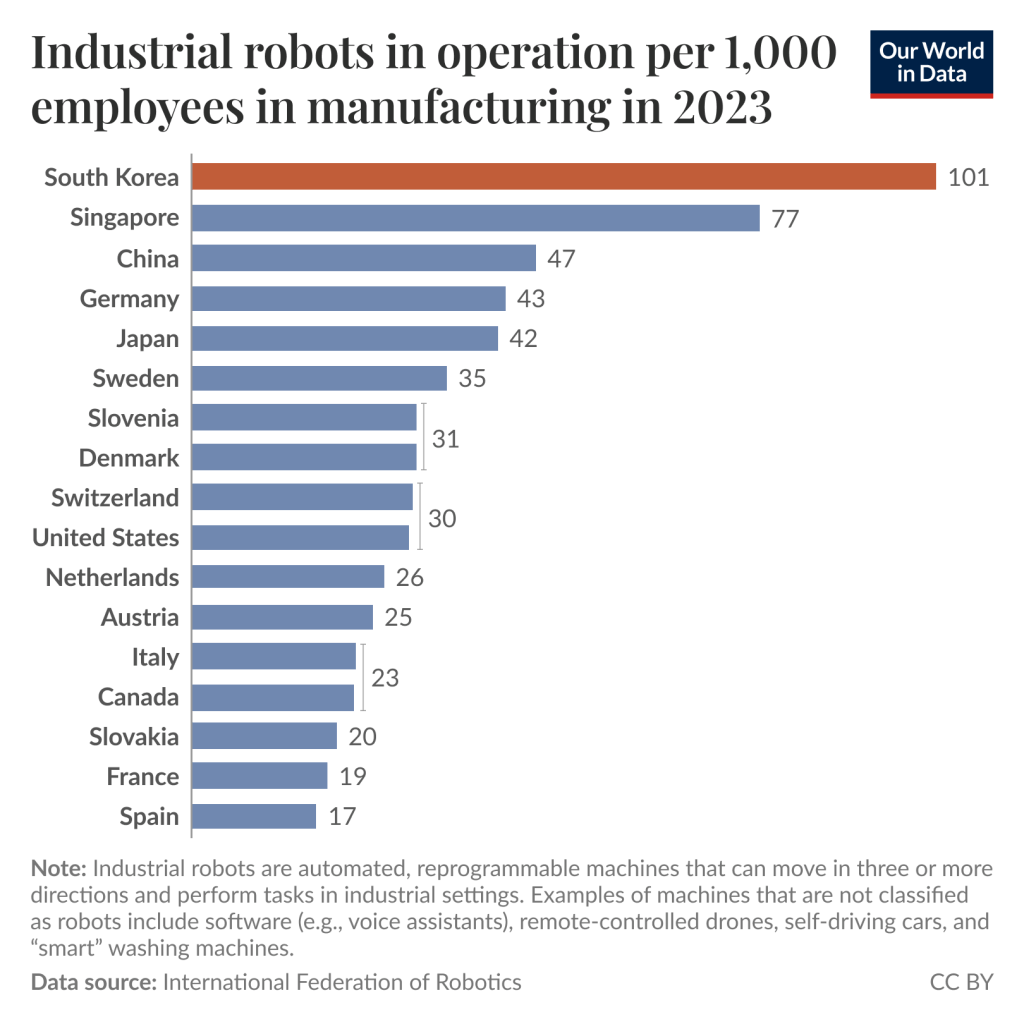
The reason AI research and development has picked up pace in this millennium in advanced economies such as the US, is because they are chasing the productivity miracle. As countries with ageing demographics and a declining population growth rate, coupled with anti-immigration policies and sentiment, these advanced economies are dependent on productivity gains alone for economic growth. Their skilled workforce growth is constrained, and this is why even countries like Japan and China with rapidly ageing populations are forced to automate and robotise their work to a high degree. In fact, it is reported that after Japan’s massive robotisation drive from the ‘90s onwards, it is China that is building the highest numbers of robots of all kinds now and it is one of the biggest uses of AI in the country. Though this chart from Our World in Data shows South Korea and Singapore leading in number of industrial robots in operation, perhaps because of the per 1000 employees filter applied.
In my opinion, AI is still not as great a need or must-have in developing and emerging economies such as ours. We have other more pressing economic priorities such as creating good quality jobs for millions as our economies grow. Therefore, we needn’t get caught up in the AI arms race playing out especially between US and China, and we needn’t follow the west like a herd. Instead, we need to focus on our own economic priorities and our needs as a country in order to be able to develop our own AI capabilities. And since we are a knowledge economy with strengths in engineering and information technology, we ought to leverage our strengths to create our own “AI infrastructure build-out’, a much-used expression these days.
India and other countries in the Global South need a much more humane approach to AI, so that we don’t face the adverse impact of AI especially those on jobs. Fortunately, since our economies are not constrained by a demographic and labour constraint in the same way as developed economies are, we have a little more time to think this through and execute our AI strategies well. And, like I said earlier, we ought to try and use AI as much as possible in the three areas I outlined along with others, so that AI augments and raises human potential and productivity. I am sure there are several applications of such AI in fields as diverse as agriculture, industry, services, research and development, medicine and healthcare, clean energy transition, etc.
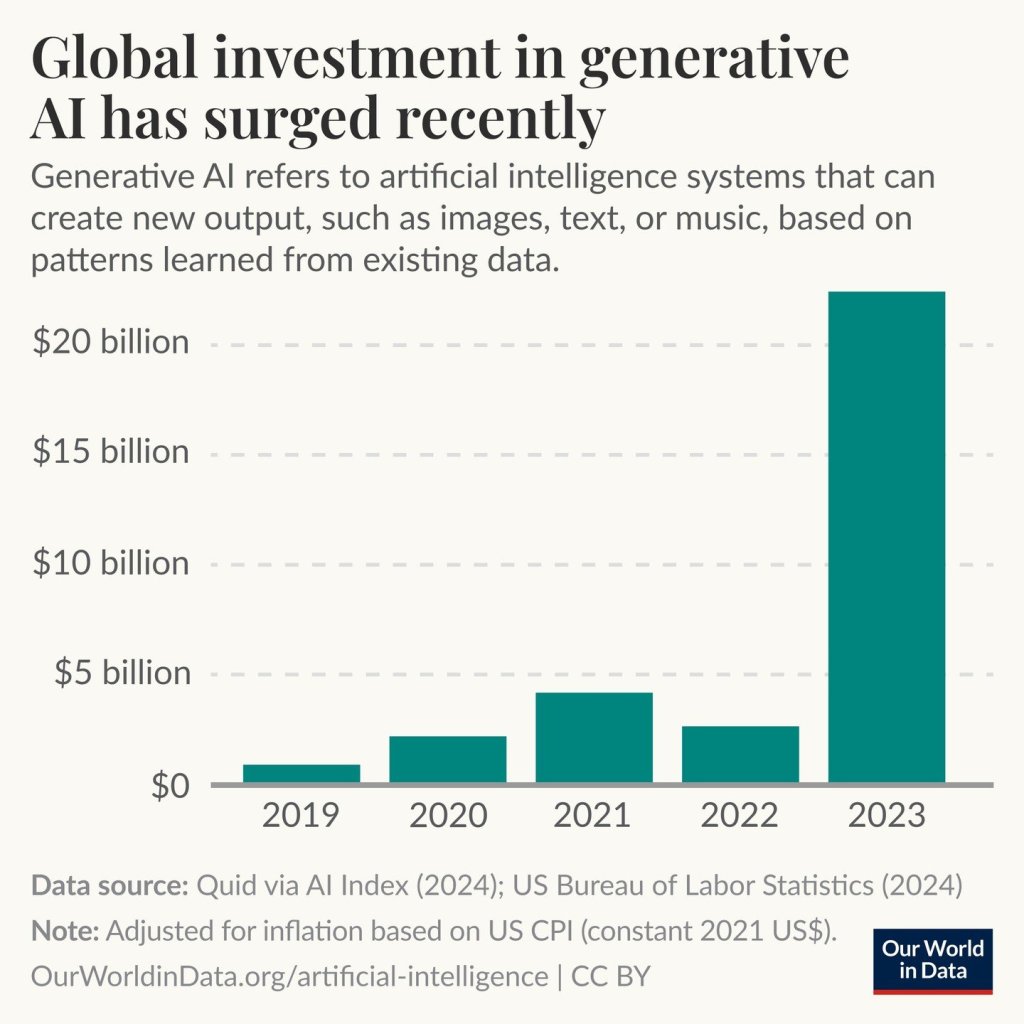
Finally, if we look at investments in AI, they have been going through the roof! It wouldn’t be overstating the case if we say that most of the GDP growth in the US economy in 2025 has come from business investments in AI. They are unprecedented and American tech giants continue to announce massive outlays for AI development. Most of it is in chips and in building data centres, the AI infrastructure build-out as it were, and this is hardly surprising. Even the massive investments that America announced in its trade deal with the UK were almost entirely to do with building data centres!
It is true that most of the AI investment is of the infrastructure kind and in hardware, and this is indeed needed. And it is also of the generative AI kind. However, it is software that ought to eventually make the AI tools work at the enterprise level, and this is where the deployment comes in. As the McKinsey report makes clear, deployment is still way behind and AI adoption by enterprises still low. I reckon most companies are still wondering how many of their functions should adopt AI and of what kind, given its effect on employee efficiency, productivity, sales growth and profitability. These are still untested waters and therefore deployment seems to be rather slow.
The fuss over the large and insatiable energy needs of AI is yet another huge concern for economies. Unfortunately, many countries are giving up on their clean energy transition and reverting to fossil-fuel sources as a way to meet their AI data centres’ demands. More of the investments are also shifting away from clean energy and into AI. This is a pity. Developing and emerging economies – most of whom are large energy importers – need to seriously weigh the costs and benefits of AI adoption at scale and prioritise better. India needs to do more to shift to renewables as well as invest in energy assets overseas in order to secure its energy supply for the future.
The road to full-scale AI deployment in India and other economies is a long and hard one. We need to prioritise and plan better so that AI is a boon, not a bane, to billions of people all over the world.
The featured image at the start of this post is by Boliviainteligente (3i) on Unsplash

 Peripatetic Perch