


It’s not exactly a New Year Resolution since I don’t believe in them. But I do intend to explore more on brands and brand-building in 2026, including mainly their connection and relationship with companies and with corporate brands. I have spent the past couple of decades thinking and working on brands – if only on my own since my career in advertising was wrecked – and it’s only fitting that I take my thinking and work now to the next logical extension, which is how brands relate to companies and to corporate brands. If you noticed, I began focusing on brands and business much more on my blog last year, and it helped that my blog was also celebrating 25 years of the 21st century which have been all about innovation.
In 2025, I thought and wrote about how UNFCCC could harness the power of a brand and actually created one around a new way to raise funds from ordinary citizens everywhere for tackling climate change. This, in addition to sharing an idea for a global climate change debt fund that UNFCCC could start, and this too could be based on the same brand concept. Then, I shared my thoughts on how brands could be built for institutions such as the UK Royals and the House of Windsor, how brands could help well-known global brands such as Absolut Vodka and Benetton rally consumers to the cause of global peace, equality, unity and similar universal values, while strengthening their brands at the same time. Finally, I ended the year with how advertising and brand communications could help promote Metro Rail travel in Indian cities and help decongest them as well as reduce air pollution to some extent.
On to 2026, when I will be exploring brands’ fundamental relationship with companies and with corporate brands, in all its dimensions. Those of us from the advertising and marketing industry know and understand brands to be the relationship that companies and their products/services have with consumers and customers. Even this area has yet to be fully explored and in recent years, brands haven’t been given the attention they deserve even by marketing teams as they have been chasing short-term sales through digital marketing. Besides, in recent years yet another falsehood has been spread in the industry that consumers don’t care about brands and that even brand loyalty doesn’t exist anymore. While this might have been exacerbated by digital marketing, what with its focus on discount offers, I think it is utter nonsense that consumers don’t care about brands anymore. The very fact that consumers prefer one brand to another while making a purchase decision shows that brands still matter to consumers. Every purchase decision is a validation of the consumer’s brand preference and even faith in brands. Of course, discount offers and promotion offers interfere with this brand choice decision that consumers make, but most often it doesn’t mean a permanent shift in brand preference. It does, however, demonstrate why perpetual discount offers erode brand values and brand preference in customers’ minds, and this is why they should be resorted to only occasionally to meet very specific sales objectives.
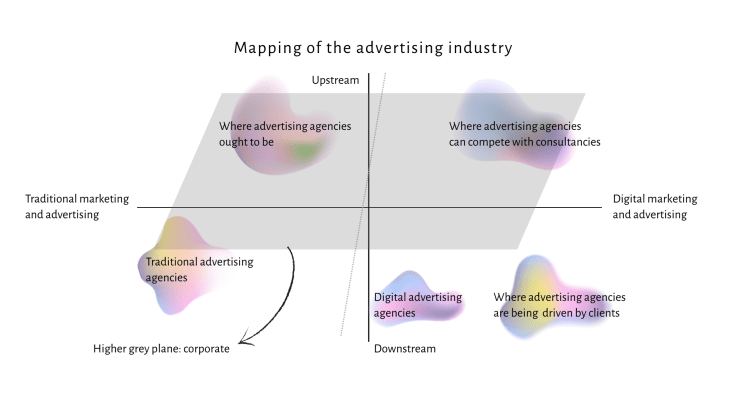
I will be taking forward my thinking on brands into the corporate sphere, which doesn’t mean that it won’t have anything to do with marketing. Rather, I will explore how individual product and service brands relate to the corporate brand and what might be the principles that govern this relationship. If you recollect the advertising industry mapping diagram that I shared in my article on a new strategy for WPP – which I am reproducing here for the benefit of readers – my area of work will concentrate on the upstream quadrant (closer to the centre) and on the higher plane of the corporate level as well. This, I hope, will shed greater light on brand-building in general and will help inform and guide our approach to building brands at all levels.
The areas I would be exploring are brands’ connection to corporate brands in terms of strategic linkages, the branding process itself, brands’ fate and future in M&As as well as how brands can make companies more competitive and future-oriented. Equally important will be the area of intellectual property that brands possess and what role they play in the brands’ corporate connections. I will probably explore why the Indian Airlines and Air India merger decades ago was a botched one, why Air India struggles even today without a clear strategy. Then, the merging of Vodafone and Idea as brands to produce a third new brand was always a terrible idea from the start and should never have taken place, but I might explore what could be a good path forward and out of this mess for the company.
I am also keen in exploring how companies can and should approach brand-building in special circumstances such as when restructuring, in M&As, when they are contemplating a change in strategy, when there’s tech disruption, when expanding into new markets and the like. I would also like very much to explore brands as engines of innovation inside companies. Nike comes to mind in this regard, a company that has been struggling recently. On the subject of intellectual property, it is not merely tech companies or pharma companies that possess them; many FMCG, automobile and several other companies can use the true power of brand differentiation to make them stronger and more competitive. I have nothing to do with Starbucks – and I haven’t even tasted a Starbucks coffee yet – but in the midst of all their recent troubles, they seem to be harking back to “the third place” positioning that the founder had devised for the brand at the start. I have written briefly about this in a blog post on the connection between brands and corporate performance, saying that every café, restaurant, bar is a third place – as in distinct from home and office – but it offers no other differentiation to build/rebuild the brand. I think the company might be better off pursuing the creation of truly differentiating intellectual property for the Starbucks brand as nothing else can justify the huge premium they charge for a cup of coffee, when there are so many other options around.
These are just some of the many areas I will be exploring in 2026, as part of what I now call Brandology: the art and science of building brands. If you notice, my blog header for the start of 2026 features Brandology and it will remain the theme of my blog for 2026 and the years ahead. I hope that through my exploration, I will be able to make many more people in our industry see brands as living, organic and dynamic concepts that do more than make customers of buyers. Backed by genuine innovation, intellectual property and meaningful differentiation, brands can spur companies to greater innovation and growth in the future.
Do follow me in this Brandology journey, when we can discover the many realms that brands occupy in our lives and in business.

 Peripatetic Perch