


Reading HBR posts online on LinkedIn where I follow them, I was always quite disappointed by the kinds of subject matter and articles that were being shared. Being unemployed for decades now in India, I cannot afford to subscribe to the publication, so I browse and read the occasional free article whenever I find something that catches my interest. So, I finally decided to share a post on LinkedIn recommending certain topics on leadership and strategy that I thought they could get management gurus to write for them or else even republish old articles from their archive once in a while as it might make for more sensible reading. In any case, HBR ceased to be a serious academic business journal long ago, which is such a pity.
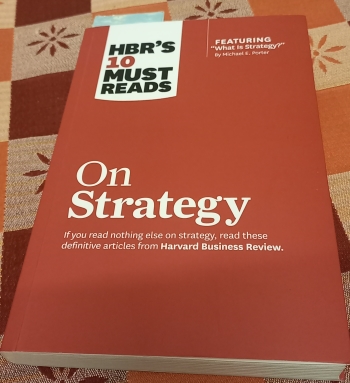
Then, I happened to find an HBR book on strategy online called HBR’s 10 Must-Reads on Strategy and I was surprised that it was so reasonably priced on Amazon India which has been pricing books ridiculously high in India, as I have written before. When I started reading it I didn’t intend reviewing it on my blog, since it is a compilation of old HBR articles. But half-way through it I thought I must write about it, if only to alert people about the extent of unprofessional PR agency idiot bosses in India meddling in publishing and book-writing, among other kinds of unprofessional nonsense that they have indulged in over decades.
The very first article in the book, which is Michael E Porter’s What is Strategy? reeked of their nonsense. Since I had downloaded the original piece from HBR long ago and read it, I knew that he had written about what strategy is, as the title says. In this book though, the article starts by first telling you that strategy is not operational effectiveness! In his original piece, Porter also writes about the generic strategies usually adopted by companies and the five forces framework of competitive strategy, as he envisioned it. Here, we have Porter writing about three kinds of positioning that I don’t think he ever wrote or could have written about, since they make no sense whatsoever. He writes about variety-based positioning, needs-based positioning and access-based positioning!
Not only are these completely mischief-motivated thoughts, they are based on my work and experiences. Variety-based positioning has come from work that I was asked to do at Perfect Relations Delhi for Nirula’s Restaurants. I suspect the reason I was asked to work on it in the first place was from reading my old emails, in which I might have mentioned to an old colleague or friend that I lunched with an old colleague from Ogilvy, Sunil Varma, at Nirula’s in Delhi at their Potpourri Restaurant in Connaught Place. Anyway, I thought that the Nirula’s brand positioning or strategy itself had to be in the variety of restaurants and fare they served, considering they were also pioneers in bringing American-style fast food to India way back in the 1970s. Based on this understanding of the Nirula’s brand, I think I also wrote a PR strategy and plan. Separately, access-based positioning has come from my being unable to access Mercedes-Benz’s website decades ago, when I wished to read more about the company and their models of cars so that I could put down my thoughts on the Mercedes-Benz brand. I have just recently shared a post on LinkedIn on PR agency idiot bosses’ mischief with links and URLs which mentions this. Of course, more recently, I have been able to read their website and I have also written on my blog about my brand strategy and communication recommendations for Mercedes-Benz.
As if these are not bad enough, we also have Michael E Porter writing about “fit” and that it drives both competitive advantage and sustainability. I am not sure he wrote this in his original piece and especially in the context of core competence and the like.
“The importance of fit among functional policies is one of the oldest ideas in strategy. Gradually, however, it has been supplanted on the management agenda. Rather than seeing the Company as a whole, managers have turned to “core” competencies, “critical” resources, and “key” success factors. In fact, fit is a far more central component of competitive advantage than most realize.”
Then there is plenty on activity system maps, as you can see in the images below, that are meant to illustrate fit.
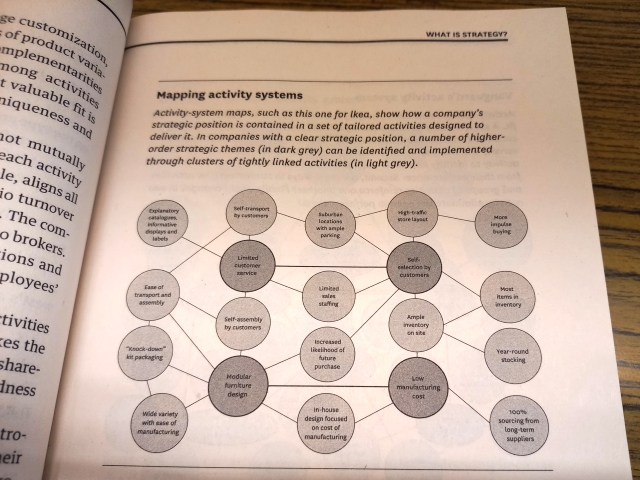
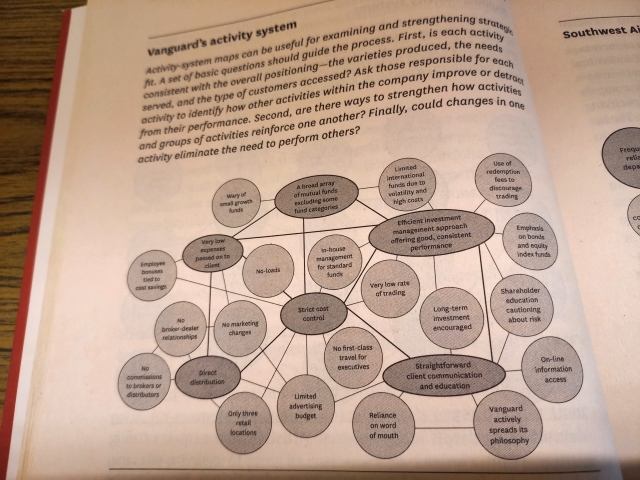

The second article in the HBR book is about the five forces of competitive strategy, but by then enough damage has been done to Michael E Porter’s thinking on strategy. The three articles that follow are actually not about strategy strictly speaking, but about business model innovation, building company vision and Blue Ocean Strategy. Even if the third subject is about strategy, it is not in the every-day sense that we understand strategy in the business context, but about strategy when a company wishes to break the mould and look for an untapped business opportunity outside existing industry practice.
The last five articles in the book, HBR Must-Reads on Strategy are about strategy execution which is an important area since most companies face problems in implementing their strategy. Secrets to Successful Strategy Execution by three senior people from Booz Allen & Co. recommends focusing on four important factors – decision rights, information flow, aligning motivators and making changes to structure. But most of the article dwells on decision rights and information flow. I am not quite sure what they mean by motivators in the context of execution of strategy. I would have thought that executing strategy well requires focusing on structure, people and processes.
In The Balanced Scorecard as a Strategic Management System article by Robert S Kaplan and David P Norton, they write that most companies’ operational management control systems are built around financial measures and targets, which are not strongly connected with the long-term achievement of strategic objectives. The Balanced Scorecard, on the other hand, is based on four management processes – translating the vision, communicating and linking, business planning and feedback and learning. According to their case study example, though they don’t say for which company, it took them two years to build a strategic management system using the Balanced Scorecard, in which steps 7,8,9 and 10 which began from the 15th month onward, are now performed on a regular basis as the Balanced Scorecard system is now a part of routine management.
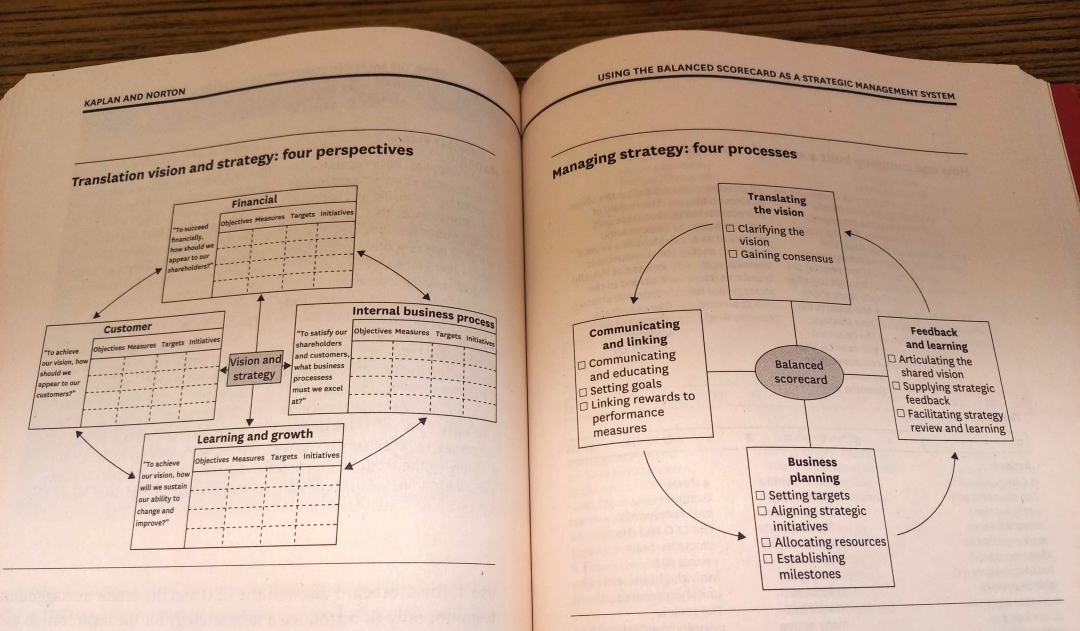

In Turning Great Strategy into Great Performance, Michael C Mankins, formerly of Bain Consulting and now with Marakon Associates and Richard Steele of Bridgespan Group, a non-profit consulting firm, write about the strategy-performance gap existing because companies tend to focus too much on estimates and growth forecasts, without questioning the assumptions first. Lack of clear communication, not prioritising key areas and resourcing poorly are the other main reasons. If allowed to continue, these tend to engender an under-performing company over time. They set out 7 rules which range from keeping it simple and concrete and debating assumptions to discussing resource deployments early, clearly identifying priorities, monitoring performance and rewarding and developing execution capabilities.
The last article in the book, Who Has the D? is a strange piece indeed. Written by Paul Rogers and Marcia Blenko of Bain Consulting, it seems to put the underperformance of companies entirely down to decisions which explains the D, I suppose! I thought that this article, along with Building Your Company’s Vision by James C Collins and Jerry I Porras, Reinventing Your Business Model by Mark W Johnson of Innosight, Clayton M Christensen of HBS and Henning Kagermann former CEO of SAP, as well as Transforming Corner Office Strategy into Frontline Action by Orit Gadesh and James L Gilbert of Bain Consulting were too simplistic and lacking depth in their solutions. I had written about the examples from the last article and how many of them seemed to be brand positioning statements to me rather than strategic principles. And the example of Tata Nano being cited as a case of reinventing the business model struck me as quite erroneous and misplaced as I shared in a LinkedIn post. I also shared a post on LinkedIn about Jim Collins’ BHAGS and how they reeked of unprofessional PR agency mischief, and could be exploited by them to the hilt at any rate for all their mischief-motivated nonsense.
I think that reading these articles one after the other in a book form also makes them appear simplistic and glib. Especially as there appears to be no editorial input in selecting and organizing the compilation. And, of course, they all suffer from lack of adequate real company examples from America and around the world. In fact, I came across several examples of insurance companies which strikes me as unprofessional PR agency mischief again from guessing my work at RK Swamy/BBDO Chennai decades ago.
I am surprised that articles by CK Prahlad and Gary Hamel, Core Competence of the Corporation and Strategic Intent were not included in this selection, as these are very much concerned with strategy though not entirely in the conventional American way. I had been meaning to read these for years and finally downloaded PDFs of them online and read them. I am not sure if these were their original articles or influenced by PR agency mischief, but I think the subject itself deserves greater consideration, Michael Porter’s reservations about core competence notwithstanding, if he had any. I am also surprised that there isn’t a single article by Peter Drucker in this book.
Finally, I am surprised and disappointed that there isn’t a single article on the importance of marketing strategy in delivering on overall business strategy. I believe that it is the marketing function at the end of the day that delivers business strategy and to this extent, Philip Kotler and Pankaj Ghemawat’s HBR articles too could have been included. The importance of brands to marketing and to business strategy is what I would like to focus on in my work and I suppose that is still a relatively unexplored area.

Postscript: I had mentioned in a LinkedIn post that I have finally bought Michael E Porter’s first book on strategy, Competitive Strategy, and am halfway through reading it now. The book again reeks of the same unprofessional PR agency idiots’ meddling. Having guessed that I was writing this review article of the HBR 10 Must-reads on Strategy, they have got Michael Porter to write in one of his introductions to the book (there are two introductions for some strange reason, when the book isn’t even an updated edition) saying that competitive strategy is not operational effectiveness! Of course, we know it isn’t the same as operational effectiveness, and there is no need to state the obvious!
They have been meddling with the HBR publication and I notice their meddling and mischief even on HBS’ website. They are an absolute disgrace and an embarrassment and just cannot mind their stupid circus and leave me alone.
By the way, there is an entire series of these HBR 10 must-reads, including in a bright, multicoloured box-set selling on Amazon India. I hope their content is not like this dumbing-down stuff.
 Peripatetic Perch