


Having just read the book, HBR’s 10 Must-Reads on Strategy, that I ordered from Amazon India, I am once again reminded of how central brands are to strategy. Not merely product brand strategy, but to corporate strategy. It’s something I have been thinking about for the past couple of decades that I have been unemployed, after a long career in advertising and brand communications in India. I have been putting my thoughts down on how I see brands both in the context of individual product/service brands and the overall corporate or business strategy and sharing a lot of it here on my blog.
This piece is not a review of HBR’s book that I have just read; I might write about it later next month. Instead, in this article, I would like to concentrate on the important role that brands can play in strategy development and execution.
I had written about Michael E Porter’s books on Competitive Advantage and his Five Forces Model long ago on my blog in which I had said that brands could well be the sixth force that enhances differentiation in ways not easy to emulate or replicate. Alternatively, brands could help in differentiation along each of the five forces that shape competitive strategy.
We usually think about brands in the context of consumers’ relationship with products and with the companies that make them. That is purely in the advertising and marketing sense. Rarely do we think of brands in the context of corporate or business strategy, and yet there is so much to explore and discover in this realm that could also help the cause of marketing and cementing relationships with consumers.
In my last post on brands, I wrote about how and why brands ought to be hardwired into products from the product development stage itself. And I had said that the main advantage of doing so is that it makes copying or emulating extremely hard for competitors. At the corporate level as well, a business strategy that helps companies decide how they will do business and compete is also about brands.
I had written about how Nike could hardwire its brand into its product and improve on the product innovation front to regain its supremacy in the sports shoes market. And I had said that the brand Nike was all about the spirit of competition – including with yourself – to get better at your sport. Well, I wasn’t surprised to see Nike mentioned in the chapter on Building Your Company’s Vision by Jim Collins and Jerry I Porras. I haven’t read any of Jim Collins’ books though I know he has researched and written bestsellers about several of America’s great companies. In this 1996 HBR article which is now part of the HBR book on Strategy, he and Porras write about the importance of building your company’s vision. This, they write is about articulating your company’s core ideology which comprises core values and a core purpose, as well as envisioning a future for the company. Without going into too many details of the process in this article, I would like to draw your attention to what they think is the core purpose of Nike: To experience the emotion of competition, winning and crushing competitors. Well, they might call it Nike’s core purpose or reason for being, but I think this is Nike’s brand positioning, like I have been writing. Now, who can say that this is only for Nike’s products and doesn’t apply to Nike company’s business strategy?
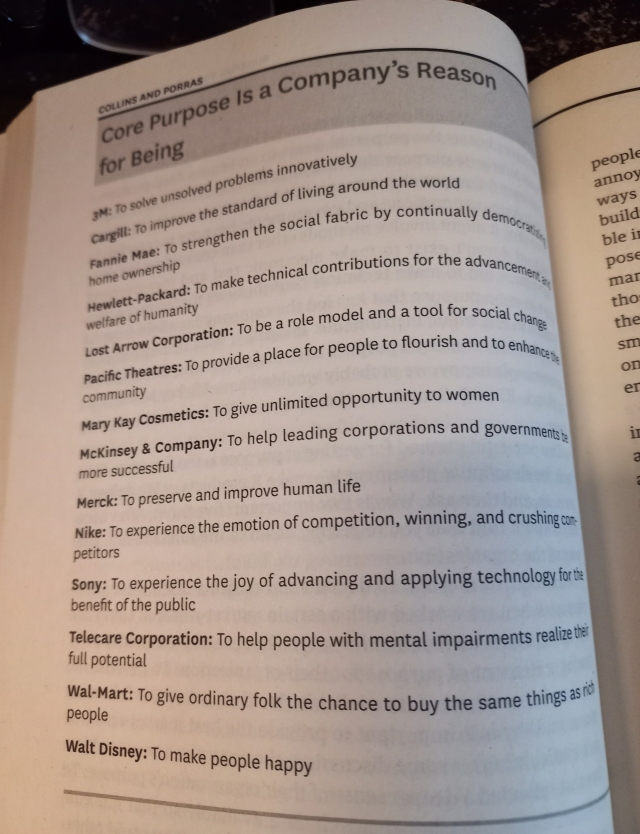
In Nike’s case, we can see that the product brand and the corporate brand strategy are so closely enmeshed, they are one and the same. This is what I mean when I say that brands are not just for products that a company wants to sell, that it isn’t only advertising and marketing, that it doesn’t apply only downstream. Brands are a way for companies to build their businesses, by imagining products and services that play a certain role in people’s lives, and by doing all of this in a differentiated manner.
From a company’s vision statement and mission statement, to spelling out specific objectives and goals, brands have an important role to play in how corporate office and all the function and business unit heads understand their company and what is expected of them in their work. Brands can help define:
- The company’s vision and objectives – what it wishes to achieve
- The company’s mission – how it will achieve the vision and what kind of company it wishes to be
- Articulate a core ideology or purpose for the company, as Collins and Porras write
- A guide to aligning your functions and business units to strategic objectives
- A way to communicate a strategic principle, as Bain Consulting partners write
- And finally, also a way to create new knowledge within the company, that becomes a store of value over time in the form of intellectual property and expertise, which I am not aware anyone has written about as yet
The strategic principle that Bain Consulting partners Orit Gadiesh and James L Gilbert write about is also interesting. In their experience of working with large American companies, they found that “it’s tricky to achieve decentralized decision-making and coherent strategic action”. And they advise that a company would do well to articulate a strategic principle, which is to distill a company’s strategy into a pithy, memorable and prescriptive phrase or statement, that everyone from the CEO to the factory worker can understand and apply to their work.
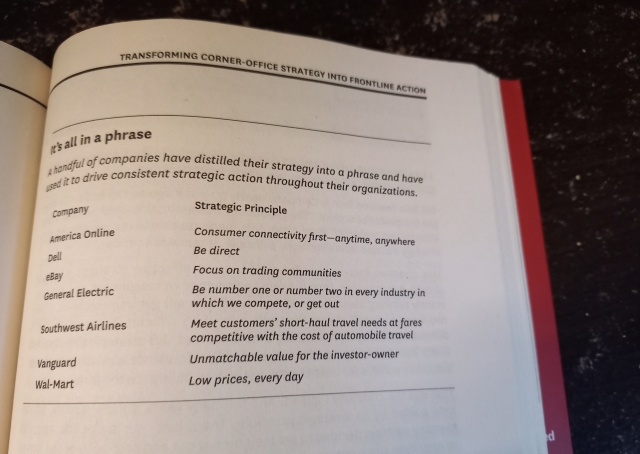
This too is something that brands can do very well. Communicating your core strategy in a memorable, pithy phrase for everyone within the company, and perhaps even partners and suppliers depending on the nature of the business, is best done by brands. When I saw some of the examples of strategic principles that they provide in their HBR article, I chuckled and thought that the statements for AOL, Vanguard and Walmart were brand positioning statements, in the sense that they sum up the companies’ strategies. They would work equally well as straplines for these brands in their communication. I think the strategic principle for Southwest Airlines is a really well-articulated one, and with all apologies to GE and to Jack Welch, I really don’t think the GE statement works at all because it is not a strategy. At best you can call it a vision statement and an incomplete one, at that.
In fact, so much about corporate strategy and its execution also depends on communication. Communication between head office and business units as well as all the separate functions and a clear understanding between them of the goal ahead and the road to reach there. Of course, one needs to keep the communication simple, clear, correctly intentioned and meaningful. And let me clarify that when I say brands can play a role in various stages of strategy development and its implementation in a company, I am not for a moment recommending catchy brand slogans!
I have always maintained that corporate brands are how companies define the way they do business. And to this extent, they are beliefs and values that the company lives, breathes and works towards every single day, both internally and externally. This is why they are central to strategy. I have also written quite a lot on my blog about how corporate brands and individual product brands are connected – and ought to be connected – and understanding their relationship is key to building a well-integrated brand system.

in guiding and implementing strategy across audiences
There is yet another important benefit in thinking of corporate strategy in terms of a company brand that you want to build, and allowing it to play a critical role in various stages of the company’s strategic path. And this is to better integrate the marketing function with the corporate office. By doing this, the company can ensure that the corporate brand values and strategy flow into product development and product brands. And that individual brands are, therefore, better connected with the company brand. I think that this would help even industrial companies and others who operate in the business-to-business space place greater emphasis on marketing than they currently do.
My concluding thought is this: strategy is about brands; brands are more than advertising and marketing, even though it is marketing that actually executes and delivers the strategy. The latter part of the previous sentence is what the finance function needs to understand and appreciate better, so that budgets and targets can be prepared jointly in consultation with the marketing team. Brands can provide that level of understanding of strategy in ways that are insightful, relevant to the company and future oriented.

 Peripatetic Perch