

It sounds paradoxical to imagine creating abundance in what is likely to be a year of slowing economic output and growth across the world. We might possibly even be looking at a few years of slowdown, what with the Trump tariffs and the uncertainty surrounding them. But even in the face of slowing economic growth, there are areas in which we can resolve to create growth and abundance and I do seriously mean business here.
My thinking is straightforward: when we know economic growth is going to slow and even stall or contract, why not turn our attention to something equally important and urgent. Something that doesn’t have time to lose. Something that affects our lives and livelihoods every single day. Climate change isn’t waiting for anyone or anything. And the world can put its talent and resources to good use by focusing on one of the most important challenges of this century.
At the end of last year, I had written a blog post on how the world can attract private capital for climate finance which is most needed for UNFCCC’s adaptation fund that helps small and low-income countries build better defences against climate change. In this context, it occurred to me that one of the ways the UNFCCC can raise private capital and enlist popular public support for it, is to harness the power of the brand.
At the start of this year, I wrote a blog post on creating a new climate change brand for UNFCCC – in two parts – and I said that the idea of creating abundance and renewal is a more powerful and inspiring idea than having to fight or combat climate change. I had also said that the global climate change debt fund idea that I had suggested could also use the same branding, so there is greater synergy between all of UNFCCC’s efforts in fundraising. Common branding would also help the fundraising by investors dovetail into the fundraising by citizens all over the world.

Well, we are already almost midway through 2025, and it appears that in the midst of all the economic chaos we might lose sight of the climate change challenge and imperative. Until the next big storm hits hard in order to jolt us from our stupor, that is. Surely no one is wishing for such a disaster, but we can do better in being fully-prepared for it. I am writing on the subject again, to remind us of its importance and also to explain what I mean by creating abundance in the context of climate change, so we all realise that these are quite simple and doable measures that we can take.
Isn’t the timing rather odd, some of you might wonder. I think the timing couldn’t be more conducive and important for pursuing the UNFCCC’s climate objectives. First, it is being reported in media that with all the economic uncertainty surrounding tariffs, trade and geopolitical tensions, investors around the world are sitting on piles of money not knowing where to invest. With every new announcement of Trump’s, the markets swing wildly this way and that, and sensible investors have been sitting on the sidelines, we are told. There is no better time to attract all this money – otherwise idling – into the global climate change debt fund. At the very least, investors know it’s a worthy cause and one with returns far larger than the monetary gains they hope to reap.
Second, with the expected global economic slowdown, oil prices have cooled off considerably. This is good news for oil importing countries such as mine, India, as it helps lower our import bills while enabling good economic growth at the same time. However, lower oil prices – aided by Trump’s “drill, baby drill” refrain – also means that fossil fuel consumption will once again rise sharply as the incentive for clean energy transition is no longer as compelling. We cannot afford to let this happen unchecked, and therefore the world must double-down on efforts in clean energy production and transition. Even low to medium income countries – especially those in Asia, Africa and Latin America have an abundance of sunshine, wind and water with which to create plenty more renewable energy. Until now, western countries, especially those in Europe, have led the initiative, along with China which has invested more in clean renewable energy in recent years than any other country.
In other words, it is time for India and other countries in the Global South to join in the global clean energy transition effort. More investment in renewable energy needs to flow into these countries creating millions of new jobs in the process. Advanced economies ought to be fuelling much of this investment into developing countries, as well as engaging in more research and innovation of their own to lower the costs, especially of technologies such as carbon capture and storage, EV batteries, clean hydrogen and others.
The concept of creating abundance in the way I meant it in the context of climate change is to do with renewal. Reneworld, the UNFCCC climate change brand that I had recommended, involves simple, easy to implement measures that we can and must engage in, in order to create a new cleaner world for ourselves and future generations.
Some of the areas that need urgent attention are:
- Better water management and water treatment, including recycling of water
- Cleaning of rivers and oceans, especially of plastic and other pollutants
- Planting more trees across the world. There’s no better or more effective carbon sink and purification of the atmosphere
- Investing in clean energy and in clean manufacturing technology for use in industry
- Introducing a carbon tax domestically as well as a global carbon tax on traded merchandise. The latter is a tweaking of CBAM that I have been writing about to make it more a more effective and fair way for countries to share the burden of decarbonization.
Some of you might argue that the last point about carbon tax would increase the tax burden, coming as they would, on top of raised tariffs. But if you consider the 25% raised tariffs that are already in effect on steel and aluminum imports into the US – which are some of the most polluting industries – it makes sense to introduce the global carbon tax on traded merchandise, so that some of the higher prices that American consumers pay also goes towards decarbonisation. This would also force steel and aluminum manufacturers to adopt cleaner technology to produce cleaner metals.
I must mention here, that around the time that I was writing about climate finance for UNFCCC and thinking about a climate change brand for them, a book titled Abundance was published in the US. Written by two editors at NYT and The Atlantic, it apparently argues for a new kind of politics in America, one that is led by technocrats so that more sensible policies are made. I haven’t read the book, only a review of it, and my thinking on abundance in the context of climate change has nothing to do with the book. That said, technocrats might not be such a bad idea for pushing climate change policies as well, as they are likely to be informed by the science of climate change, the imperatives, as well as the pragmatism required. It is also about making choices that are fundamentally apolitical in nature, though in America it appears that even climate change policies are coloured by politics thanks to the push by the Progressives on the Democrat side and by climate change deniers on the Republican side, both digging in their heels at the extremes. Too many deeply entrenched vested interests and powerful lobbies make those choices for the American people. I am glad it is not that way in the rest of the world. American exceptionalism also comes with its own costs.
There is another sense in which the idea of creating abundance is understood by many people. It is about the importance of creating public common good and ensuring that there is enough of it to go around. This operates at a more philosophical level and engenders a strong sense of social cohesiveness and community. This concept of creating abundance is as much about the distribution of public good such as education, healthcare, basic infrastructure such as water, electricity, public transportation, adequate housing, connectivity, etc. as about the creation of it. While I am not aware of any government proactively taking up the idea of creating abundance per se, many Nordic economies that ran successful welfare states through most of the 20th century would perhaps qualify, even if they never called it creating abundance.
In the context of climate change as well, the distribution of the common good that comes from clean energy, decarbonization, cleaner rivers and oceans, more forests, is important. The people who suffer climate change the most are the poor and economically vulnerable, and it is to them that the benefits of creating abundance need to go. However, in their case, it is always a case of making the worst trade-offs, Hobson’s choices as it were, that put them at a disadvantage from which they are scarcely able to rise. Poor developing countries are the ones most at risk from the extremes of climate change and it is to help them build their first line of defence against it, that the UNFCCC emphasizes the need for the Adaptation Fund to grow.
There is one particular conception of creating abundance, though, that my Reneworld idea has nothing to do with. The idea of abundance as imagined by supply-side economists, who are driven by the notion that if you build it, they will come. Climate change and clean energy transition has plenty to gain from innovation and investing in research and development, but the ends matter as much as the means. If the only end it results in is more consumerism of the wasteful kind, and a pot of gold at the end of the rainbow for the wealthy, it isn’t about renewing the world, is it?
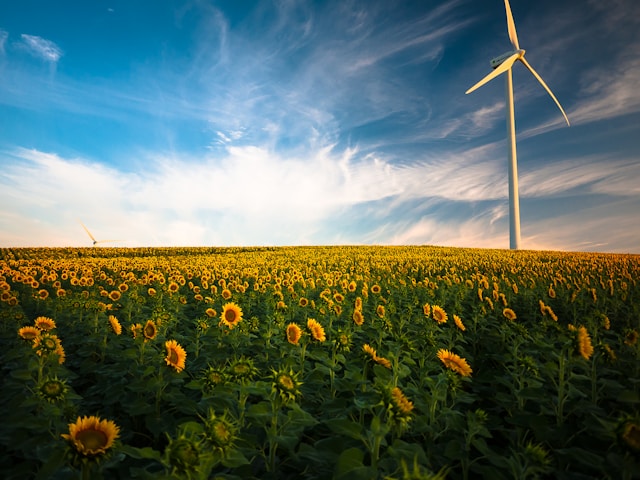
The featured image at the start of this post is by Gustavo Quepons on Unsplash

 Peripatetic Perch