


The start of a new year usually means the world’s global elite gather at Davos-Klosters in Switzerland for their annual summit. And this year was no different. After three years when these were disrupted due to Covid-19 pandemic and had to be held virtually, they are back in person for the second consecutive year now. And that is a good thing, considering last year and this one will continue to be quite challenging.
Challenging can be an understatement, when you think of all the risks that the world faces at the moment. In fact, the World Economic Forum released its Global Risks Report 2024 just ahead of the Davos Summit and I thought that the Davos Summit might take off from there. However, the theme for this year’s summit is Rebuilding Trust, and if one looks at the Global Risks Report, it appeared that this year’s summit might be treading the same ground as the 2023 conference which was about increasing cooperation in a fragmented world. Looks like nothing much has changed since last year, has it?
Well, the conference dates as well as the theme and the programme look like the interference and meddling of unprofessional PR agencies from India, such as Perfect Relations. All to continue to try and make me someone else, I suppose.
Having said that, let’s dive straight into what this year’s main issues are. In my blog post of a month ago, I had written that the world is largely relieved that it escaped a recession, which was a serious concern last year. However, 2024 is going to be a year of considerable economic slowdown thanks to persistent high inflation – even if it is ticking down – its effect on consumer demand, high levels of debt both government and household, as well as geopolitical tensions impacting commodity prices and global trade. Then, there is the effect of technology in the form of AI that businesses will be investing in and that will bring its own set of problems, mainly to do with lack of sensible regulations, retraining people, and job losses.
From reading the Global Risks Report 2024, I am not surprised that the biggest concerns are about AI and misinformation and disinformation, climate change, societal polarization, cyberattacks and geopolitical tensions. The report appears to be based on a perceptions survey of risks that WEF has put forward and to that extent, it might not accurately reflect the real concerns of CEOs, in any particular order. I think the respondent base might also be a wider representation of society and not just businesses or CEOs, as I have only read the report summary which doesn’t say who the respondents are, nor does it share the methodology.
I think businesses will have to navigate a particularly tough year in 2024, what with these issues as well as inflation-related consumer demand issues and preparing their people for the tech-related overhaul that will be required. However, from the Davos summit programme which had the discussions organized under four main themes, it seemed to me that the main geo-political risks were not being given the attention they deserve. We had many of the world’s leaders at Davos, and even if the forum mainly deals with economic matters, it has to contend with geopolitical issues as well. After all, that’s what the world’s biggest business leaders and political leaders ought to be meeting to thrash out and resolve to whatever extent possible. Instead, we had the new President of Argentina, Javier Milei, apparently making statements that were completely political in nature and meant to divide the West from the rest. The WEF is not the UN, and is perhaps not the right forum to be airing his political grievances.
On the other hand, I wondered where all the economists were at this year’s Davos Summit. Except for a couple of discussions featuring Gita Gopinath and Kenneth Rogoff, and hearing Kristalena Georgieva of the IMF, I didn’t see or hear from any other economists who are regulars at Davos such as Raghuram Rajan, Paul Krugman, Joseph Stiglitz, and several others.
CEOs were plenty in attendance, as always. And from the news coverage of the summit, it seemed that they were all quite optimistic about the year ahead, despite all the challenges. Economists were the ones reportedly exercising caution and highlighting the problem areas that need attention. And especially tempering market expectations that there are likely to be interest rate cuts this year.
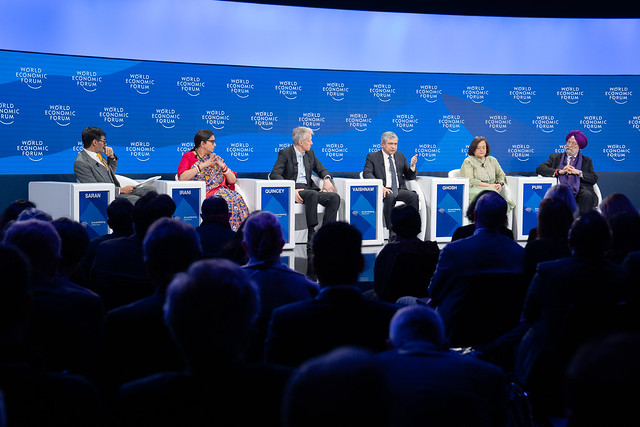
Besides navigating the tough geo-political landscape in 2024, companies will also have to find new drivers of growth in a year of slowdown. In my opinion, innovation and diversification – not merely of supply chains – and being nimble will be key. In terms of growth engines, China is still critical to the global economy. Among the few panel discussions I watched, was the one on Recharging Growth in China, and I thought it was quite useful and to the point. China has just released its Q4 2023 and full year GDP figures and I have to say that 5.2% growth is not bad at all. In fact, some of the other internal data such as retail sales and industrial production too were quite good, even if they were a tad below estimates.
In terms of low consumption demand, there seems to be a view that wage growth has slowed in China though no one is sure of the data. In one of my blog posts, I had written that the cause of low consumer demand in China needs to be identified, and if it is low wages, perhaps a wage-revision for all public sector employees might do the trick. In the Davos discussion, Zhu Min had an interesting suggestion to make: that millions of Chinese workers in the big cities who do not have city registration need to be given city IDs which will help them settle in cities and will provide an immediate boost to consumption in his opinion. I first read about this system called hukou in The Economist several years ago, and Arthur Kroeber of Gavekal Dragonomics also writes about it in his book, China’s Economy: What Everyone Needs to Know, as partial urbanisation.
Another discussion that I watched because I think it is critical is Supply Chains of the Future. Unfortunately, this discussion didn’t delve deeper into issues of how governments can help businesses secure supply chains and shipping routes, especially in times of crisis, be it war, conflict, piracy, pandemic or a natural calamity. I think this will be an important requirement in future, besides diversification and digitization of supply chains. And I don’t think countries resorting to friend-shoring as the default option is the best answer.
There is one other discussion at Davos that I watched on Decrypting the US-China Relationship that I think is at the heart of global geopolitical tensions. The world’s two great economic powers competing with each other in such a vicious and toxic way that it spreads around the world, is surely untenable. I thought the participants made good and pertinent points, including on the legitimacy of invoking national security as a means to block the other country, and I think resetting relations between these countries is absolutely essential to peace and stability around the world.
In this regard, I think it’s important to listen to what the Chinese Premier, Li Qiang, had to say at the Davos Summit. He outlined five measures to rebuild trust between countries: improve cooperation on macro-economic policies, increase collaboration on trade and industrial specialization, increase cooperation in science and technology, improve cooperation on green technology and climate change and to improve North-South and South-South cooperation for truly inclusive economic growth and development around the world. The Chinese government is clearly sending out a message of openness and inviting investment, trade and economic cooperation from the entire world. As was also apparent in the discussion on decrypting the US-China relationship, south-east Asian countries don’t really have a choice between US and China and already trade a lot with China, as I have been writing in my blog posts. The discussion on supply chains too brings out the fact that East Asia is still the hub of consumer electronics manufacturing, including various kinds of chips that are critical to technology products around the world.
And while there was a conference theme titled Creating Growth and Jobs for a New Era, I didn’t get a sense of any urgency on the need to reskill, upskill and equip people for the new AI-based era from the reporting on the conference. We must take serious note of the fact that 2024 has begun with huge layoffs at three large companies, Google, Amazon and Citigroup. With more to follow. And this brings me to the subject of AI. From all the reporting on the summit, apparently AI was the one subject everyone at Davos was talking about. Well, the panel discussion on AI that I watched, Generative AI: Steam Engine of the Fourth Industrial Revolution? was rather disappointing, even though it featured the heads of some big tech companies. I got the sense that these leaders were getting a little too carried away by the novelty and the potential of AI, as creators of these new technologies. What I would have liked to hear are also words of caution, of sensible advice on the challenges that lie ahead and what businesses need to do to adopt AI.
And, of course, hardly anyone spoke on the need for regulation of AI, except to say that we must be careful not to regulate too much, lest it kill innovation! From what I have read on how countries like the UK plan to regulate AI, the above statement is pretty much their approach. The EU is taking a slightly tougher stand on AI regulation, but again it is mostly on AI applications. I did watch one panel discussion titled 360° on AI Regulations, which was meant to assess the extent of AI reguIations in different countries/regions and say what more needs to be done. This too was quite cursory, and didn’t touch upon the most important aspects of AI and how it is going to impact our lives and work. I think we need to hear more from AI developers and experts as well as regulators on guardrails for the underlying AI technology itself.
My own opinion is that AI ought not to be equipped with cognitive capabilities (thinking and understanding) and creative skills equal to, or superior, to those of human beings. It is one thing for AI to compute and analyse, and quite another for it to be able to exercise independent judgement of its own. It is more of this kind of fundamental AI regulation that we need globally, as also industry-specific regulations.
Coming back to the growth engines for this year and beyond, India too can provide an impetus to global growth, though not at the scale of China. India was present at Davos, though I didn’t get the sense that we were there with any particular focus. I would have liked India Inc to have participated at Davos with a clear strategy in mind and with the focus on clean and green energy (which includes EVs and battery technology) as well as semiconductors, AI and cloud computing. These industries are growth engines in themselves and all economies with strengths in these areas ought to be pursuing them with new ideas and investments.
As I said earlier, innovation and diversification are also key to growth in a year such as 2024 is expected to be. However, the important caveat to this is that the world must explore both these routes to growth, without having to resort to protectionism and geopolitics. Innovation and diversification will yield fruit only if they are conducted in an atmosphere of openness, collaboration and cooperation. Which brings us back to the subject of this year’s Davos summit: Rebuilding Trust.
One needed to hear from more of the world’s political leaders at the conference, on their commitment to resolving geopolitical disputes, so that all economies can grow. That said, there was the panel discussion that concluded the 2024 Davos Summit, The Global Economic Outlook that was worth listening to. The most critical issues facing the world were raised in this discussion, and some good ideas and solutions were offered. It might have been a better idea to have opened the summit with such a discussion, which would have set the context for the rest of the conference.
I am struck by how business and politics always find ways to work with each other within countries. Between countries, not so easy. Where does the onus lie? I believe it is the job of political leaders to raise the sights of their citizens – including the corporate ones – to look beyond narrow differences and focus on the big prize instead. When we do so, we’ll find that often they are those that concern all of humanity.
Unfortunately, from what some of the experts at several discussions at this year’s Davos summit said, it appears that the US-China relationship which is critical to the proper functioning of the world economy is likely to continue to be antagonistic and dysfunctional because of US intransigence. If the US continues to disengage from the world thanks to domestic politics, it must also accept that its influence in the world will accordingly shrink; it can’t have its cake and eat it. Meanwhile, the world will have to find ways to work around this, instead of getting drawn into this large confrontation and possible Cold war.
Finally, a few words on the media reporting on the Davos Summit. For years, I have watched with amusement, media from various parts of the world descending at Davos to speak to industry and political leaders from their own countries! Davos is a gathering of the world’s business and political leaders to discuss matters of great importance to the entire world, but media seems to be quite clannish in their reporting on the proceedings at the Summit. What’s more, this time I saw only business news channels, CNBC and Bloomberg at Davos, with both BBC and CNN giving it a miss. A few Indian news channels such as NDTV and India Today were there, of course. I wonder if this isn’t unprofessional PR agencies meddling again.
Here’s hoping next year’s Davos Summit will focus minds better, strive harder and sharper to achieve agreement on critical issues that face the world.
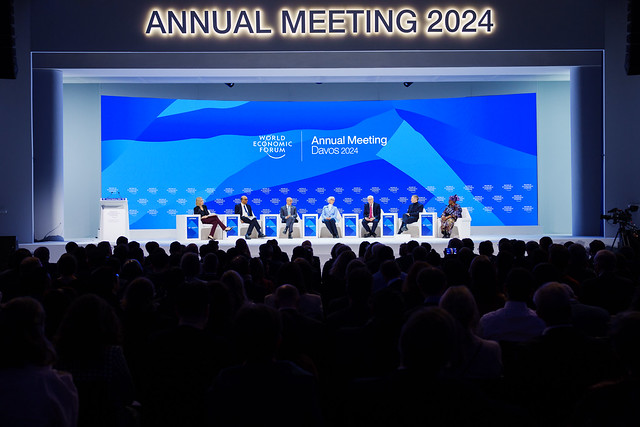
The featured image at the start of this post of Davos, Switzerland, is courtesy Flickr on WEF’s website.

 Peripatetic Perch