

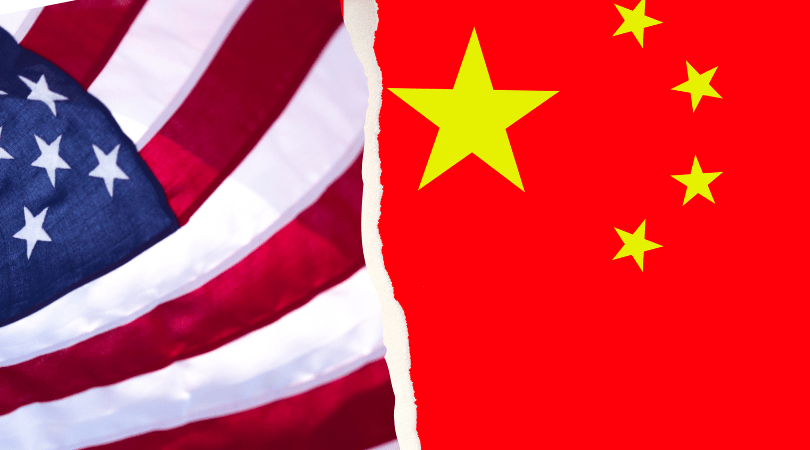
The current semiconductor competition between US and China is fast threatening to morph into a larger Cold War of the 21st Century as I have written before on my blog. It is part of the continuation of the Trump-era tariff and trade wars that the two superpowers engaged in, in a tit-for-tat raising of tariffs on a wide range of goods traded between the two countries. Even just the two superpowers engaging in such a trade war is bad enough and has global implications for the rest of the world. To make matters worse, UK and Europe were dragged into this anti-China camp, both by Trump and by Biden in different ways. The main difference was that in Biden’s regime, it turned into a coalition of democracies against China. My country, India, too joined the bandwagon.
Why the health of the US-China economic relationship matters
To understand why the world cannot afford another Cold War between the US and another superpower, China this time, we need to understand the basis of their economic relationship, when things were going well. Since Deng Xiao Peng’s economic liberalization policies of the late 1970s, China opened up its economy to the world, and boy, did the world rush in! Through the subsequent decades American multinationals and other MNCs from around the world decided to set up factories in China, not merely for export, but to ultimately serve the massive Chinese market.
This was the birth of globalization in the modern world. A force that led companies and governments to seek expansion and new markets with a vigour not seen since the days of Empire. The main motivation was availability of cheap labour, enabling multinational companies to save hugely on production costs, while exporting to markets around the world from Chinese factories. The US and Chinese governments negotiated trade agreements that lowered tariffs on both sides and as a result, even the American consumer benefitted hugely from cheaper Chinese imports. Everyone was happy.
Multinational corporations also had an eye on the growing Chinese domestic market and the growing Chinese middle-class consumer. And while total trade in goods between the two countries ballooned from US $ 7.6 billion in 1985 to US $599 billion in 2015, according to the US Census Bureau, the Chinese government amassed huge foreign exchange reserves, bulking up on US debt. It soon became America’s biggest creditor owning US $ 1.26 trillion of US treasuries in 2015. The result is a massively tangled bilateral relationship with both countries hugely dependent on each other, economically.
Unequal superpower influence
As we all know by now, problems arose when the US and other western countries expected China to also liberalise politically, which hasn’t materialised till date. China adopted capitalism, but as it always likes to say, with Chinese characteristics. And state control is an integral part of it.

I think that problems were magnified because in the opening up of the Chinese economy, many more countries around the world also benefited economically. Countries from Latin America and Africa, to those in Asia and East Asia were all beneficiaries of China’s meteoric growth. US has been feeling its hegemony weakening, both economically and politically and is under pressure to act. Or to react. Some of this is certainly showing up as loss of American influence in several poor and developing countries, where China has invested heavily and also lent to, massively. While concerns around the increasing indebtedness of some of these countries to China are legitimate and must be addressed on a priority basis, there is no denying that America is under pressure to reassert itself.
America First redux
In such a situation, you would expect the more established superpower to find ways to engage better with the rest of the world, including with China. However, the 2008 Financial Crisis preoccupied the US and other western countries to such an extent, that they hunkered down and focused on the health of their own economies. While that was much required, it finally hit home that in all the happy go-go years of their globalization around the world, especially with China, they had not prepared their own people for the consequences, or for how to overcome new challenges that globalization presented.
This was most manifested in Trump’s regime, when he decided to take the economic competition to the Chinese, through a trade war. Obsessed with US’ trade deficit with China, and playing to his voter base, he led the US and other western countries into a confrontation with the Middle Kingdom. I had hoped that things would change with the Biden regime and the Dems back in power. Alas.
Biden has only chosen to toe the Trump line and policies, when it comes to China. It is now not merely America First, but Only America. I thought some of his intransigence when it came to China was more posturing for domestic audiences, especially in order to get bipartisan support for his spending plans. He was already talking of a coalition of democracies (read western allies) to take on China, when Russia attacked Ukraine in 2022 and there was the prospect of China doing the same in Taiwan.
Technology, the ultimate power
I am not so easily convinced that the US is engaging in this technology competition with China, in order to protect the interests of Taiwan. In fact, after the Covid pandemic exposed the deficiencies of the global chips manufacture and supply system, it has been widely recognized and accepted that the world needs to diversify its semiconductor supply chains in order to avoid depending so heavily on any one country or region. And the US plan to intensify chip production at home is likely to adversely affect Taiwanese companies.

I think Biden’s regime is leading America into a tech war with China because they recognize that technology is the ultimate power in today’s world and will be even more powerful in the future. On the one hand, this has fantastic opportunities for the world to solve several of its most pressing challenges. On the other, it has frightening prospects for the world, considering that so much of this new technology powers defence equipment and will fuel the arms race even further. Even without the arms race, it is believed that just the new world of chips and AI is enough to power the growth of economies.
In this sense, AI and chip-enabled technology growth will fuel economic growth as well as defence capabilities simultaneously and America seeks salvation in this conjoining of two powerful forces. And although we are living in different times from when Paul Kennedy wrote his famous book, The Rise and Fall of Great Powers, the central premise that countries need economic growth before building or asserting their military might, would still hold water.
Watch out for Chips Act, Part 2
If you read about the US CHIPS Act passed in October 2022, you are likely to think that it is a purely economic policy intended to improve the competitiveness of the US economy. That would be only half the story, however. America wouldn’t be spending US $280 billion – that too at a time of economic recovery from the pandemic – on domestic manufacture of semiconductors merely to be self-sufficient.
It seeks to build and strengthen capacities in the US on everything from studies in STEM and computer sciences, R&D in semiconductors and chip manufacture, to its uses in defence and many other related strategic areas of national security. McKinsey has outlined the allocation of resources under the US CHIPS Act 2022, and you can see that most of it goes into research, especially through the National Science Foundation. Carnegie Endowment for International Peace writes about how the spending through the US CHIPS Act can better deliver the goals it seeks to achieve, by focusing more on the assembly, testing and packaging parts of the chips supply value chain (ATP), rather than merely the fabrication.
Where I tend to agree with their recommendations is in the need to set global standards for the industry, while diversifying semiconductor supply chains. That brings me to my next point on regulations and standards.
Global supply chains need global regulations and standards
The fact that the US leads the world in information technology especially in the new AI technologies and chip design and manufacture doesn’t mean it owns the field and can play by its own rules or change them as it pleases.
And this is where the other half of the story comes into the picture. If the US is increasing its own economic competitiveness especially in technology, nobody can or should have any arguments against it. However, if it is also banning the sale of certain high-end semiconductor technology to China at the same time that it is passing the CHIPS Act at home, it is obviously in a confrontation with a competing superpower that is said to be very close to the US in developing new AI and advanced semiconductor technology of its own.
I see the US CHIPS Act as a new and important addition to the same old US strategy of decades, to try and contain China. Recent visits by high level US officials to China is a good sign, but I am not sure how much substantive change these are likely to bring, unless there is a change in policy as well.
It has also been reported that most of the technology under the ban or embargo, are necessary for China to fulfill its part of the semiconductor assembly and manufacture for the world. Therefore, what the US is attempting to do is reduce China’s capabilities in this industry, so that the US can power ahead and corner most of the world market for itself.
CSIS (Centre for Strategic International Studies) has mapped the global supply chain of chips and semiconductors and you can see how intricate and complex these are involving many countries, most of them in east and south-east Asia. With the growing divide between the US and China, it is very likely that the world might be faced with two very different technology systems and standards in the near future. Countries that are all part of this global supply chain – and more that might follow, including India – cannot be expected to take sides in a spat between two superpowers. This will be the undoing of the globalized, interconnected world of economic cooperation, business ties, trade and investment that has delivered an additional US $ 50.9 trillion of global economic growth, created around 1 billion additional new jobs in developing countries, and taken over 1 billion people out of extreme poverty since 1990.

Diversified supply chains, unified standards
When tiny semiconductors are as ubiquitous as they are in everything from a mobile phone and computer to smartwatches, wearables and washing machines as well as bank payment cards and cars, and are only likely to be present in ever more ways in our lives, does it make sense for two countries to be at loggerheads over the manufacture and supply of these? Nope, but when you consider that they also power drones, military tanks and fighter jets as well as missile systems, they become strategic suddenly and assume importance of nationalistic proportions.
The same was said of computing technology in the last century. And of communications technology, including telecommunications technology. And of nuclear technology. Today these are widespread around the world bringing huge benefits to people from the Americas to East Asia.
We need to do the same with semiconductor technology and AI. So much of new technology, especially to do with the internet has gone unregulated, simply because the world’s greatest superpower, America, cannot get its act together. And now they are threatening to go into another Cold War with a superpower, when it is a completely changed world from the previous one. Now, the non-availability of a chip, or an app from one corner of the world can have disastrous consequences for people in another far-flung corner of the world. That is how much globalization and the internet have connected us.
Just as the world was able to come together then and agree on common rules and standards for the use of computing and communications technology as well as nuclear technology, in times of peace and in war, we ought to be discussing common global standards and regulations that the entire world can abide by. Perhaps this ought to be taken up under the aegis of the United Nations, and soon, so we can avert another Cold War as well as a military one.
The world has too much to lose from fighting over chips.

 Peripatetic Perch