

In recent days and months, there’s been plenty of excitement in India over the various trade deals we have been inking with several countries around the world. The biggest ones are the more recent trade agreements with the EU and with the US. Actually, many believe that it is the former that led to the latter which, by the way, is still not a done deal as the final agreement has yet to be signed by India and the US. And with Trump in office – which is the reason for the high tariffs – there can be many a slip between the cup and the lip as the days progress.
The latest wave of breathless euphoria is over the US announcing an immediate lowering of the 50% tariffs to 25%, on account of India agreeing to stop buying Russian oil, according to Trump. Though no one in the Indian government – least of all our Prime Minister – has confirmed this as yet. In fact, the latest on the Trump tariffs is that the Supreme Court in the US has struck them down saying that they are unconstitutional, though Trump will still try some other route to push through his tariffs. All of this still strikes me as the global circus of unprofessional PR agency idiot bosses and their political nonsense as well as their wheeling-dealing.
I would like us to step back and see all this in context and proper perspective. For some reason known only to the BJP, the NDA government has been obsessing over growing exports from the time they came to power in 2014. They initially professed a serious intention to make India emulate China’s SEZ policies, except that they forgot that India is not China. The only industry in which SEZs have worked in India, and to a limited extent, is information technology. Later, perhaps a few pharmaceuticals-focused ones. Otherwise, this SEZ obsession is a non-starter and we ought to be thankful that we are not building an export-led SEZ-based economy like China. One has only to see the Chinese economy right now that is struggling to boost domestic consumption, to know what the perils of being an export-led economy can be. Their economic growth these past two years since reopening it after the zero-Covid policies, has come only from exports and that too because of overcapacity in certain advanced and high-technology industries, as I have written on my blog. Of course, their real estate sector slumping has also contributed to weak consumer sentiment, which is yet another structural issue that China has to deal with, as I have written as well.
I have always believed that for a large domestic economy such as ours, pursuing an export-led growth strategy would be inappropriate. We need to generate and cater to local consumption demand first which, incidentally, accounts for 60% of our GDP. We ought to be thankful for this and pursue policies that do not damage or sidetrack this, but augment this with better jobs and living standards, on an economy-wide level.
That said, growing our exports to a higher share of GDP and becoming part of global supply chains is a good and sensible idea. Not because we wish to boost manufacturing – another obsession of unprofessional PR agency idiot bosses and the government’s – but because it would help us move up the value chain and improve our competitiveness in new and important industries. If we are to follow through on this objective, India must also rationalize and lower import duties on certain types of intermediate goods and on capital goods.
In this regard, I must mention the few important areas that stood out to me from reading the Indian Economic Survey 2025-26. In a chapter on industry titled Industry’s Next Leap: Structural Transformation and Global Integration, I was struck by the fact that India is one of the few countries/regions that is experiencing good manufacturing growth along with China and Africa, in 2025, and that there is a shift towards higher value-added manufacturing as well as higher technology products, according to UNIDO and UNCTAD cited by the IES (Indian Economic Survey)
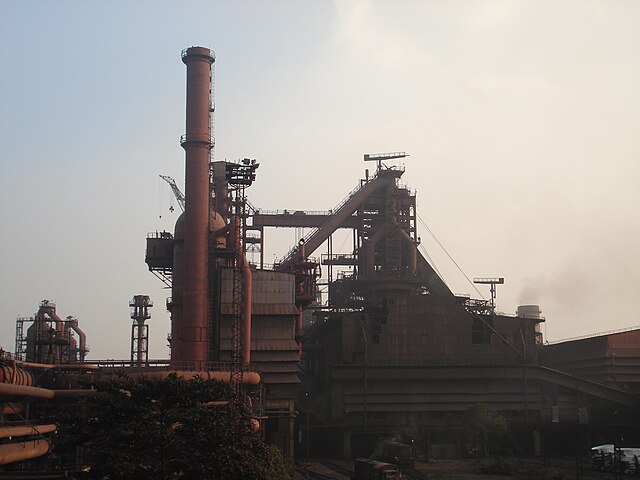
However, there is one aspect of our measuring industrial production and manufacturing activity that ought to improve: we must measure and report capacity utilization as well as productivity on a regular basis. When I look at the industries cited in the survey, it seems to have been done from the exports point of view; we must view industry not only from the exports angle but from domestic demand as this is where the strength of most of our industries lies. When looking at the core industries, for example, I find that with the exception of cement, there are imports in almost all of them, and in the case of steel and refined petroleum, we have exports as well.
In many of the industries, there is plenty of scope to increase R&D and innovation in newer, more advanced and superior product types, such as cement that can withstand extreme weather events which are a common occurrence in India and around the world, and another type that can withstand earthquake tremors as the entire northern belt in India falls in the high seismic activity zone and we need to better prepare for such calamities. After the earthquakes of Kobe and Kyoto, Japan did plenty to vastly improve their construction materials as well as structure designs to withstand earthquakes better, and it has stood the country in good stead. Similarly, in steel, I see only crude steel and finished steel featured in the Survey; what about specialty steels where India can innovate and again produce superior products that can serve the needs of climate change, among many others. Capital goods is an area that stood out to me as too reliant on imports, even though production is growing. Here as well, there is R&D possible to innovate and produce better quality capital goods domestically, including in partnership with international companies.
This brings me to the subject of why India, therefore, needs foreign direct investment. Even as we export more and trade more with other countries, India needs to attract long-term FDI as business investments that help generate employment and more importantly, help us raise the level of our technological capabilities. There are two ways in which a country can raise the level of its technological capabilities: a) through increasing one’s own R&D and innovation efforts and investments and b) through increased FDI in certain industries that allow for technology transfer and technical collaboration besides equity participation. Both are required in India at this juncture, and the latter will help to diffuse new technologies throughout the Indian economy faster. This could be particularly useful in new and nascent industries, where international companies have the technological expertise and the advantage in terms of commercializing their product innovations. These could be in industries such as cyber-security, quantum computing, clean tech including carbon capture and storage, and a host of others.
The World Bank in its World Development Report 2024 argued that low-to-middle income countries need to make huge investments in new technologies, allowing them to diffuse through the economy before innovating, in order to overcome the middle-income trap. In the case of India, we are already innovating in several areas of technology and enjoy strengths in engineering and technology that help us keep pace with the rest of the world. And inviting FDI and foreign know-how is not new to us; India built its state-owned steel industry at the time of independence by collaborating with American, German and Russian technical know-how and these helped build the nation’s capacity for economic growth. It was not mere import-substitution, but a way to gain technological knowledge and capabilities, so that India could move forward independently.
India has been attracting FDI since the start of this century. It seems to have picked up pace in 2006-07 and later again from 2014-15 onwards, according to this FDI fact-sheet from DPIIT (Department for Promotion of Investment and Internal Trade) and is reported to have reached US$ 50 billion in 2025. The 2008 Financial Crisis and the Covid-19 pandemic impacted trade as well as FDI inflows into India, but not to the same extent as many other economies suffered. According to what I read in the Indian Economic Survey, DPIIT’s fact sheet as well as on RBI’s website, FDI inflows slowed considerably during 2022-23 and 2023-24, in the post-Covid period.
The more important statistic to look at is the net FDI inflow, since in recent years, Indian companies have also been investing overseas in order to grow their businesses and globalize their operations. In this regard, India is performing poorly. The Indian Economic Survey says that FDI inflows into India slowed in the past couple of years, in line with the weakness seen in FDI flows around the world. It cites an UNCTAD report that says global FDI flows declined by 11% in 2024, driven by a 58% decline in Europe and a 29% decline in China. The IES also says that while FDI declined by 2% in India in 2024, it remained the largest recipient of gross inflows in South Asia and surpassed countries such as Indonesia and Vietnam. This is why we need to look at net FDI inflows, which had gone into negative territory, as outward FDI from India increased in FY24, FY25 and through FY26. Since then, net FDI in India has just about turned positive, but after adjusting for repatriation – which have increased – and for outward FDI by India, the IES says that net FDI for FY25 was just US$ 1 billion. This amounts to a mere 0.024% of FY25 nominal GDP of US$ 4.13 trillion. This is not a good state for foreign direct investment to be in, in the fastest-growing, and fourth largest economy in the world.
In recent years, there has been a growing trend of MNCs opening global capability centres or GCCs, as they are called, in India. Many of them have also started global research centres in the country. This is a welcome development, in the sense that it creates plenty of high value-add, and high-tech related jobs in India. It appears that most of these are in the services sector, and many operate in SEZs. To this extent, they are not threatened by Trump’s tariffs. What’s more, this is a good way to avoid attracting the ire of anti-immigration folk in America and other western countries. However, GCCs are still another form of offshoring, even if the offshoring operation is part of the company’s own operations. And to this extent, it is still labour cost arbitrage, and perhaps doesn’t bring in as much foreign exchange earnings for the country as regular outsourcing/offshoring does in the IT industry. GCCs also do not add to the technological capacity or capabilities of our country, even if they provide much-needed jobs to our educated engineers and programmers. The danger is also that it could lead to greater brain-drain from India, as the MNCs might offer these GCC workers better job prospects overseas.
That said, it is still a good development and a sign that there is global demand for Indian talent and skills. Besides, I think the GCCs might employ our workers’ knowledge and skills in new areas and widen and deepen their exposure to working with the latest technology and practices. And in this context, I must mention the area that I see huge opportunities for our engineering and technology strengths as a nation, in high-end engineering design and consultancy. I have written about this before, even though I am not an engineer or a tech professional; I see this purely from the way technology has intersected with engineering and the servicification of all these areas. Apparently, India has been building a competitive advantage for itself in semiconductor design; this clearly signals that the area of high-end engineering design and consultancy is ready for exploration and investment.
So, India must consider increasing long-term FDI inflows into the country, in addition to growing exports and integrating with global supply chains, as well as GCCs. Trade deals are good to grow merchandise exports mainly, and GCCs work to export our brain power and talent in services, but we also need FDI to increase our technological capabilities at a deeper level and become more future-ready. With a weakening Indian rupee and a persistent CAD (current account deficit) that is -1.3% of GDP at the moment, India needs long-term FDI and a higher net FDI inflow as well.
The FDI fact sheet from DPIIT doesn’t tell us how many M&A deals for inbound FDI were executed in recent years, but this article from The Economic Times says that 2026 might be a better year for mergers and acquisitions, given the policy reforms that have been announced recently. However, the article also says that local M&A deals favouring consolidation in India and outbound FDI from India have been the larger components of M&A activity in the country. It does say, though, that although the number of inbound M&A deals had reduced in the past few years, sizes of the investments were larger in 2025. In recent years, India hasn’t had a very good record with international M&As with many of them breaking up, because the foreign firm decided to exit the market. And overall, I think our experience with joint ventures and M&As with Asian firms from Japan, South Korea, Singapore and even China have done better than those from western countries. Perhaps Asian firms are more patient and are willing to invest for the long haul.
The other area to note is that India still attracts FDI mainly in financial services, business process outsourcing, computer software and hardware, trading, telecommunications and automotive industries – the clear favourites for many years. We need to start attracting FDI – with technical collaboration – in new industries, where we need to build our capabilities. Clearly India’s industry bodies and the government must find a way to direct FDI better to these new industries, and I think this would be best done through bilateral agreements, requiring government’s active role in this exercise.
Time then, to focus on raising inbound FDI of greater technological capacity in new areas, for India to be future ready. This would accelerate our journey to developed nation status by 2047.
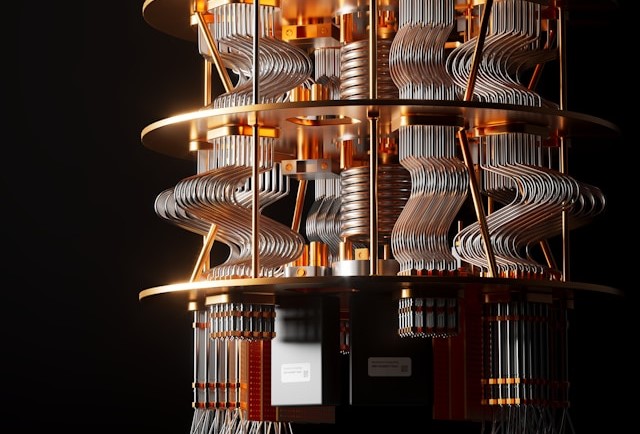
The featured image of a quantum computer is by Planet Volumes on Unsplash

Post script: I must mention that when I first read the World Bank’s Development Report that I have shared in this article, the Report talked of diffusion of technology, not infusion. And this report has once again been turned into a question-answer format, like they did with a CSIS article on China Industry 2025 that I had cited long ago in one of my blog posts. Unprofessional PR agency idiot bosses’ meddling with economic data, with governments and with organizations, both domestic and international, is out of control!
 Peripatetic Perch