


It was long overdue. In fact, GST should have been launched in 2017 with no more than a couple of slabs. Ideally, it should have been just one at 18%. But in a country like ours where most of the population can barely afford even the daily essentials, perhaps a rate of 5% on some necessities is warranted. Anyway, I have been writing more recently on how GST on cars ought to be reduced from 28% to 18% and how even more generally speaking, a lower GST might be beneficial as it would boost consumption in a non-inflationary way. Glad the government has finally seen sense in reducing GST across the board, and we now have to cope with just two slabs at 5% and 18%, except for luxury and sin-goods that are still taxed at 40%.
One of the biggest beneficiaries of this GST rationalisation are buyers of cars and manufacturers of cars in India. Actually, the entire range of automobiles stands to benefit, including tractors on which GST has been reduced to 12%. I shall focus on passenger vehicles such as cars in this blog post and how companies can take advantage of the cut in GST. The most obvious step is to lower prices, which all car companies have done, and it helps that the GST rationalisation announcement came at the start of the Navratri festival in India. I thought that we might miss this year’s festive season, but the government’s decision was swift as it was decisive.
The first and biggest advantage of the lower GST rate on cars is that it will open up the market to millions more customers who had perhaps been waiting to buy their first car, but found the costs exorbitant. This is the reason that the small car market had almost completely collapsed in the past few years in India. Now there is renewed hope that millions of first-time car buyers and others will be able to afford their own small car. For a large country such as India, passenger vehicle ownership by households in terms of market penetration is still extremely low at around 16-17% from a quick calculation that I did though there are no reliable numbers available online, or Google wouldn’t serve me the right search results. In terms of volume growth, therefore, nothing can beat this segment which had all but vanished. Therefore, car manufacturers operating in the mass car market, ought to seriously consider this opportunity to think afresh.
Fresh impetus to the small car market in India
Because the GST on cars of 1200cc capacity and 4m length and below, has been reduced to 18% and cesses too have been done away with, it is the small car segment that stands to gain the most. These can be of petrol, CNG or LPG variants, and therefore there is also a chance for companies to push the cleaner fuel variants more than petrol and diesel, and encourage the shift to clean energy. I was surprised to learn that CNG cars sell in large numbers in India, and I think this might be bought more by taxi fleets and ride-hailing companies. However, I don’t see why it shouldn’t be popular with regular owners of private cars, if the idea is sold properly to them. Until now, I have not seen any car company actively pursue this as a brand or marketing strategy. I think there is a huge opportunity here.
This has to be seen in the larger context of India’s urban landscape and how we can plan better for the future. Our towns and cities are already clogged with vehicular traffic and we don’t want to be exacerbating the problem of congestion as well as pollution. Of course, this has to work in tandem with our towns and cities developing better public transport infrastructure, especially the metro rail. Once metro rail has perfectly connected every corner of our towns and cities, it would be time to educate our citizens on driving less and taking the metro more often as people do in large metropolises all over the world. Owning a car doesn’t mean having to drive it every day; we Indians have a long way to go in learning how to live the “metropolitan” life. Then again, the traffic snarls in our cities at rush-hour is already so bad that we might just realise on our own that it makes more sense to take the metro for the daily work commute.
Next, I think it’s a chance for car companies to rethink this small car segment entirely. We don’t have to stick with the hatchbacks, cross-terrain, small sedans, and compact SUVs of the past. Since GST on car components and parts has also been reduced to 18%, there are significant cost savings to be had which car companies can either pass on entirely to customers, or use intelligently to offer greater value than before to small car buyers. Perhaps compact cars can now get sportier, or have a navigation system, or better trims, etc. This is also a great opportunity to address women car owners as a separate segment and offer them mobility like never before.
What I am saying is that companies should approach the small car, the mass car, in a completely fresh and new way. Both in terms of target audience and their aspirations as well as design and functionality. Time to go beyond just lowering the price, though the lower price on account of the GST rationalisation is what will initially bring back the new car buyers. However, in order to keep customer interest alive and sustain the momentum, it is better that car companies rethink their small car offering and its brand positioning.
More competitive pricing for India-made cars
Car companies in India can now pursue more competitive pricing of their vehicles both in the domestic and international markets. For the same reasons that the GST on all components and parts – including tyres – have been lowered to 18%, car companies now have much more leeway to rethink their product portfolio and its pricing. The competitiveness of Indian cars in overseas markets should also improve as a result.
More pricing strategy options for large and luxury cars
This leeway and extra wiggle room in pricing of cars and designing new models is also available to makers of larger cars in India, including in the luxury segment. Here too, what is standard equipment can now be rethought to offer customers greater value. Though larger cars (above 1200 cc and 4m length) are still taxed at 40%, the absence of cesses will now bring down their overall prices moderately. The makers of cars that are mid-size or large 3-box sedans such as Honda City, for example, might decide to lower prices a little in order to be competitive. While luxury car companies might offer greater value to their customers for whom price is no object anyway. This will also help to grow their sales.
It is also perhaps time to ask if we can expect a home-grown Indian luxury car brand, as a result of the GST rationalisation. In my thoughts and ideas for Tata Motors and JLR on my blog, I had written about the possibility of JLR helping Tata Motors design and develop premium and luxury sedans meant for the Indian market.
A chance for SUVs to redeem themselves
I am personally not a big fan of SUVs as they tend to be gas-guzzlers, although they have been growing in popularity in India and all across the world. And even if I have shared my thoughts on Land Rover on my blog, I think that it will be interesting to see how SUVs respond to the GST cuts in India. I hope they will improve their mileage, as also make them in CNG or LPG variants. So far, my impression is that it’s diesel SUVs that dominate the market because their running costs are lower; on the other hand, diesel is a dirtier fuel especially in India.
The marketing of cars in India needs to catch up
This is the part I am most concerned with and most interested in, as an advertising professional. And as I have been writing on my blog, most of the communication for cars in India – and overseas – is awful. Not merely because it is commonplace, but because it treats the customer as a nondescript and passive entity. And I think this is because most car brands in India do not have a clear strategy in place. Car companies seem to think that by just designing and launching new models every few months their job is done.
No, I am sorry to say the designing of cars ought to follow strategy. And it is strategy that determines car models, their branding, their design and functionality, and of course the brand’s positioning in customers’ minds. As I have also said often before, car companies are the automotive brands, not the models they introduce. All the more reason why it is important to focus and devote enough time and attention to overall brand strategy, before rushing to launch that next vehicle in the market.
In the context of the recent GST reduction, I have been seeing a slew of adverts from car companies announcing festive offers. None of the communication distinguishes lower prices on account of GST from festive offers and not much thought has gone into creating them. Perhaps companies have merely passed on the benefits of lower GST to customers, as festive offers. This is to treat customers as idiots or morons. Instead, car companies could have chosen to communicate in one of two ways:
- Persuade customers to advance their plans of buying a new car now that the prices are lower than before
- Persuade customers who are considering a new vehicle in the festive season that their cars make the most sense.
I hope the difference between the above is clear; the first addresses customers who are not decided yet on buying a new car but are planning on a purchase sometime in the future while the second addresses people who are considering purchase during the festive season and who need to decide which one.
Either way, it would still require companies to tell customers why their cars are a better choice than competition; therefore, a brand selling proposition is still required.
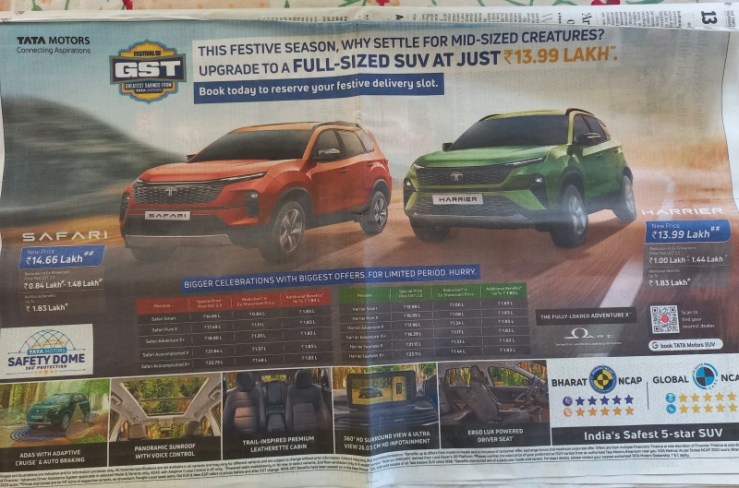
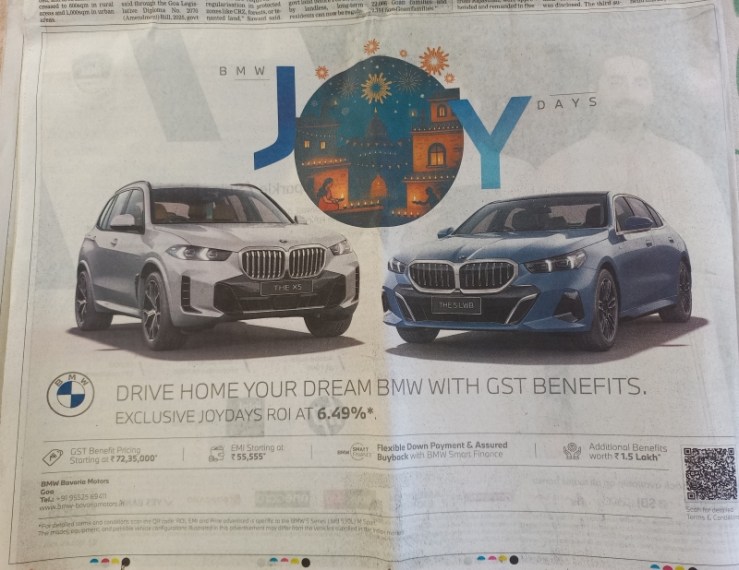

Instead, what I saw in the newspapers were adverts created and motivated by unprofessional PR agency idiot bosses that were full of their usual colour-coded nonsense and perverted and vulgar references to women’s appearances and bodies. These were especially true of adverts for Tata Motors and BMW, both of which I suspect were prompted by the same set of PR idiot bosses as they reflected similar thinking, if there was any thinking at all. The red and green cars Tata Motors advert was followed by the BMW grey and blue advert the next day, followed by the grey and red Tata Motors Punch advert on the third day. The colour-coded nonsense is in reference to some of my sarees, and the way the cars are depicted are complete PR agency idiots’ vulgar mischief and proves why I say they are unfit to be in the corporate world and ought to be booted out of the industry. What the marketing folks at Tata Motors were doing allowing such work is anybody’s guess! Then, if BMW is communicating joy days, Mercedes Benz is talking of dream days! This is the pathetic level of competition between these two rival international luxury brands.
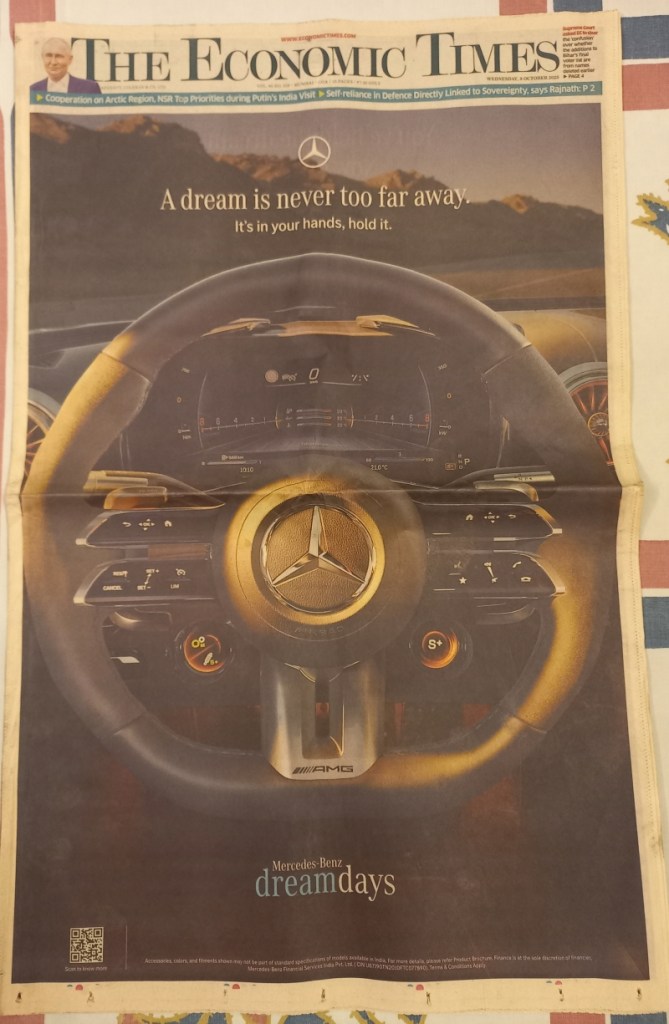
As I said, it reflects a complete lack of strategy for all of these car companies and brands. Until they get back to the drawing board and rethink their strategies, I suppose we will see more of the same. But car sales through Navratri festive season went through the roof, so why bother? And by the time car companies get their act together it might be time for the next price hike which is usually at the start of every year. In my reckoning, car manufacturers would be squandering all the advantages of GST rationalisation that I have outlined in this article, if they don’t take remedial action soon.
The featured image at the start of this post is of Bangalore evening traffic by Umar Andrabi on Pexels.

Post script:
Since I had shared my thoughts on Mercedes-Benz brand strategy and ideas on my blog some time ago, I thought I would share a couple of quick thoughts that I had on the kind of advertising they could do on GST cess cuts timed with the festive season. This is merely to illustrate what I mean when I say that the festive season is the most important season for car purchases in India and therefore the adverts don’t really stress on the festive season, but hint at celebration all the same.
More important is Mercedes-Benz’s engineering and the luxury aspect. You can see how these adverts stay on strategy and message when you compare them with the main brand campaign that I had shared earlier on my blog. Frankly speaking, Mercedes-Benz and other car brands ought to also have TV advertising during the long festive season in India but I don’t see any on television except for Skoda’s Fan-Fest which tries to hint at the main brand campaign and MG’s Windsor EV Pro which is totally focused on product.
Having shared my thoughts on how the UK Royals can build their brands, I think branding any product or service as Windsor is a problem. The UK Royals need to register Windsor, as I had suggested in my blog post. And perhaps MG Motors ought to rebrand their vehicle.
The images I have used in the festive adverts for Mercedes-Benz are from Unsplash and Mercedes-Benz’s own website.
 Peripatetic Perch