


It’s been a long time since I last wrote on the UK and the EU economies, which was just around the time of their elections in 2024 and not since then have I considered how they’re faring. Of course, France had its own very consequential election soon after the EU elections, and the big one coming up is in Germany on February 23, 2025. As Europe’s largest economies and the ones that steer the EU ship together, it is important to see how this goes.
Of course, with Trump tariffs looming large on all economies, it is important to consider economic growth against the backdrop of what it will do to trade and investment. As of now, both the UK and EU suffer from weak economic growth, with inflation proving stubborn and with business investment weak as well. You might wonder why I am writing of these two economies together since Britain left the EU five years ago, when Brexit took effect. It shall become apparent later in this article why I think the two economies are still connected in many ways.
The EU, seized of the importance of improving its competitiveness, issued its EU Competitiveness Report, authored by Mario Draghi, former chief of the ECB, in September last year. It seeks to identify the problem areas for the EU economy and lay out policy proposals for remedying them, in order to improve the productivity and competitiveness of the EU as an economic region. There are two parts to the document which is rather large and detailed, and since there is no executive summary, I managed to read sections of it that I was interested in, as an outsider looking in. The three focus areas are
- Improving productivity through innovation and investment
- Decarbonising and increasing competitiveness
- Increasing security and reducing dependencies
I think these are the most critical areas for the EU to focus on in the next decade and beyond. However, I find the context for setting the strategy for EU competitiveness too focused on the US as a comparison and reference point. I mean, the EU needs to focus on these areas outlined by Mario Draghi for the sake of its own economies and the region’s growth, irrespective of how the US or China might be doing. While it is true that international investment takes place in a comparative context, the EU is in a different position from the UK, for example, in that it offers a huge market in its own right and one that is actually larger than the US in terms of consumers. The UK which I will come to later, on the other hand, is much more dependent on foreign investment that is likely to go to the US simply because the latter is a larger market to cater to.
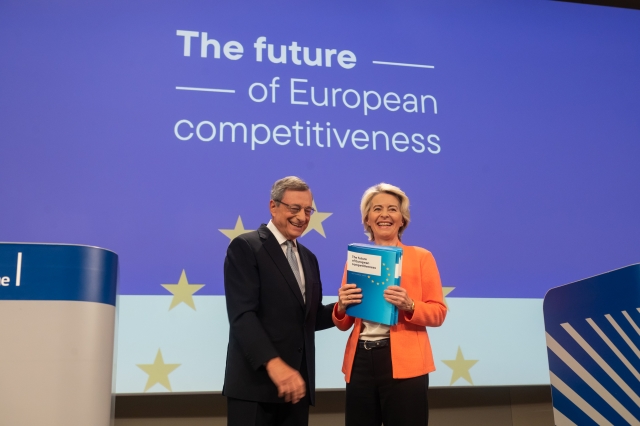
The report also points out the main disadvantages that the EU faces, in terms of lack of enough new technology and digital firms, the lack of a deep and large capital market, as well as the fragmented structure of the EU itself. These are aspects that the EU Commission President, Ursula von der Leyen, also addressed at this year’s WEF Annual Summit in Davos, when she also outlined the main decisions that the EU has taken to become a more competitive and innovative economy.
Draghi’s report also recognises another very important disadvantage that the EU faces and that is an ageing demographic, especially in western and northern Europe. Therefore, he argues that there is an even bigger need for the EU to double down on increasing investments in digital and other new technology as well as on innovation in these areas. This has two important components in my opinion – the need to strengthen the capital markets and unify them, as well as the innovation ecosystem.
I was surprised to learn that the EU has a European Innovation Council as well as a European Investment Fund. This is good indeed, but the funding support that they provide will have to be much larger, if the EU is to achieve its objectives sooner. Overall, Draghi mentions that an additional annual investment of €750-800 billion is needed, to meet the objectives outlined in his report. I think that might not be adequate, especially if it also envisages public funding support to new technology innovations at least in the initial stages, as well as the funding of new technology infrastructure that might have to be set up or upgraded, right across the continent.
Some interesting facts that he cites are worth greater consideration. That European households save more than their US counterparts, but they aren’t channeled into productive investments in the economy; Europeans therefore, have less wealth than the Americans, because their investments attract lower returns in the financial markets. Also, that four-fifths of the investment in the EU is undertaken by the private sector and government funding is only one-fifth. Government investment will have to increase, he reckons, to around 5% of GDP for a sustained period for it to reflect in economic growth. This would be in line with IMF recommendations as well, he writes. There will be some inflationary impact in the short term, but with total factor productivity improving as a result of the investment, the EU can manage it by keeping the costs of capital low. As it is, the ECB is on a rate reduction path, having lowered the key interest rate by another 0.25% at its last policy meeting.
How the EU can manage this across all 27 member countries is to be seen. Because it is important to not only raise investment and innovation in new technologies, but to make sure that these effects are diffused across the EU. Right now, capabilities in new and digital technologies exist in few countries such as Sweden, Denmark, Netherlands, Finland, Germany and Austria. I was surprised to see Belgium mentioned, and Netherlands left out; I would have thought it should have been the other way around. An interesting fact that Draghi mentions in the field of technology, is that China and the US have the leading edge in highly complex new technologies of the digital era such as AI, IoT, cloud and quantum computing, whereas the EU leads in relatively less complex technologies in the energy and transport areas such as wind, hydrogen and green transport. Therefore, an area of focus for him is also how the EU can build a similar kind of competitiveness in digital technologies, while also leveraging its strengths in energy through more cutting-edge innovation in clean-tech.
In the second part of his report which deals with detailed policy recommendations by industry, there is also a section which makes broad policy recommendations common to all industries. Here, in the chapter on innovation, for example, he writes about digital and green technologies together, and I suppose it is because of EU’s need for developing higher capabilities in clean-tech. However, he doesn’t attach the same kind of importance to biotech as in biomedicine which is also gaining momentum as a high-growth industry and requires digital technology as well. With EU’s strengths in the pharmaceutical industry, I thought it would be a natural and sensible progression to pursue and would also help develop EU’s digital technology capabilities.
What the EU must do is to ensure its energy security, what with its dependence on cheap Russian gas for so many decades having been hit badly. Digital technology, especially AI, is said to require vast amounts of energy and Europe will have to start preparing for such a future. However, with America having replaced Russia as the main supplier of oil and gas (45%-50% of EU’s needs), Europe will have to think about diversifying its supplies even more. Especially with Trump in office who will definitely produce cheaper oil and gas in his term, but is also likely to use his tariff tantrums to good effect.
Defence capabilities and EU’s security is another area of focus and EU member states do need to spend a higher percentage of their GDP on defence, not only to help Ukraine, but for the entire region’s security. The main focus of EU’s competitiveness must come from building capacity in new technologies to become more productive, competitive and dynamic as an economy, as well as to integrate member countries together in new ways such as a unified capital market, a common energy grid, etc. After all, the EU would like to attract investment to its region because of its large, single and unified market.
This is not true of the UK economy. It faces a different set of challenges on the economic front. Here too, economic growth has been anemic and inflation, although trending down, has been stubborn. The UK economy also needs to seriously upgrade and invest in its public services such as NHS, water supply and other infrastructure which are reported to have deteriorated in the past decade or so. After the landslide victory that the Labour Party came back to power with, they have to increase public spending in these areas, but also have to watch the large fiscal deficit as well as the debt. They don’t have much space to manoeuvre in, as I have written before. This means that the government will have to raise taxes as well as depend on borrowing. I haven’t had a chance to look at the mini-budget that the UK chancellor, Rachel Reeves presented in autumn last year, but I am sure more thoughts on fiscal consolidation and public spending will emerge in the main budget this year.
In the meantime, the UK government is said to have embarked on a new industrial strategy to increase investment, productivity and growth of Britain’s economy. I believe that the UK has announced several industrial strategies in the past decade, so one doesn’t know how this one is different or better. Anyway, from what I read on the UK government’s website, I think they are on the right track, focusing on the eight growth sectors of Britain’s economy, as also on addressing more and better paying jobs, and encouraging greater investment in the country.
The new industrial strategy was open for consultation in the UK and I happened to read economist, Mariana Mazzucato’s, piece on it, through Project Syndicate some time ago. She is of the view that the Labour government will have to get public-private partnerships right. Further, she writes that the government is better off focusing on making the entire industrial strategy mission-led, rather than growth sector-led. And she says that the UK government has five missions; I could only see three which are not missions but objectives: achieving net zero emissions, regional growth, and building economic security and resilience.
I am only an advertising and brand communications professional observing and reading all this from India, and I think the broad direction is quite right for the UK economy to try and achieve all this in the next 10 years. I think focusing on the high-growth sectors is also relevant, especially from a business investor’s perspective. However, the UK must recognize that along with its strengths, it has certain disadvantages which it must turn into an advantage or else, overcome.
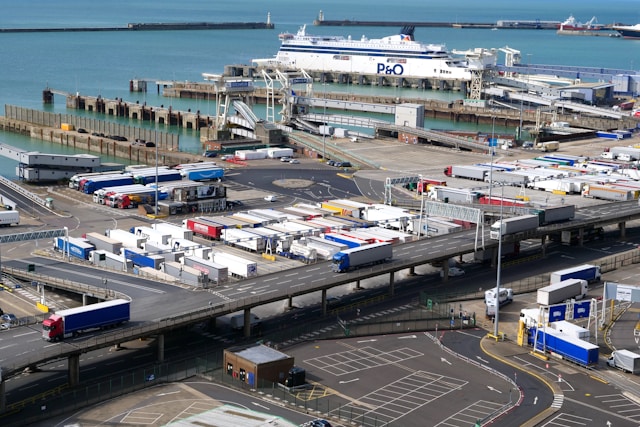
The main one is that Britain is a small island economy, in terms of population of only around 70 million, and therefore size of the overall domestic market is limited. Businesses in the UK therefore, have no option but to consider investing in order to serve the domestic as well as the international market, with more of their revenue and profits being generated by overseas markets. I don’t see any acknowledgement of this anywhere in the strategy and its implications.
Therefore, UK has to attract foreign and domestic investors, who would otherwise consider the US or Europe, both of them being larger markets to serve. In this sense, it is so different from the challenges Europe faces, the investment environment being much more comparative. There is another difference which UK could turn into an advantage and that is its strengths in digital technology as well as AI, relative to the EU. In fact, UK tech companies could consider expanding their businesses in Europe and perhaps helping the EU build its capacity in this area.
If we approach the industrial strategy from business’s point of view – which we must – then UK has to find even sharper points of differentiation from the US and the EU in its strategy, since that is the comparative framework. The areas of differentiation as I see them are:
- UK’s eight high-growth sectors
- The country’s strong research and innovation ecosystem
- UK’s favourable geographic position, ideal in order to serve EU and US markets
- Its time zone is already a well-accepted advantage, especially for the banking and financial services industry
In addition to these, the UK government will need to identify and hone in on the new and emerging areas of growth within the eight growth sectors, where Britain has advantages, and go all-out to invest in these new and emerging areas. The strategy document does talk of sub-sectors, but rather than getting bogged down by sectoral divisions, it might help to look at these new and emerging technologies and consumer needs of the future, more broadly. Many of these emerging areas are likely to be interconnected, especially since digital technology underpins all of new industry nowadays.
For example, bio-tech or bio-medicine, as I have mentioned in case of the EU as well. And I am surprised to see automobiles and aerospace not in the growth sectors, unless these have been included in advanced manufacturing which I find too vague a term. Britain has strengths in these areas, surely, which it shouldn’t give up, but build on. Britain’s JLR, Aston Martin, McLaren and Rolls-Royce are iconic companies and British brands, even if a couple of them are foreign-owned. Similarly, Rolls-Royce aviation engines, BAE Systems, and other British companies in the civil and defence aviation space ought to be encouraged to expand, innovate and invest in technologies of the future. Foreign companies in these industries too ought to be encouraged to invest in UK, since the high-skilled ecosystem for innovation and production already exists.
It is in deeper examination of the emerging needs and technologies of the future that Britain could find comparative advantage and invest in those now.
The document mentions eight investment zones or clusters that have been developed for the purpose of attracting investment from industry and I went online and had a look at them separately. Because one of the main objectives of the government is to achieve regional growth across UK, and because it doesn’t have a federal structure, these investment zones have been set up as a joint collaboration between the government in Westminster and the local mayoral/county authority. These are designed to work in partnership with business and local academic/research institutions in each region.
Each of these investment zones has an industry/specialization focus which is good from industry’s perspective. Some of them, it appears, offer tax benefits and others don’t. I don’t know exactly what kind of tax benefits and how it is all designed to work, but it brings me to my next main point.
Since Britain’s economy is designed to be an open one, linked to international markets for reasons I have mentioned already, the government ought to consider how they can reduce the costs of doing business and facilitate easier trade as this is critical to businesses investing in the UK. These would have become more complicated and complex since UK left the EU with Brexit five years ago, and the government’s focus ought to be on simplifying the processes and procedures for business. Meanwhile, in an economic update and forecast, the CBI (Confederation of British Industry) has forecast that while household consumption and business investment would improve in 2025, business investment is likely to slow down in 2026.
Furthermore, I think the UK government ought to also consider new and upgraded infrastructure that is again designed to make it easier to do business in the UK. Road, rail, ports and airports infrastructure, as well as energy supply and 5G broadband connectivity, etc. ought to be expanded. With UK producing renewable energy, it should be possible to lower electricity prices and at the same time Britain can consider importing surplus geothermal energy from Iceland next door.
Finally, no strategy is complete without offering an advantage on costs of doing business – in this case in comparison with the US and with EU. Incentives such as tax benefits, employment linked schemes and others related to pensions, capital gains, import duties, tariffs, etc will have to be considered more carefully. Perhaps we will hear more on these areas in the Spring Budget of 2025. These policies ought to be crafted carefully, as they should remain in place for the next 10 years since the industrial policy is Invest 2035. Businesses like certainty and a predictable environment, and so do the financial markets.
Finally, the reason I write about the UK and EU together is because their economies are linked in many ways. Besides 41% of British exports going to the EU, Britain has a services surplus with the EU. The EU, like the US and the rest of the world, will continue to be important markets for Britain. I am glad that UK has joined the CPPTP (Comprehensive and Progressive Agreement for Trans-Pacific Trade Partnership) and I hope it will reset relations with the EU. An arrangement like the one Norway has with EU (EEA) or a customs-union would benefit both economies immensely at a time of rising geo-political tensions and fragmentation around the world.
The featured image of St Pancras International Railway Station in London is by Frederic Koberl on Unsplash

 Peripatetic Perch