


In my previous blog post I wrote about how changes in politics and geopolitics the world over can impact the global economy this year and the next few years at least. Now that the Annual Spring Meetings of the IMF and World Bank have concluded, I thought I’d write about how they see the world economy and what I think is important for it to grow at a good and sustainable pace.
While the IMF has raised the forecasts for global growth for most major economies and regions this year, they and the World Bank warn that global growth has been the slowest in a couple of decades. Although they don’t say it in clear terms, it appears that the lingering effects of the 2008 Financial Crisis, the Euro Crisis as well as the Covid-19 pandemic are still around.
Going ahead the IMF is of the view that advanced economies are likely to accelerate their economic growth while emerging and developing economies are likely to slow down in 2025 and possibly beyond. They don’t offer any reasons or explanations for this prognosis, though they do say that advanced economies will also bring down CPI faster than emerging and developing economies.
While I do not wish to get into this “advanced economies vs emerging and developing economies” comparison or competition and the way it is being framed by the IMF, I do think that inflation is of different kinds, depending on what is primarily causing it. Inflation in emerging and developing economies is usually goods-led and reflects supply-side constraints, especially for those economies that are dependent on imports. The strengthening of the US dollar for the past couple of years has also been putting pressure on the currencies of emerging and developing economies, making imports more expensive and fuelling inflation. As world economies stage their economic recovery post the pandemic while at the same time controlling inflation, the cyclical improvement also puts pressure on commodity prices – even with China’s slowing growth – and that too impacts emerging economies in different ways. Commodity exporting countries in Latin America and in Africa might gain from this cyclical recovery for a while, while those importing commodities such as my country, India, as well as China and many east-Asian economies will feel greater pain in being able to control inflation.
Strangely, the big concern of EMDEs (emerging and developing economies) which is their high and rising debt levels is not flagged off as a concern in the WEO April 2024 document. I usually always read the summary of these reports, but this time the document – of four chapters – covers global prospects, the housing market, lack of business investment and low productivity, and the effects of trade spillovers from emerging market economies many of which are GVCs.
I visited the World Bank Group Spring Meetings website and found that the entire meeting has been turned into a PR event exercise and a talking shop. No prizes for guessing which unprofessional PR agency idiots from India might be behind this. Did they think that the WB Group Spring Meetings is another WEF Davos Summit – which the same unprofessional idiots ruined this year – or a networking event? You may see the schedule and watch some of the conversations or discussions if you like.
Returning to the April 2024 WEO, chapter 3 on declining levels of investment at firm level and the resulting fall in total factor productivity struck me as curious. Does IMF mean to say that this is the chief reason why economic growth has been slowing for most of the past two decades? If so, and if this is indeed true, it needed greater emphasis so that policymakers can take appropriate action.
I am not sure to what extent this has contributed to falling and slowing growth, but I have observed over many years especially since the 2008 Financial Crisis that media reports spoke of how many MNCs had piled up profits – including in tax havens overseas – but were not investing them. Instead, companies were increasingly resorting to returning money to shareholders and in frequent share buybacks. With easy monetary policy prevalent at the time – just as now during the Covid pandemic – stock markets soared, investor wealth increased, but economies were still not reviving quickly enough. Increased returns to shareholders and share buybacks at the expense of reinvesting profits in the business, have become a wide trend across many industries, and perhaps needs to be examined more closely by policymakers.
It appears therefore that corporate tax breaks meant to boost investment have not worked. I remember writing on my blog years ago about Trump’s tax cuts and ours back home in India, saying that it will help companies improve their balance sheets and reward shareholders better, but is unlikely to boost investment very much. Perhaps there is a strong case for governments to now consider fiscal policy measures such as higher dividend distribution taxes and capital gains taxes to discourage rewarding shareholders at the expense of business investment. The aim ought to be to encourage reinvesting in business and creating more and better-quality jobs and to create a better balance between the short-termism of shareholder returns and long-term, stable growth.
On the subject of global debt, especially that of developing economies, Project Syndicate had a piece by Larry Summers and NK Singh on the WB Group Spring Meetings and how multilateral institutions and governments had much to do on showing greater forbearance on the debt repayment terms and schedule of poorer countries. They have outlined four critical and urgent measures on how to help the global economy grow more equitably and sustainably in the medium term.
The world has also been talking of the reform of these multilateral institutions for several years and little progress has been made. In this context, I did see a note on Bretton Woods that was meant to be a subject of discussion at the Spring Meetings, which I have downloaded but haven’t had a chance to read yet.
The way to think about the global economy in these geopolitically fraught times is to be aware of the dangers and challenges that lie ahead and to prepare for them and endeavour to grow, despite them. The biggest problems in the near-to-medium term are controlling inflation, managing debt and fiscal deficits, boosting business investment and creating well-paying jobs. These problems exist in every economy to a lesser or a greater degree, and have to be managed in the context or environment of a world at war, threatened by extreme weather and climate change and at the same time facing the greatest technological disruption of this century in AI.
It is quite apparent that the three forces operating in the environment are global in nature and affect everyone from advanced economies to emerging economies and low-income developing countries. The way forward is to minimize economic fragmentation and for economies to work together as much as possible, from trade and capital flows to supply chain management and a new global order in also managing the internet which is an increasing part of our economies today.
Chapter 4 of the WEO document has been somewhat altered since I saw it a few days ago. It talked of the dimmer prospects of economic growth for emerging and developing economies including China. Now it says that economic growth can accelerate in EMDEs, excluding China, with the right set of economic reforms because they are facing supply shocks through trade and GVCs (global value chains). However, the original text still forms part of the executive summary, which is about dimmer prospects of growth for EMDEs including China, even now. I suspect this view about dimming growth and the subsequent change in Chapter 4 – having guessed my reaction to the original thought – are both prompted by unprofessional PR agency idiot bosses and their motivated mischief and forms part of the same advanced economies vs emerging economies narrative.
It is true that advanced economies – especially the US – have certain advantages that will help them recover and grow faster, but whether that growth is sustainable over the medium to long term is debatable. While emerging and developing economies including China are faced with challenges – mostly external in the form of export dependence, currency weakness, expensive imports, etc. – it is not as if advanced economies don’t have any challenges. They have the biggest ones, actually and they are domestic – mainly the demographic challenge which puts pressure on the younger labour force, on their social welfare and entitlement system and their innovation engine, as well as demand. When you also consider that many of these advanced countries have rising right wing populism and anti-immigration policies, it exacerbates their demographic challenge and puts further pressure on their economies.
My own thinking is that in the medium to long-term emerging and developing economies including China have plenty of room to grow. These economies are still relatively underdeveloped and need to also explore other economic growth drivers. China itself has plenty of room to grow, when you consider how large the country is, and how most parts of it are still not fully developed, with growth having largely come from the south-east coastal part of the country. It is also a populous country – like my country, India – and even after having lifted 800 million out of poverty in the past couple of decades, there are still millions of poor especially in rural China who need better jobs and higher standards of living.
Other south-east Asian economies that are considered miracle economies, Asian tigers and what have you too need to diversify their economies towards services, when hitherto they have been manufacturing powerhouses including in high-end manufacturing such as semiconductors, consumer electronics, and more. Many of these countries are small economies and to that extent, hugely dependent on exports, but with a shift to services there could be a fillip to growth in both their domestic economies as well as external markets.
China’s economy might be in a spot of trouble right now, and it has been deliberately targeting slower growth rates as well, in order to grow more sustainably over the long term. A sobering and perhaps humbling exercise might be to look at China’s growth vs the US over the long term. It is a close number two world economy, with a GDP of US$ 18 trillion, as compared to the US GDP of US$ 25 trillion. Quite unlike Japan which was previously number two, but trailing far behind at US$ 5-6 trillion for several years. When you look at their GDP at constant prices (2015), the gap is even narrower between US and China. What’s more, even at slower rates of economic growth, China has managed to narrow the gap with the US appreciably over the past 10-15 years. And as I just said, the country still needs to bring millions more out of poverty, create more investment in manufacturing as well as services, provide good quality jobs, and most importantly boost domestic consumption.
Of course, it all depends on whether China takes the right decisions and steps as far as structural economic reforms are concerned. Looking elsewhere around the world at emerging and developing economies, including my country India, I can only see huge opportunities for economic growth. For the same reasons that I mentioned: scope for further economic development, investment and raising standards of living, as well as the fact that many of these regions will also have a growing and younger workforce. The latter does put pressure on governments to be able to invest more in better education and healthcare and in creating employment for millions.
So, even as money returns to the US and to other advanced economies, in the medium to longer term, growth will emerge from EMDEs as well as low income developing countries. This is where multilateral institutions such as the IMF and World Bank as well as multilateral development banks ought to be concentrating on. And it is time that the Bretton Woods system reformed itself to reflect the new and changing global order, as well as repurposed itself for the challenges of this century. Else it runs the risk of never being able to shrug off the “Washington Consensus” epithet.
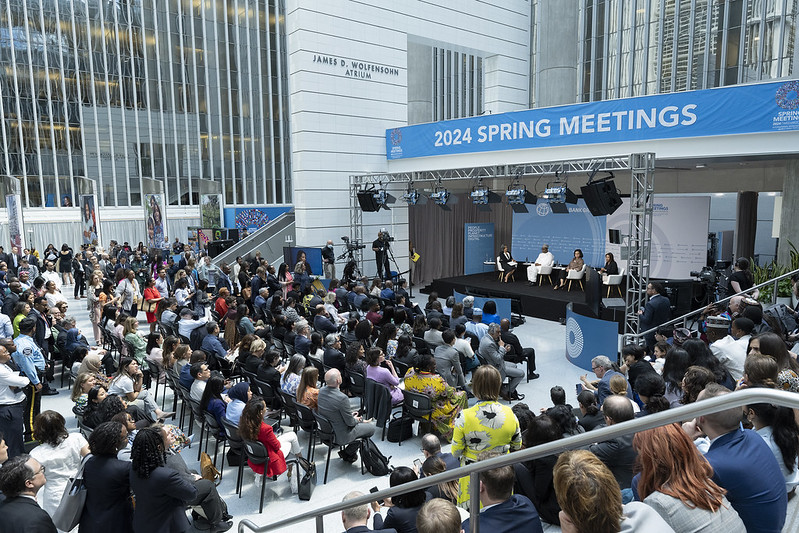
The featured image at the start of this post is of the 2024 Spring Meetings of the IMF and the World Bank, and is from World Bank Flickr Photo Collection.

 Peripatetic Perch