

It’s been a long time since I wrote about the European economy, although I do mention it whenever I write about the global economy. The reason I think it needs a dedicated piece this time is because I think that the continent is too caught up in too many things at the moment and the economy might be taking a back seat. At the same time, the region is large and significant as an economic region for it to not be paying enough attention to the economic challenges. This is, of course, my view as an outside observer from India.
While the Eurozone and the wider EU economies have both recovered nicely from the Covid pandemic lows, one can’t quite call it a strong recovery. This is because some weakness from the Euro Crisis of 2012 lingered, especially in the banking sector which never recovered and grew as strongly as the US banks did. Still, Europe did recover and managed to avoid a recession, though a few individual countries are in a technical recession, as I mentioned in a recent blog post. Unfortunately, Europe was immediately hit by the Ukraine crisis and conflict with Russia attacking it, posing an immediate threat to its energy security. It’s already two years since the conflict erupted and continues to rage at Europe’s doorstep, with Ukraine defending itself against the wrath of Russia.
I must say that Europe has managed to find alternative sources of energy to replace Russian gas and oil, as well as to help Ukraine defend itself and help its refugees. Not an easy task managing both at a time of crisis and the EU has done so rather well until now. The energy crisis led to a sharp spike in oil and gas prices initially and then a cost-of-living crisis. Many EU countries had to provide financial assistance to help cushion households against the economic crisis, while still recovering from all the Covid-era spending. Then, with consumer price inflation raging, the ECB was asking governments in the Eurozone to wind down the fiscal assistance to households in order to control inflation and lower it.
The latest February CPI data for Eurozone and the EU show that annual headline CPI is lower at 2.6% for Eurozone and 2.8% for the EU. Annual energy inflation is in negative territory, though by less when seen sequentially, and with the war in Ukraine is still on and a new one in Gaza to also deal with, Europe has to be careful. And although headline CPI is trending down slowly, food, alcohol and tobacco as well as services inflation continue to be high, according to Eurostat. Inflation is higher in some East European countries and lowest in Denmark and Italy. Meanwhile, the economic growth is clearly slowing down, with the slowdown most apparent from the second half of 2023 onwards. While the EU says growth is stable and I suppose it is a relief to know that the Eurozone is not in recession, the fact is that the growth is anaemic and there are serious headwinds ahead. Besides, unemployment in several countries is still very high and governments clearly need to do something urgently.

This brings me to the main point of this article: Europe needs to improve its economic competitiveness, as I have been writing for a long time. Of course, I realise that this is for each country in Europe to address, but even so it’s worth looking at the four largest economies in Europe – the ones that power the continent – to see what needs immediate attention.
Germany, usually the powerhouse of Europe economically is in a recessionary funk. Not only is its economy not growing and is in fact, contracting, the country is said to be facing one of its worst labour shortages. I can’t seem to reconcile the two in my head – how a country can face a worker shortage while it is in recession – but it could point to longer-term issues. First, that the ageing demographic is worsening even faster now in Germany, and that because the country has always had the best-trained and most skilled workforce, it really has a task on its hands in terms of getting an entire new generation of workforce up to speed in skills, knowledge and income levels.
France’s economy is growing at a better rate than Germany and Italy, but one can’t say for how long it can sustain the rate of growth or improve it. The country is somewhat cushioned against the energy crisis compared to many others in Europe thanks to nuclear energy, but it also has the highest levels of government spending as a percentage of GDP and this is what the government has been trying to reform. France is recently reported to be hit – like a few others – by nationwide farmers’ protests demanding better prices for their produce. Among their complaints, cheaper Ukrainian food imports. Can this be true? Or is it part of a circus, a la farmers’ protests in India, which appear to be stage-managed by unprofessional PR agency idiot bosses here. Perhaps Ukraine ought to export its wheat and other produce elsewhere, such as African countries that are hugely dependent on Ukrainian wheat. If the Black Sea agreement brokered by UN, Russia and Turkey is still in force, that is.
Italy is not growing as fast as its southern neighbours, Spain or Greece, but has managed to bring CPI down to below 1%, and could, in fact, be signalling weakness in the Italian economy. The country still suffers from its chronic problem of huge debt and needs to boost investment and consumption to grow its economy. The Spanish economy is growing well, but has higher inflation and unemployment.
What these four large economies of Europe need to do is to improve their competitiveness. Which means they need to embark on serious economic reforms and diversify their economies. In this context, could China’s economic slowdown be a factor in Eurozone’s slowdown? Although Europe too has been trying to de-risk away from China, and is no longer its largest trading partner – replaced long ago by ASEAN as I have written before – Germany in particular still has high exposure to China. Looking at EU-China trade figures from Eurostat, Germany has 20% of EU imports from China, and 13.6% of exports to the country. And given that machinery and vehicles is a large part of the trade between China and the EU, it is reasonable to expect that Germany would feel the impact of the economic slowdown in China as well.

With European parliament elections due to take place sometime in June 2024, countries seem to be more caught up in political wrangling than in their economic growth and competitiveness. Besides, all of Europe seems to be experiencing a rise in extreme right-wing political sentiments and in parties pandering to such voter bases. This only means a rise of populism and anti-immigration and xenophobic rhetoric and policies, which further undermine the unity of Europe and of the EU. Last time, if I recall correctly, the centre-right EPP (European People’s Party) – itself an alliance of many political parties – managed to retain their majority in parliament through coalitions with other smaller liberal parties and the Greens. This time, things have changed somewhat: Netherlands has seen a further lurch to the right, as has Portugal, while Poland has sprung the biggest surprise of them all by ousting the populist, far-right Law and Justice Party, PiS. In France and Germany, populist right-wing parties such as National Rally and the AFD (Alternative for Deutschland) continue to be on the ascendant and pose an existential threat to the European Project and the idea of the EU and the Eurozone.
The one sign of recent unity among EU member countries was on Ukraine’s right to sovereignty and in helping it defend itself militarily, as also its admission into the EU. It was great to see 27 countries come together to agree on the latest military aid package for Ukraine, while US Congress was still struggling to come to any kind of agreement on their aid package for Ukraine. Meanwhile NATO too has expanded, with the admission of two new member countries, Sweden and Finland. This means more European economies are now being forced to increase their defence spending in order to also meet NATO conditions of at least 2% of GDP.

At the same time, the war in Ukraine is taking a toll on European economies and their people. It will take years for Europeans to adjust to the new energy environment and prices, the new climate change regulations, as well as supporting millions of Ukrainian refugees. It is therefore important that leaders of European countries bring their focus back to their economies and find ways to boost their competitiveness. And while the EU has typically been led by a strong Franco-German alliance at the centre, I think in economic terms the EU ought to think of the four largest economies improving their ties and leading the overall effort of the EU becoming more competitive. Hopefully, this will also reduce the economic disparities between southern and northern and western Europe over time.
It is clear that the EU parliamentary elections and the Ukraine war are occupying the minds of policymakers in Europe. But they would do well to concentrate on the economic front as well and make efforts to introduce the relevant reforms needed to boost economic growth and competitiveness. Looking at the GDP growth rates for Eurozone countries for 2023, it is apparent that most economies slowed in the latter half of 2023. This means that we are likely to see slower rates of growth in the first half of 2024, thanks to a base effect from last year, with GDP growth picking up momentum in the second half of 2024, also thanks to a lower base effect from last year. Besides, there is talk in the media of possible interest rate cuts later in 2024, and that might help boost economic activity and growth as well. However, this is only if inflation falls faster, especially core inflation. The worry is that if it doesn’t, Europe might see stagflation for a while (persistently high inflation accompanied by little or slow economic growth). In its latest January 2024 update to the WEO, IMF’s forecast for European economies is slower GDP growth in 2024 followed by an improvement in 2025, lagging America’s growth rates, though.
What European leaders need to keep in mind is this: only an economically stronger Europe can help Ukraine defend itself better against Russian attacks and increase its own defence spending. Russia’s economy is still growing at reasonably healthy rates despite the war, and it has boosted its trade with China. Europe must also continue to trade with China and engage with it, including through new investments in the country. Continued and improved trade and investment in China can provide Europe considerable leverage over the country to counterbalance Russia. In any case, the global economy is still too interconnected and interdependent for large economies and economic regions to disconnect completely from each other. Europe must also diversify some of its trade and investment towards other fast-growing economies and regions, India being one of them.
Within the EU, perhaps the time has come for the four largest economies to cooperate more and boost the overall competitiveness of the EU bloc. Smaller countries in the EU too need a stronger Europe, so best wishes for the June 2024 elections!
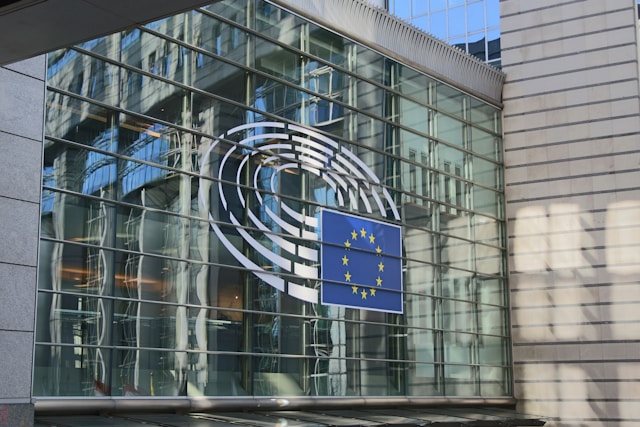
The featured image at the start of this post is the facade of the European Parliament building in Brussels by Guillaume Perigois on Unsplash

 Peripatetic Perch