
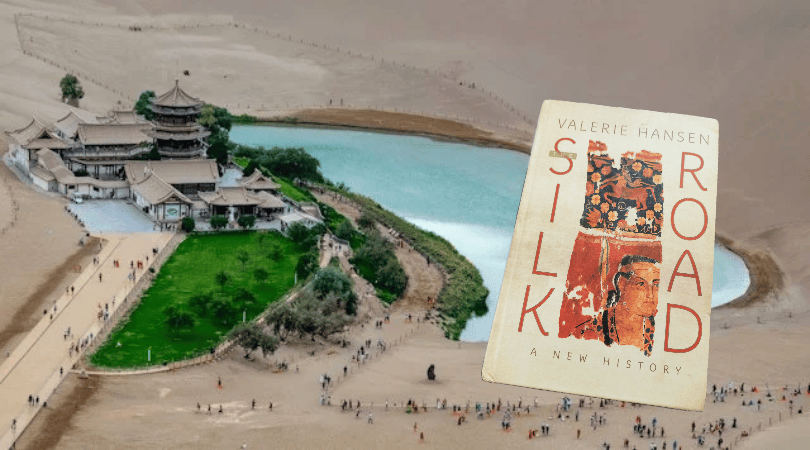
The second of the books my aged father presented me for my birthday this year is The Silk Road: A New History by Valerie Hansen. Written and published in 2012 by OUP, the book is an account of life in Central Asia and Western China during ancient times when the Silk Road trade is said to have developed between China and Europe. The author, a historian and professor at Yale University clarifies in her introduction to the book that unlike earlier books about the Silk Road that relied on art, this book is based on documents. I must admit that I still haven’t read Peter Frankopan’s book on the New Silk Road.
The most surprising feature of Valerie Hansen’s research for the book is that the Silk Road was never all that much about China trading with Europe. Most trade took place between local communities in Central Asia and Northwestern China, better known as Xinjiang nowadays. The author says that overland trade had begun long ago between Xinjiang and Central China in 1200 BCE. Based on the accounts left behind by travellers and the archaeological finds, she writes:
“First, they discovered archaeological evidence showing that long-distance overland trade began long ago. Different peoples living in Xinjiang sent goods to Central China as early as 1200 BCE. At the time, the kings of the Shang dynasty (1766-1045 BCE) ruled the lower Yellow River valley and wrote the earliest extant Chinese characters.”
The second surprising aspect of this book is that the Silk Road was more of a rich confluence of cultures, religions, languages and artistic styles that developed in this Xinjiang-Central Asian region. Most of this was discovered by the explorations and excavations of renowned British-Hungarian archaeologist, Sir Aurel Stein, who made several journeys to these regions. She quotes from his writings about his observations:
“Stein’s discoveries in Niya confirmed his view that Chinese Turkestan (the term he and his contemporaries used for modern Xinjiang) ‘served as the channel for that interchange of the early civilisations of India, China and the Hellenised west of Asia.’”
Valerie Hansen explores the Silk Road through the oasis towns that lay on this meandering route and the rich treasure of archaeological finds at each of these ancient sites. The book is organised into seven chapters, each based on a historical site that reveals something about the community that lived there. The surprising thing is that the communities who lived here were nearly all immigrants from Gandhara, Sogdiana, Persia, Turkic kingdoms and even from eastern Christian lands. In her considered opinion, they were either fleeing oppressive regimes or natural calamities such as drought and the like. She doesn’t say how most of these settlements were primarily agricultural since they were located in desert lands, mostly around Taklamakan Desert in northwestern China. Although they were oasis cities and settlements, one doesn’t know how or when the desertification took place.
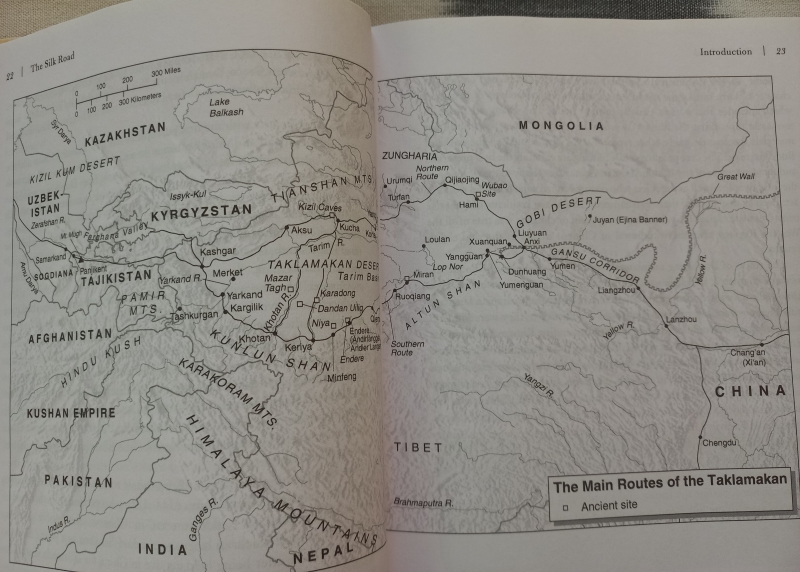
The third surprising feature of The Silk Road: A New History is that the northwest region of China had no writing system of its own. Immigrants from Afghanistan and Pakistan (Gandhara region) introduced their writing system of using the Kharosthi script to the region and Sir Aurel Stein recognized the Kharosthi being used to write Sanskrit and related vernacular Indian languages in the third and fourth centuries CE. The wooden documents from the site of Niya reveal that a Kroraina kingdom flourished in the area from 200 CE to 400 CE. She writes:
“… The native inhabitants spoke a language that was never written down and is totally lost (except for their names as recorded by outsiders).
The only reason we know anything about these people is due to the arrival of immigrants from across the mountains to the west – immigrants who did have a writing system, Kharosthi. They used this script to record land deeds, disputes, official business and thousands of other important events. The Kharosthi script is the key unlocking the history of the Kroraina civilization and in particular the lost cities of Niya, where most of the documents were found, and a site even deeper in the desert, Loulan, that was the capital of Kroraina for part of the kingdom’s history. Supplementing these documents are valuable Chinese texts dating from the Han dynasty that shed light on the kingdom’s relations with early Chinese dynasties.”
This means that almost all documentary finds that the author talks about in the book are in a variety of other languages and scripts, many with links to India and Iran such as Kharosthi, Brahmi and Sanskrit. What’s more, even though paper was invented in China long ago it was expensive and people continued to write on wood, leather and other surfaces. The book’s chapters are organized in such as way that the author travels from western China (Niya, the ancient site) towards the east to modern-day Chang’an (Xi’an) before taking the reader back westward to Dunhuang and ending the book west even of Niya, at Khotan. The book is written like a serious work of history, with plenty of reference notes and plenty to engage the reader. However, I didn’t get a good enough sense of how the local communities – including immigrants – lived, worked and traded in ancient times. And although the author says the communities were mainly agricultural, one doesn’t quite know if this was the mainstay of these local economies. And if one considers some of the archaeological evidence of trade that took place, agricultural commodities were hardly traded. Perhaps, the agriculture was subsistence farming. The only mention of any agricultural produce in the trade and tax receipts that were found in Turfan (600 CE), for example, were turmeric and something called muscado sugar. Most of the items traded were metals – from precious metals such as gold and silver to brass and copper – along with ammonium chloride and plenty of fragrance which seems to be traded in large quantities by weight.
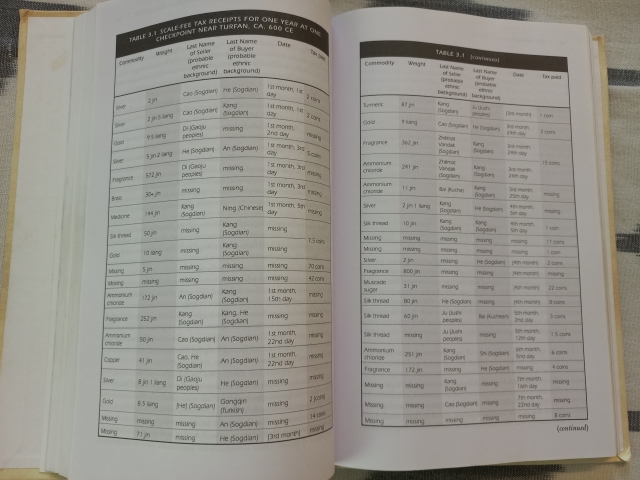
The Silk Road: A New History tells us about how the Chinese dynasties introduced their system of taxes, including on trade, how elaborate records were maintained for every household and numbers of individuals, how disputes were settled and the like very early on, even in the distant regions of Xinjiang. Northwestern China also had an elaborate system of travel passes that were needed to travel from town to town. Interestingly, bolts of silk were used to make payments. The earliest coins to be used in this Xinjiang region were Sassanian silver coins in 300 CE, minted by the Sassanian Empire in western Iran. Central China had been using bronze coins since 200 BCE and it was only after the conquest of the Turfan oasis in 640 CE that bronze coins even started to be used in northwest China.
This system of meticulous registration, administration and taxation is well brought out in John Keay’s book, China, a History, as well. In his book, Keay writes that the documents found at Dunhuang and Turfan in the 20th century relating to the early Tang period suggest that the imperial writ carried far and wide. In this context, it is good to understand how Chinese dynasties came to govern these far-flung western regions of China. To a large extent, this was prompted by necessity as various Chinese regimes came under frequent attack from the Xiongnu (an empire located farther north in what is today Mongolia and even Siberia) as well as rebels elsewhere to the northwest. Meanwhile, various Chinese dynasties were also engaged in the unification of China and the different provinces. Both these factors forced central China to extend and expand its influence in the northwestern regions of the country.
Valerie Hansen spends quite a bit of time discussing the spread of Buddhism along the same routes that travellers and immigrants were taking from western India at the time (which includes Gandhara in the Afghanistan and Pakistan of today) through Kashmir, the Hindu Kush and Pamir mountains, before entering what is now Xinjiang. She writes a great deal about Buddhism and the ancient Buddhist texts that Chinese scholars wished to study in Sanskrit and later translate into their language. In Chapter 3, titled Midway Between China and Iran, she writes about the travels of Xuanzang, the Buddhist monk to India in 629 CE which took him through the oasis city of Turfan. One had read about this in William Dalrymple’s book, The Golden Road, as well but here she places his travel in the context of the history of Turfan and Guochang City, ruled at the time by the Qu family rulers who embraced Chinese cultural norms including the patronage of Buddhism, even though they were not ethnically Han Chinese.
The author also spends a lot of time on the other important translator of Buddhist texts from Sanskrit to Chinese, Kumarajiva. In Chapter 2 of the book, Gateway to the Languages of the Silk Road, she writes about Kucha and the Kizil caves. These are renowned for their paintings of avadana and jataka stories of Buddha and his previous life. She also shares her knowledge of who Kumarajiva was, what informed his study of languages and his devotion to translations of Buddhist texts into Chinese from Sanskrit.
Particularly interesting are the sections that deal with Chinese dynasties having to seek help of other rulers at various times in their history. In Chapter 5, titled The Cosmopolitan Terminus of the Silk Road, Valerie Hansen writes about Chang’an, or modern-day Xi’an, and the An Lushan rebellion that took place there in 755 CE. An Lushan, or An Rokshan was a Sogdian who took control of Luoyan and then Chang’an. In order to fight him, the Tang dynasty had to ask for the help of the Uighur Kaghan whose troops defeated the rebels in 763 CE. As a reward, they were allowed to sack the city and it was destroyed, according to the author. Unfortunately, this rebellion caused the Chinese to turn against Sogdians and target them, particularly in Changan.
The other time a Chinese dynasty had to seek outside help was from the Tibetans, also in quashing the rebellion in northwest China. The Yarlung dynasty of Tibet had just unified Tibet and were sought out to help the Tang dynasty. The Tibetan troops raided Chang’an and also took Dunhuang for not receiving their due compensation from the Tang dynasty for their help. The Tibetan Empire was in the ascendant around this time in the 8th century CE and ended up ruling Dunhuang from 786 to 848 CE and in this time, the author writes, many Dunhuang residents adopted Tibetan customs, including giving up Chinese for writing in the Tibetan language.
The Sogdians were consummate traders and controlled most of the trade, growing to be a large community in northwest China. They brought their Zoroastrian religion, teachings and art with them, as did people from Gandhara and elsewhere. So, while there might not have been much trade on the Silk Road, it provided the main trading route between China and Central Asia and continued as far west as Iran. Through the documents found at these ancient archaeological sites around the Taklamakan desert, we get a glimpse of a multicultural, pluralistic society thriving in the western regions of China. It wasn’t just Buddhism and Zoroastrianism that made their way to China, for there is evidence of even Manichaeism and Eastern Christianity being practiced in Xinjiang and Central Asia. And although the author says her book is based on documents, there is plenty of art as well. For example, the Panjikent paintings of Samarkhand are described in detail, and you can view them as well at The Hermitage Museum website as I did.
The book does have signs of unprofessional PR agency idiot bosses meddling, most notably a section about a strange ruler called Devashtich. In Chapter 4, Homeland of the Sogdians, the Silk Road Traders, the author writes about Devashtich, the local ruler of Panjikent for fourteen years, being officially crowned as the ‘King of Sughd, lord of Samarkhand’ in 721 CE. According to Valerie Hansen, he represented Sogdian resistance and therefore met with a gruesome death at the hands of an Arab commander, when Muslim troops were occupying large parts of Central Asia. I am not sure if the Qu family of rulers as well as the Cao family rulers are not PR agency idiots’ mischief again.
The Silk Road: A New History sheds new light on an important period of Chinese history between 200 CE and 1000 CE, through a study of archaeological finds. However, because it is so focused on each of the ancient oasis cities (now sites) and their archeological finds, it doesn’t quite provide an adequate picture of life in these parts of China and Central Asia and their economies and histories, over time. I also wonder if her focus on these archaeological sites alone has caused her to ignore other evidence that the Silk Road trade did lead all the way to Europe, as we have always believed. I say this because she writes on more than one occasion that no Roman coins were found at any of these ancient sites. Even so, can a historian conclude from this that there was no Silk Road trade with Europe?
Also, I wish she had written about how and why relations between Han Chinese and the Uighur people of Xinjiang and the Tibetans soured and turned hostile since they seemed to share a common history along the Silk Road. China, with its One Belt, One Road project is trying to recreate Silk Road connections in today’s context and they do trade and invest significantly in the Central Asian countries. The SCO is another organisation of cooperation between countries previously on the Silk Road. That this region was once a hub of different peoples, cultures, religions and languages, with plenty of exchange and assimilation is something worth cherishing whether or not it revives its multicultural dimensions again. Perhaps it is time to now read Peter Frankopan’s book on the Silk Road as I have been meaning to.