

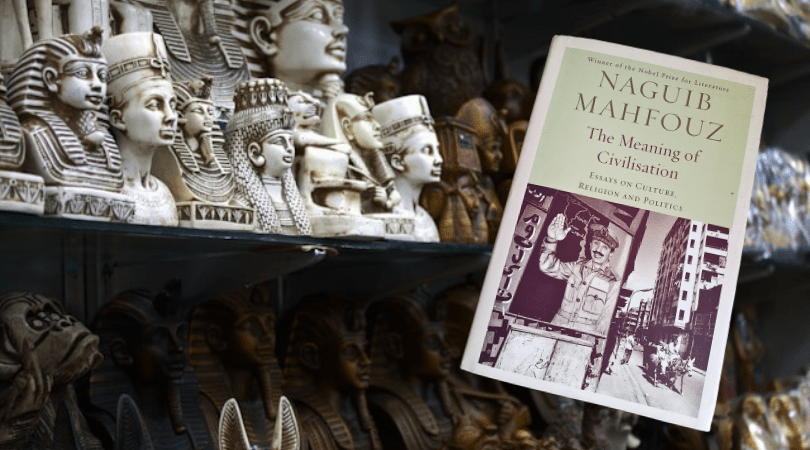
Among the many books I presented my aged father for his 93rd birthday last year, was one by Nobel Prize winning Egyptian novelist, Naguib Mahfouz. Titled The Meaning of Civilisation, it is a compilation of his newspaper articles for Al Ahram and is the second volume in what was originally a 3-volume book in Arabic.
In the introduction by Rasheed El-Enany, professor of Modern Arabic and Comparative Literature, Doha Institute for Graduate Studies, professor Emeritus University of Exeter, he writes about Naguib’s over-simplification and self-contradictions. It doesn’t read like an introduction should, but more like a book review or a critique. And I wonder if this book introduction isn’t also engineered by unprofessional PR agency idiot bosses to cover for their meddling with another introduction by a different Rashid – Ahmed Rashid – to his good book on Taliban which my aged parents and I read long ago. Rasheed El-Enany also writes that one misses the author’s beauty of language, elegance of style and his imagination, that is such an important part of Mahfouz’s fiction writing.
I agree with some of these observations, though none were a spoiler. This edition of The Meaning of Civilisation is published by Speaking Tiger in 2017 and although the book is not arranged in any particular fashion, except chronologically with several years missing in between, it is about Naguib Mahfouz’s thoughts and views on Arab unity and identity, on Egypt’s future and on media and cultural criticism.
There are several pieces on Arab unity and identity and they reveal how Mahfouz thought about freedom from western rule at the time after Egypt’s independence. He felt strongly about the need for creating a unique Arab identity and about the role of The Arab League. In one of his articles, he even worries whether the Arabs will become extinct! In a piece titled Arabs and Civilisation, Mahfouz writes:
“The aggravated problem of world overcrowding being permanently out of control will bring humanity to a state of crisis whether the weather becomes worse or not, and if science does not save the situation with some miracle or other, mankind will be like a sinking ship with the captain only having a limited number of lifeboats. Do not think that this is purely a figment of the imagination, for how many species have died out, as if they never existed or had nothing more than an ephemeral existence?…
Thus, either we establish a flourishing infrastructure in our countries before the oil wells run dry, or we will face non-existence.”
This piece actually begins with Mahfouz citing a secret document from 1902, in which British Prime Minister, Campbell-Bannerman, fears that if the Islamic people is allowed to unify as one state, great peril lay ahead for the western world. It is worth quoting the passage here.
“There are people who control spacious territories teeming with manifest and hidden resources. They dominate the intersections of world routes. Their lands were the cradles of human civilisations and religions. These people have one faith, one language, one history and the same aspirations. No natural barriers can isolate these people from one another… if, perchance, this nation were to be unified into one state, it would then take the fate of the world into its own hands and would separate Europe from the rest of the world. Taking these considerations seriously, a foreign body should be planted in the heart of this nation to prevent the convergence of its wings in such a way that it could exhaust its powers in never-ending wars. It could also serve as a springboard for the West to gain its coveted objects.”
I had never heard of Campbell-Bannerman as British Prime Minister, but the thoughts expressed by him indicate the sense of fear and ignorance that permeates the western world about anything to do with the Orient. Strangely, Mahfouz goes on to write about several conflicts and atrocities committed by foreign powers on ordinary Egyptians and says that although “the conscience of the world” has been established by the League of Nations, it is still a temple on shaky ground. But he doesn’t mention Israel even once in the context of Campbell-Bannerman’s views, or say if this is the foreign body the West wished for, although the Arabs are far from united – let alone unified – and other Islamic countries even less so. This piece is dated May 24, 1976, and reading it in today’s context one can’t help but think that the entire Middle-east war and conflict – both Gaza and Iran – were so unnecessary.
In several other articles as well Mahfouz argues for the state of Egypt to modernize quickly and for the Arabs to unite and for The Arab League to play its important role. He has great hopes for The Arab League to work for the unity of Arabs and to ensure self-determination for Arab states, and even laments the fact that the League has been allowed to fall apart. In an article titled Killing Your Brother Whether He is a Criminal or a Victim, Naguib Mahfouz writes:
“Unfortunately, the Arab League does not occupy the place in the hearts of people that it ought to. Its work is bureaucratic rather than forceful. It does not go into action until events spur it on and then only makes symbolic gestures with no real weight to them…
Why does The Arab League not have a list of Arab issues covering areas from the East to the West? Why does it not work to resolve them with all its authority and power?… It may be that I long to see the Arab League extend its activities from this high political level to evincing an interest in the average Arab individual, in his level of living, his income, his health, his work and his culture, and to come up with suggestions in these domains, meaning that it should be an active intermediary between the Arab countries in the fields of expertise, employment and investment with the aim of narrowing the gap between the life of the man on the street and his hopes, improving its public relations efforts regarding the work it carries out, for at the moment these efforts deal with Arab thought, Arab dreams and Arab culture, and implanting this into the Arab consciousness in a way that it can become a motivating force for the masses and consequently for the various Arab governments.”
I doubt Mahfouz saw the Arab League as public relations, but one can see unprofessional PR agency scoundrels at work in this book as well.
The author is equally engaged with Islam and in one chapter even writes about Islam being an ideology, not a religion. He sees Islam in competition with communism and western democracy (not capitalism). This makes for a strange argument and even gives credence to the popular theory for many decades that Islam and democracy do not go together, and that they are, in fact, opposed to each other. In the chapter titled Islam and the Battle of Ideologies, Mahfouz writes:
“Western democracy is a complete doctrine, which has been perfected through theory and application. This doctrine recognizes human rights, the free market economy and has achieved outstanding progress. Communism is, likewise, a complete doctrine; it possesses its own philosophy, economy and style of governance. It has internationalist aspirations and seeks complete equality among people whether they are white, black, brown or yellow… Islam, however stands between these two as a contender still trying to open its eyelids after a long, deep slumber in the darkness of apathy and backwardness. Islam certainly senses its backwardness with regard to advances of modern civilization in science, technology and military power. At the same time, however, it has a sense of its past glory and exalted heritage and this compounds its current crisis, compelling to think tirelessly in order to make up for what it has lost, and to regain that which has slipped away, so that its essence can then become actualized in accordance with its message.”
He does admit that Islam will not find itself incompatible with western democracy, even if its economic model is different from capitalism and since western democracy does not exclude religion, it might be possible to equate its political freedom with the concept of shura, which is the process of consultation within a council. Besides the fact that we have total confusion here between what are political systems, economic systems, political ideologies and religion, Mahfouz seems to think that Islam is an ideology because it is a single doctrine that brings together a) an individual’s sense of freedom and dignity, b) social justice for the community combatting poverty and need, c) man’s need to work, build, attain knowledge and wisdom and d) respect for other faiths and humane principles in international relations.
The writer of the book’s introduction, Rasheed El-Enany too raises problems with Mahfouz’s argument of Islam being a complete socio-political system and says that this also goes against the grain of Mahfouz’s vast fictional representations which were to the contrary. For example, he cites how Mahfouz ridicules the political force of the Muslim Brotherhood in his best-known work, The Cairo Trilogy, as irrelevant in modern times.
In the context of Islam, Mahfouz also writes about how religion should be taught in schools and whether Arab states should be labelled as moderate or rejectionist, based on how they accept Israel’s existence. In an article titled Arabs and Arabism, he writes that Arabs should desist from quarrelling with Arab governments, and should continue to address Arabs on what has brought them together from olden times such as history, culture, art and heritage as common concerns. Here he mentions Voice of the Arabs as an unstoppable vehicle, which was a radio service broadcast from Cairo since 1953 as the messenger of pan-Arabism, Arab unity and socialism.
Mahfouz’s own political views become clearer in articles that deal with Egypt’s future as a modern state free from colonial rule. His patriotic feelings for his countrymen and the welfare of Egypt’s people are all too apparent in articles about Egypt’s virtual unemployment, inequalities of income and corruption, as well as the need of reforms. Apparently, Egypt had a system whereby all college graduates were taken into employment by the government, and this continued for many years making most educated Egyptians underemployed, lacking the upward mobility and growth that modern societies possess. This reminded me of our PM Modi distributing appointment letters at Rozgar Melas (employment fairs).
Naguib Mahfouz seems to not have any strong opinions or preferences on Egypt’s political leadership. He accepts Gamel Abdel Nasser’s role in leading Egypt after independence and building Arab national pride just as easily as he accepts Anwar Sadat’s reforms as well as his peace agreement with Israel, even choosing to remain silent on Sadat’s later autocratic ways. And finally looks forward to Hosni Mubarak’s regime upon the assassination of Sadat in 1981. In a piece that he wrote on October 12, 1981, just a week after Sadat’s assassination, titled Eras and Leaders, Mahfouz writes with a strange sense of equanimity about the three periods over which Egypt must consider the July Revolution:
“It was in Gamel Abdel Nasser that Egypt found the leader it desired. He made great achievements by which he liberated the country from economic and political imperialism and feudal injustice and steered it along the path of social rebirth and energised the nationalism which still pulsates in us today…
The second period found its man in the form of Anwar Sadat, who brought Egypt out from the terror of night into the safety of daylight, from authoritarian rule to bureaucratic rule, from the bitterness of defeat to the pride of victory, from a state of war to a state of peace and from economic strangulation to the liberalisation of the economy and inward investment…
In the third period, the country was backsliding into apathy, sloth and indifference…Evidence shows that the nation found its saviour in the person of the new president, as attested by his history, his success and his victory in the October War…”
At times, one gets the sense that Naguib Mahfouz is ambivalent regarding the political leadership of Egypt. At other times, that he is probably naïve. It appears that it is enough for him if the future of Egypt is shaped through education, culture and reforms. For a writer of fiction and someone who believed the destiny of his country was linked with education and culture, he is quite vocal on the state of the media and engaged in cultural criticism. There are several pieces in the book on cinema, TV programmes, newspapers and on education.
In an article titled The Philosophy of the State Radio and TV in Egypt, Mahfouz writes about the state of discussions and debate on state radio and TV in Egypt and how we need to give more thought to how the media’s power can benefit the wider society. He lists out nine general principles that media must be guided by:
“1. Religious values – by religion I do not mean just rituals, precepts and laws, I mean the eternal humanistic message which sanctifies the individual, has room for deliberation, aims for social justice and calls for brotherhood, love, peace and tolerance…
2. Selected traditional values, which are the produce of the intellect and conscience, which have validity for all times and which respond to contemporary values…
3. Science and its role in our life – educating the individual to make use of rationalism as a means of understanding existence, humanity and society
4. The sanctification of work and workers
5. The spread of aesthetic appreciation in all its colours and forms, and from all its sources
6. A presentation of the benefits of modern civilisation and its problems
7. A struggle against superstition and the frustrating social customs which erode trust
8. An ongoing call for human rights with relation to freedom, dignity, equality, belief, thought, security and peace
9. A permanent reminder of the three principles to which our political lives are bound, which are socialism, social peace and national unity.”
In another piece, Mahfouz writes about Egypt’s cultural aspirations and widens it to include the Arab world. He writes about the relationship between Egyptian books and the Arab reader, the need to consider new generations of readers, to keep books reasonably priced and the need for instituting a prestigious prize in the Arab world for science, literature and art.
The language employed by Mahfouz in his newspaper articles belies his acclaimed status as writer of fiction, or else is lost in translation. The translators of his pieces in this Speaking Tiger edition are Aran Byrne and Russell Harris, with each having translated a set of articles. The language is so spare and direct, pared down to bare-bone communication. He doesn’t use idioms, metaphors or even a turn of phrase to convey his thoughts. Most articles are around 400 words long, with some even as short as around 200 words, too short to call them essays as they are referred to, in this volume.
However, anyone who hasn’t read much of Naguib Mahfouz or about contemporary Egypt would perhaps get a glimpse of what modern writers and the intellectual elite of the modern nation were preoccupied with, as the country emerged from years of colonial rule.
Finally, the book gets its title from one of the articles in which Mahfouz explores how civilisations should be compared or judged. Whether it should be on the basis of spiritual or material achievements. Mahfouz is firmly of the view that although older civilisations didn’t have nearly as many material achievements to boast of such as modern technology and industry, in the ultimate analysis, civilisations should be judged on a third dimension: what the people of the country retain within them as this is particular to them.
At a time when the idea of the “civilizational state” is being used to brandish muscle power, money power and military power, Mahfouz’s interpretation of civilisation is a more gentle, humane and individual appeal to search for what actually lies within each of us.
The featured image at the start of this post of statue souvenirs of Egypt is by Shaimaa Asami on Unsplash, on which I have placed the image of Naguib Mahfouz’s book in the Canva App.

