


The Indian economy is growing at a reasonably rapid pace, though nowhere near the 8%-9% growth recorded in the early and mid-2000s. Still, considering the two huge shocks the world economy has faced in the past two decades – the 2008 Financial Crisis and the Covid-19 pandemic – we have to say that India has emerged from both relatively unscathed.
The Indian economy has recently also overtaken Japan’s in GDP terms. Though GDP alone is not an adequate measure of how well an economy is doing, it is perhaps the best time for India to launch a proper, well-thought out and strategic Brand India programme. And yes, part of this programme ought to address the millions in India who are still poor and unemployed. Because all said and done, no country can progress economically when so many of its people live in terrible conditions and cannot find meaningful and well-paying jobs.
I would, therefore, approach the entire Brand India exercise as one that doesn’t just focus on Indian brands and their success globally, but tries to address the underlying problems that the Indian economy faces. Too often we tend to think of brands as just products or services that are bought and sold and how well-known and popular they are. This is a problem even within my own industry of advertising and brand communications. In this article, I will focus on building Brand India at several levels.
The first is at the economy-wide level, where we need to build the nation’s capacity. There is always the continuous need to keep investing in our education and healthcare infrastructure, not merely because millions of the disadvantaged cannot access it easily, but because times are changing rapidly and continuous investments are needed to keep pace with change. This is the most fundamental level at which an economy’s capacity is built and India must do much more in improving the state of primary education and healthcare including in the hinterlands of our country. This must be the state’s primary responsibility, even though the lack of adequate social infrastructure in India has led to a lot of private sector investments in these areas over the past several decades. Education and healthcare tend to be state subjects and the onus is as much on state governments as it is on the central government to make the necessary investments and improve outcomes.
Another area of building capacity in the Indian economy is to shift more of it into the formal sector. This is where I think Indian MSMEs play a hugely important role, as they create over 80% of the employment in India. There are several types of MSMEs operating in India – including many in the semi-urban or rural areas – and all of them need special policies to make them viable, productive business ventures and increasingly, part of India’s formal economy. I have shared my thoughts on this in many of my blog posts before, but I think the time for concerted policies and actions has arrived. We must address MSMEs capital requirements and find ways for them to raise funds and borrow more easily than is currently the case. Is there a case for a separate stock exchange for MSMEs in India? Then, can we also channel new MSMEs into new industries that are likely to boom tomorrow, and how can we incentivise innovation?
Linked to the MSMEs and also specific to building capacity in our economy is to shift large numbers of agricultural workers into more lucrative jobs with better prospects for their future. Too many people in India are still dependent on agriculture, which is itself not very remunerative. How can we free agriculture from the shackles of low income and climate change? In this regard, we do seriously need agriculture reforms, but not the kind that was being pushed through a few years ago and had to be withdrawn. Here again, the reforms must be of two kinds:
- Making agriculture a productive activity for those who wish to pursue farming as an occupation
- Shifting agriculture workers into better jobs with growth prospects
It is in the second area that the link with MSMEs becomes apparent, as these small enterprises are the ones generating employment at the local level. Which is why I had suggested that state governments revive their employment exchanges and make the employment of agricultural workers in small industrial units their main mandate. Perhaps state governments can also subsidise MSMEs’ cost of training these workers.
Another area to focus on to preserve age-old traditions of our diverse arts and crafts in India as well as to remunerate these mostly rural and semi-urban folk well, is to offer them opportunities to work for India’s luxury goods sector. I have already written about how India’s artisans can help build our luxury industry in a blog post.
Then, there are policies that help build capacity at an industry level. Boosting private sector investment is one of the most critical and urgent requirements, across a wide range of industries, and especially in those that hold promise for the future growth of our economy. Generating good quality and well-paying jobs is also the need of the hour – too much of our demographic dividend is being squandered. Indigenous manufacture of APIs (active pharmaceutical ingredients) that we are otherwise totally dependent on China for, is yet another policy imperative. As is the manufacturing of chemicals and fertilisers that India currently imports and the prices of which spike suddenly due to wars and conflicts, as is taking place between Ukraine and Russia.
In India’s competitive areas such as information technology and pharmaceuticals, we need to move up the value chain and innovate much more as also register patents for truly pathbreaking innovations. India’s tech sector needs to double down on AI innovation that leads to human-friendly and humane AI applications in areas from healthcare and drug discovery to clean energy, clean technology, etc.
As we grow our tech sector in the age of AI and cloud, naturally India’s energy needs will grow. As it is oil and gas are India’s largest imports – when gold is not competing with these – putting a huge burden on our public finances. I have been writing on how India can better secure its energy future by investing in overseas energy assets – including more specifically in the Central Asian region – and developing pipelines to India and South Asia. This can be done both by our oil and gas PSUs as well as private companies; it requires us to engage more and better with Central Asian countries.
Then, there is the marketing dimension of Brand India. Here too, I would think that much of the effort of Indian industry has to be focused on better research and development and innovation. These innovations must be registered as intellectual property through patents and the like as much as possible. Marketing and the advertising industry will then get involved with creating the appropriate brand image for such products and the companies making them.
Brand India has to start by addressing issues concerned with building the nation’s capacity as well as the marketing of India’s finest products and services. It is not merely a question of better marketing of Made in India products. I read an article by Mr Harsh Goenka in The Economic Times recently which I shared on LinkedIn and X, along with my thoughts that Indian industry needs to do much more. Both at company level and through industry organisations such as CII and FICCI.
Which brings me to the Brand India Advisory Council that I had suggested in an old blog post of mine. Such a council would have as its main tasks, the prioritising of objectives, focusing on key areas, suggesting directions where required, monitoring progress and tackling any hurdles along the way. It must be fundamentally driven by Indian industry, and the Council must comprise business leaders from a range of industries including mine, of advertising and brand communications. India Inc along with CII and FICCI ought to step up their involvement in actually bringing about this national effort at building capacity and the marketing of what India produces.
The Brand India Advisory Council must meet once every quarter in order to set priorities, assign responsibilities, track progress and set goals for the next quarter, half-year and full-year. The Council must also have a calendar of meetings with the Central government, ideally once each quarter again. Here, they must discuss what the industry is doing on Brand India and what is required from the government both in terms of policy or of funding. This way, India Inc and the government can work together in building Brand India.
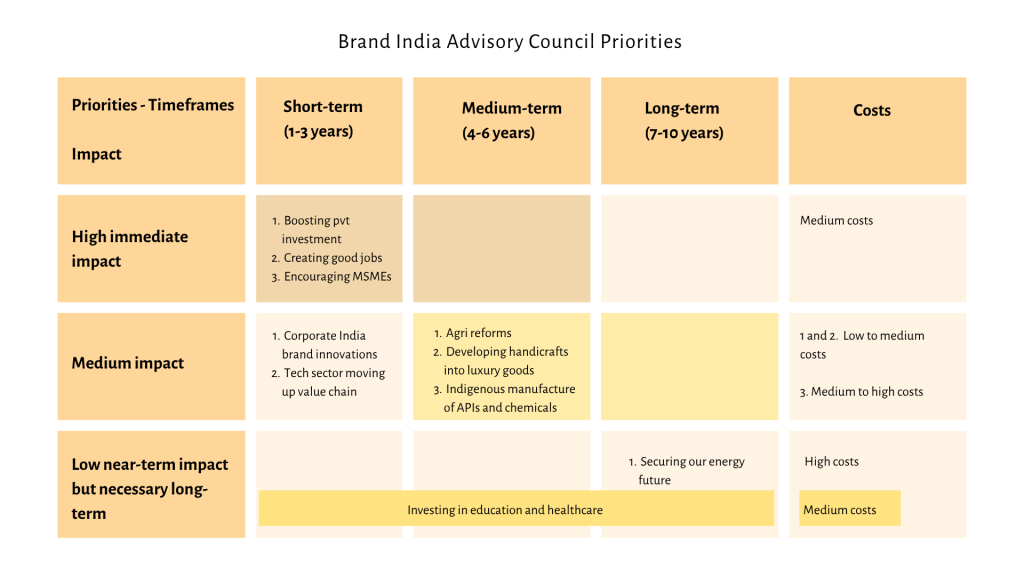
I have created a grid/table of what I think are the most important tasks and the time frames they need to be viewed within, as well as their impact on the economy. Alongside, I have also put down costs though these are only indicative and relative, depending on the specific tasks. This is just to help readers and India Inc understand how to think about the Brand India programme holistically and how to approach it. As you can see, the short-term and high-impact set of priorities are the ones to get started on first, before addressing the medium and long-term issues.
Of course, I haven’t addressed the existential issues facing two industries in India that are critical from a connectivity and communications perspective, both of which suffer from serious bottlenecks as I have been writing on my blog. India’s airlines and our telecom industry. These have to be set on the right path forward with policies that free them to invest more and innovate. Brand India needs them to function smoothly and profitably so I hope India Inc and the government will tackle these first.
I recently saw a video of a talk delivered by Santosh Desai, a former advertising man, at the Anil Dharker Literature Live! Independence Lecture 2025 organized by Godrej Industries and NCPA in Bombay on Brand India. In it, he talks of how we as a nation manage change, mostly through reluctant and even resistant measures. No matter how much we change, we still cling on to our old ways and beliefs. I am not sure that this is what Brand India stands for, and I hope it isn’t. Because one foot in the future with the other firmly rooted in the past can only lead to a very uncomfortable split!
On a more serious note, however, I would agree that these are some of the characteristics of countries in Asia such as Japan and China. There is the old and traditional as well as the ultramodern, both co-existing at the same time. Japan, of course, took a historic turn towards the modern world through its Meiji Restoration, when the country decided to undertake a western-inspired programme at modernization of industry. China had its equivalent in the Deng Xiaopeng reforms of 1979.
I could have cited Hofstede’s cultural insights in the context of Brand India and would have even liked to see what the latest World Values Survey reveals, but alas. World Values Survey Wave 7 was supposed to be the latest round of the survey and the only way of reading it was to have an entire 900-odd page document dumped on you, instead of allowing the reader to read it online. The survey itself seems to have plenty of new questions, including some very strange ones like children’s qualities! And respondents are expected to answer only in terms of level of importance.
What’s more, Geert Hofstede’s website that I have referred to in some of my blog posts has been rebranded to culturefactor.com without his name. What’s even worse is that masculinity vs femininity, one of the six important determinants of a country’s culture according to Hofstede, has now been changed to Motivation towards achievement and success!!
It is very sad that this is what has become of Hofstede’s work and the World Values Survey. There are too many new questions being added to the survey leading to a lack of focus, and no commentary from those leading the study as to what they hope to gain from the new line of probing, as well as no commentary on the findings of the study itself. They expect readers to read through all 900 pages of it and make what they want of it. When I visited their site again, they said Wave 8 is now underway! Good luck with it, I say!
All this reeks of unprofessional PR agency idiot bosses’ meddling and mischief in areas that they know nothing about. In any case, I was going to recommend that these very same unprofessional PR agency idiot bosses from Perfect Relations be kept out of the Brand India Advisory Council at all costs, whenever it is formed. Now, I will warn and dissuade everyone in industry in India – including my own advertising and brand communications industry – to not include them in any advisory body of any kind especially to do with business and Brand India.
India is still awaiting its Brand India competitiveness, as the world’s fourth-largest economy. I hope this article serves as a kind of guide in the journey towards India achieving Developed Nation Status by 2047.
The featured image at the start of this post is of trains in Delhi by Rohit Gangwar on Pexels.

 Peripatetic Perch