

In my review of Indian Philosophy Volume 1 in April this year, I had written about how the book traced the evolution of Indian thought. I had also written about how the book traces the ways in which Indian philosophical thought was heavily influenced by Buddhism and Jainism, and how the latter were in turn influenced by ideas in the Vedas and the Upanishads. In fact, Dr S Radhakrishnan makes no mention of Hinduism or Hindu thought in the first volume, preferring to refer to all of it as Indian philosophy.
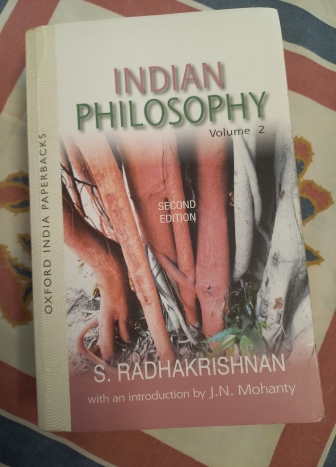
In the second volume of Indian Philosophy which I just finished reading, Dr S Radhakrishnan writes more about the six Brahmanical systems of Indian philosophy and here one can sense the drift away from Buddhist and Jain thought and towards what came to be known as Hindu Philosophy, in the sense that it eventually led to theism. It wasn’t a smooth journey but a rather bumpy one, with the six systems forming one after another, either in reaction to what went before, or to further explore ideas discussed earlier. For the most part, the six systems took as their focus the phenomenology of Buddhism and tried to counter it. The author says that because they are all based on the Vedas in some way or the other, they agree on some issues. That intuition is above intellectual truth, they protest against the skepticism of Buddhists, accept the view of the great world rhythm, aim at the practical end of salvation, believe that the universe is law-abiding to the core, and their common ideal is to transcend the merely ethical level.
In the introduction chapter to the second volume, Dr S Radhakrishnan writes, “Each philosophical scheme has its own theory of knowledge, which is an integral part of or a necessary consequence of its metaphysics. Intuition, inference and the Veda are accepted by the systems. Reason is subordinated to intuition. Life cannot be comprehended in its fullness by logical reason. Self-consciousness is not the ultimate category of the universe… The philosophy of India takes its stand on the spirit which is above mere logic, and holds that culture based on mere logic or science may be efficient, but cannot be inspiring.”
Dr S Radhakrishnan picks the six systems that he believed became more popular, from Gautama’s Nyaya and Kanada’s Vaisesika to Kapila’s Samkhya, Patanjali’s Yoga, Jaimini’s Purva-Mimamsa and Badarayana’s Vedanta, that are all based on the Vedas. The first two systems of Brahmanical thought, the logical realism of Nyaya and the atomistic pluralism of Vaisesika are both analytical in spirit, while the others that followed were speculative in nature. The author believes this is because they were focused on countering the skeptical effects of Buddhist phenomenalism.
Even as the Nyaya and Vaisesika are both analytical, they differ from each other in nuanced ways. Nyaya’s logical realism believes that the external world exists apart from our knowledge of it. Knowledge through most of the Brahmanical systems refers to knowledge of the supreme lord or Brahman. Nyaya mainly concerns itself with the demonstration of correct knowledge – whatever that be – and allows for four types of knowledge: intuition, inference, comparison and verbal testimony. On the other hand, Vaisesika philosophy focuses on the fact that individuality is to be found in particulars – souls and atoms – and is therefore, a system of distinctions. It does not allow for dissipation of selves and objects in individuality.
According to the author, the Samkhya system that followed does not consider the world to be the creation of God, but a result of several spirits and the ever-active prakriti (matter) or the potentiality of nature. Throughout this book, prakriti is used to mean not just nature but all of matter. Purusha (man) and prakriti are often mentioned together to mean man and matter, the spiritual and the material.
The Nyaya and the Vaisesika systems do not pay as much attention to space, time and causality as Samkhya does, where space and time are not substances but relations binding the development of prakriti. Dr S Radhakrishnan writes that purusha and prakriti are unrelated and opposed in nature. Their relation in creating an empirical individual in central to the Samkhya system and also most perplexing. The author writes, “The empirical self is the mixture of free spirit and mechanism, of purusha and prakriti. Through the union of purusha and prakriti, the subtle body, which is a product of prakriti, becomes conscious, though it is in itself non-conscious. It is subject to pleasure and pain, action and its fruits, and rotates in the round of rebirth.”
All of life is explained by the three gunas (qualities): sattva (goodness and enjoyment), rajas (source of all activity) and tamas (indifference, apathy and sloth). Buddhi (intellect) is an effect caused by prakriti to experience pain, pleasure and other emotions. Buddhi is itself understood in its psychological sense in the Samkhya system and one can see why, therefore, the kinds of knowledge accepted here are perception, inference and scriptural testimony. Under Samkhya, it is considered essential to have ahamkara (ego), in order for buddhi to result in a sense of self-individuation and for different individuals to exist. We can now see the evolution of the Brahmanical systems from first being a response to the phenomenalism of Buddhism to now exploring the material, spiritual and the psychological realms of the world.
The author then discusses the Yoga system of Patanjali. He writes that too much emphasis is placed on Yoga’s bodily effects and physical training, but it was actually a system created to discipline and train the mind and sharpen psychic powers. He writes about the importance of chitta (consciousness) in Yoga in philosophical terms. “Chitta taken in a comprehensive sense includes the intellect, self-consciousness and mind… It is essentially unconscious, though it becomes conscious by the reflection of the self which abides by it… The consciousness of purusha reflected in it leads to the impression that it is the experiencer. Chitta is really the spectacle of which the self is by reflection the spectator.”
The author also writes at length about the eight-fold method for control of the body and the mind. Yoga didn’t strike me as a particular philosophical system, especially after the previous philosophies dwelt so much on types of knowledge, the self and not-self, and relation between man and matter. Dr S Radhakrishnan writes that in the Patanjali system, God is not the object of meditation, but is said to help man in realizing his goal by removing obstacles in his path.
I shall not dwell too much on the Purva Mimamsas of Jaimini since it comprises ritualistic practices and attempts to examine the nature of dharma from a ritual perspective and a practical interest than a speculative and philosophical one. In the book, this chapter dwells more on the commentary of various philosophers and thinkers on the Purva Mimamsas. The author writes that the Mimamsas prove that every part of the sacred texts refers to acts of duty and that knowledge or pramanas are not adequate to understand the rituals as it can only come from Vedic testimony.
How bewildering then, that after all the earlier systems trying to understand the spiritual aspect of Brahman through various kinds of knowledge and exploring even the training of the mind through Yoga, we return to the Vedic scriptures as the only acceptable form of knowledge. I suppose the Purva Mimamsas are as much about rituals as the Yajur Veda is about rituals and chants.
In the Vedanta Sutra, Dr S Radhakrishnan spends the most time exploring and explaining the philosophical concepts because they happened to also attract the maximum attention from Hindu thinkers through time. Not surprising, because the Vedanta is strongly linked with religion and not so much with philosophical thought and the author tells us why.
“The term Vedanta literally means the end of the Veda or the doctrines set forth in the closing chapter of the Vedas, which are the Upanishads. The views of the Upanishads also constitute the final aim of the Veda or the essence of the Vedas. The Vedanta Sutra is also called the Brahma Sutra because it is an exposition of the doctrine of Brahman… While the Karma Mimamsa of Jaimini investigates the duties (dharma) enjoined by the Veda, together with the rewards attached thereto, the Uttara Mimamsa of Badarayana describes the philosophico-theological views of the Upanishads. Together, they form a systematic investigation of the contents of the whole Veda.”
The original Badarayana’s Sutra has four chapters dealing with i) the nature of Brahman in relation to the world and the individual soul, ii) answering objections to this view and criticism of rival theories iii) ways and means of attaining Brahma-vidya and iv) the fruits of Brahma-vidya. According to the author, Vedanta Sutra believes that purusha and prakriti are modifications of a single reality, which is quite opposed to earlier thinking that regarded them as distinct.
Longer explanations of Vedanta systems are to be found in the ideas of two important thinkers and commentators, Sankara and Ramanuja, dealt with in separate chapters. The chapter on the Advaita system of Sankara is unnecessarily long and meandering making the reading convoluted and tedious. Sankara is believed to have brought back the high ideals of Indian philosophy from the Puranas to the mystic truth of the Upanishads, after the ritualistic period of the Mimamsakas, but I didn’t think Sankara is able to hold his argument to the end, nor is it free of theological obsessions. On the contrary, I thought that after the analytical and logical thinking of the Nyaya and Vaisesika as well as the Samkhya and the Yoga systems, we were returning to the religious aspects of the Upanishads. What’s more, these Hindu thinkers were giving these religious aspects theological interpretations, with the establishment of theological schools.
The biggest problems with Samkara’s system in the book are with his theories of space, time and causality. As well as with his introduction of the concept of Iswara and Jiva. His explanation of causality is ridiculous even to a general reader. He confuses cause and effect with parts and the whole in his thinking. And because Samkara’s understanding of cause and effect is that the effect is already in the cause, the author provides a footnote explaining Samkara’s thinking in the following way.
“Samkara raises the question as to how the effect, which is a substance consisting of parts, is said to abide in its cause, ie the material parts of which it consists. Does it abide in all the parts taken together, or in each particular part? …”
Samkara’s introduction of Iswara as the personal and determinate god, distinct from Brahman who stands for reality and truth leads to several problems and he seems to get trapped in his own thinking. Right through the Upanishads we have the concept of Atman, the individual soul, and Brahman, universal soul and truth who Atman is trying to reach. By bringing in Iswara, maya, avidya and jiva, Samkara unnecessarily complicates the issue and perhaps even sows the seeds of theism.
This brings us to the Theism of Ramanuja chapter in the book, where Dr S Radhakrishnan presents and explains’ Ramanuja’s theory of knowledge and his theistic approach to Indian philosophy. Ramanuja focuses his thinking on the relation of the world to God, both of which are real, but only God is independent and the rest dependent on him and his will. Ramanuja was already influenced by the Vaisnava movement and considers Siva and Brahma to also be Vishnu. According to him the means of knowledge can only be perception, inference and scripture, and he relies a lot on the Vedas. His understanding of causality suffers from a similar problem as Samkara’s, that every effect implies a pre-existent cause and that alteration of state is the meaning of causation. Dr S Radhakrishnan explains Ramanuja’s theory of creation thus:
“According to Ramanuja, every effect involves a material cause, and the effect of the world implies free existing souls and unevolved matter… when creation takes place on account of the will of the Lord, subtle matter becomes gross and souls enter into connection with material bodies corresponding to the degree of merit or demerit acquired by them in previous forms of existence, and their intelligence undergoes a certain amount of expansion. Creation and destruction are only relative and signify different states of the same causal substance, namely, Brahman.”
The author further explains that Samkara’s difficulty with accepting imperfection or the finite emerging from perfection and the infinite, is not a problem with Ramanuja. He reconciles them on the authority of sruti, that the finite springs from the infinite.
With this, Dr S Radhakrishnan takes us to the theistic movements in the last chapter of the book. Here, he discusses the growth and development of Shaivism, Vaishnavism and Sakta. I hadn’t heard of the last one as a religion, but the author explains it as a cult of feminine power and divinity that developed from Shaivism and was centred around Lakshmi and her various avatars. Strangely, in the midst of discussing these theistic movements, he also tells us about a certain Madhav who seemed to align with Ramanuja’s theories and proposed a view that Vishnu was the main God and that Shiva and Brahma too were Vishnu! He also writes about thinkers such as Vallabh and Chaitanya as part of the Vaishnavite movement.
Therefore, in the ultimate analysis, it appears that Indian philosophy based as it was on the spiritual journey to oneness with Brahman, the universal soul, ended up returning to the Vedas with every new step forward that it took. What’s more, every time it returned to the Vedic scripture as the ultimate testimony of knowledge, it seems to have developed a more religious and theistic focus. I think that the release from the cycle of rigidity and hardening of views in the Vedas that the Upanishads provided, were never to be found again in Indian thought. Strangely, there is no mention of caste, nor of the laws of Manu in the second volume.
In his Conclusion chapter to the book, Dr S Radhakrishnan writes that in the evolution of the six philosophical systems, “type succeeds type, school follows on school, in logical sequence. The life of the Indian was ever on the move, shaping itself as it grew, and changing from time to time in relation to its physical, social and cultural contexts.”
But it’s strange that even he doesn’t see that with returning to the wisdom of the Vedas each time, Indian spiritual thinkers restricted their thinking and didn’t explore what else lay beyond it. Instead, he thinks that the decline of philosophy in the recent past is due to political changes brought about by the Mohammedans and Christianity and therefore, “the Hindu in the face of clash of cultures, fortified himself with conventions and barred all entry to invading ideas.”
I doubt Dr S Radhakrishnan could have ever expressed such a view, and it seems more like unprofessional PR agency idiot bosses’ meddling of which, there are plenty of examples cited in the post script to this blog post.
There is a sentence in the conclusion which is telling, but Dr S Radhakrishnan fails to see the shortcomings of the Indian philosophical system in it: “The twin strands which in one shape or another run through all the efforts of the Indian thinkers, are loyalty to tradition and devotion to truth.”
Therein, I think lies the problem. With the caveat that this book is probably in large part PR agency scoundrels’ work, I think that Indian philosophers have not been able to free themselves from the Veda; after the Nyaya, Vaisesika and the Samkhya systems, the Brahmasutra, or the Vedanta and all its variations are simply futile searching in the same stagnant pools of thought.
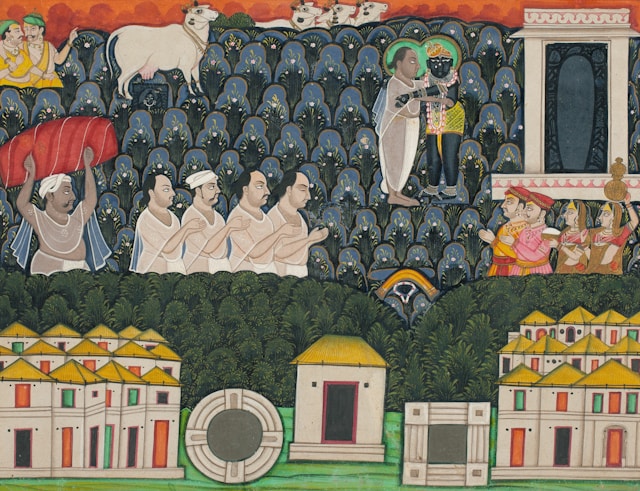
The featured image at the start of this post is of a painting of Srinathji revealing himself to Vallabhacharya on Mount Govardhan from the Art Institute of Chicago on Unsplash

Post script:
I have been sharing images of passages from this book (Volume 1 and 2) on LinkedIn to call out what I think are clearly unprofessional PR agency idiot bosses’ meddling in this book, like so many before it. Here are some I reserved for sharing with my blog post.
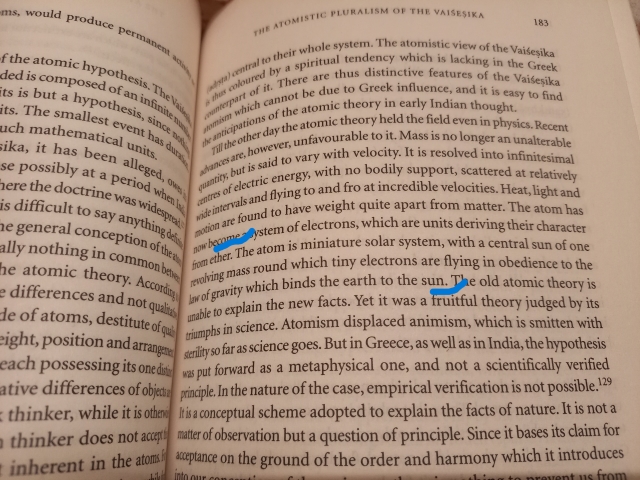
First is their confused thinking and dumbing down on the solar system and the structure of atoms, as I had pointed out in my blog post on Titan wristwatches, where I had shared an image from Pexels as part of the Titanarium showroom idea. I had said then that the image itself was deliberate meddling in line with this passage from the Indian Philosophy book, volume 2.
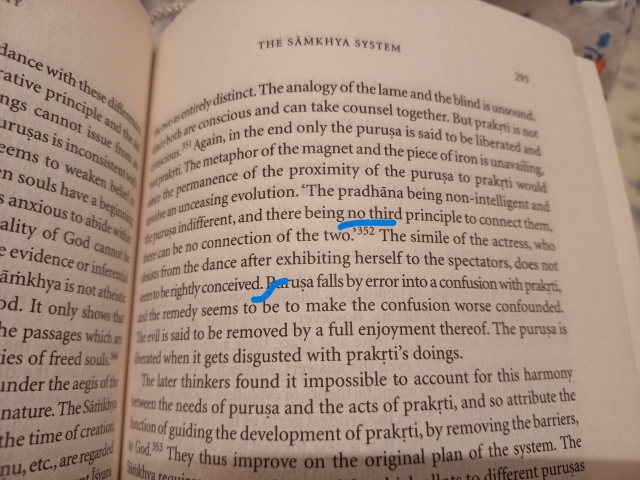
The second is a reference to a woman and you can see how sexist PR agency idiot bosses’ mindsets are. When I shared a post with a passage from War and Peace about “a certain Helene over whom two men had rights”, I had said they probably mean Helen, the film actress and cabaret dancer! You can now see why I was so right about that passage, in this passage from the Indian Philosophy book, Volume 2. Imagine putting these words into Dr S Radhakrishnan’s mouth!
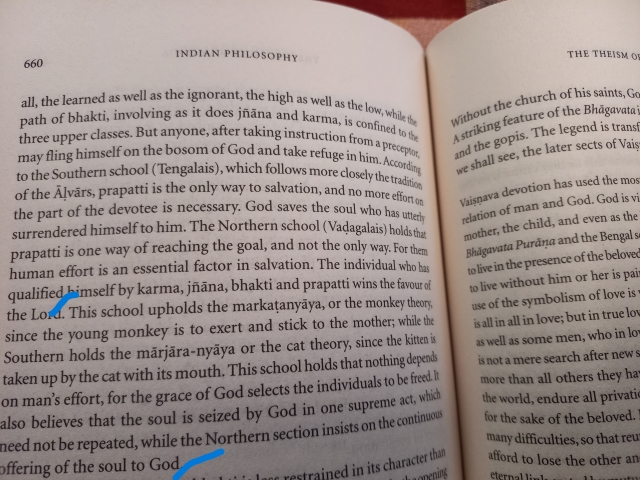
And the third and final example of their meddling in this book is about northern versus southern schools, which itself reeks of mischief as you can see. Further, animal metaphors are deployed to explain theories, in keeping with their obsession with animals and wildlife and to make me my younger sister, Bhavani Sundaram!
And lastly, I must add that just like the first volume ended on page 606, this one ends on page 727. Again, I suspect to make me my younger sister, Bhavani, or someone else!

