

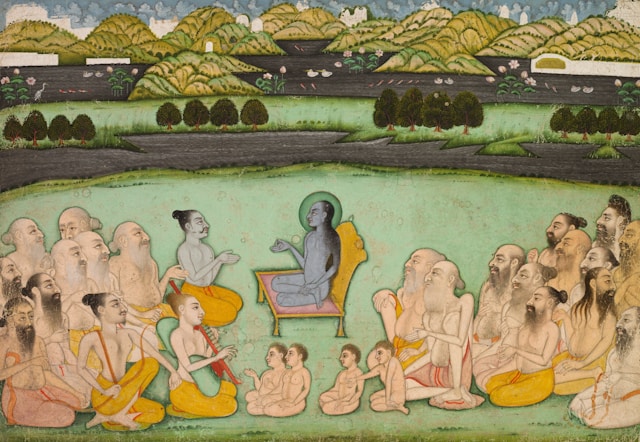
A couple of months ago, I happened to chance upon Indian Philosophy by Dr. S Radhakrishnan, a two-volume edition published by OUP in India. I was actually browsing on Amazon India searching for The History of Western Philosophy by Bertrand Russell which I wished to re-read and add to my now-depleted library of books thanks to termites at my aged parents’ place in Goa. Instead, these volumes on Indian Philosophy caught my eye and I bought them, since I had read Radhakrishnan’s Thirteen Principal Upanishads years ago at my aged parents’ place in Goa.
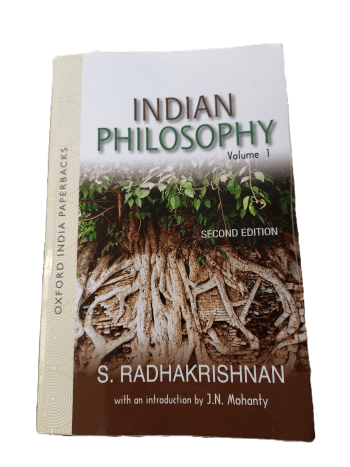
The first volume which is what I am writing about now comprises 11 chapters with the author’s own introduction to the book forming the first chapter. It deals with Indian thought and the dominance of intellectual interest that existed in India from ancient times. I had expected it to be a book of the history of Indian philosophy but as Dr. Radhakrishnan writes, Indian philosophy isn’t chronological but an amalgamation of many schools of thought over time, with many deriving from each other. Strangely, the author attributes the ferment of thought in India to the fact that “India was a land of plenty” and that “the climate was enervating.” I was reminded of Nirad C Chaudhuri who, on the other hand, thought that India was the Continent of Circe!
The first and most important observation Dr Radhakrishnan makes about Indian Philosophy is that most of it is spiritual in nature. If what he means by spiritual is “of the spirit” rather than things concerning matter, I am in agreement with him. But then, he quickly tells us that Indian Philosophy is mainly concerned with religion and that this is the main difference between Indian and Western Philosophy.
He writes:
“The spiritual motive dominates life in India. Indian philosophy has its interests in the haunts of men, and not in supra-lunar solitudes. It takes its origin in life, and enters back into life after passing through the schools…
The problems of religion stimulate the philosophic spirit. The Indian mind has been traditionally exercised over the questions of the nature of the Godhead, the end of life and the relation of the individual soul to the universal soul. Though philosophy in India has not as a rule completely freed itself from the fascinations of religious speculation, yet the philosophical discussions have not been hampered by religious forms. The two were not confused.”
Volume I of Indian Philosophy is divided into two parts: The Vedic Period and The Epic Period, and even though it is not meant to be chronological, it describes the evolution of Indian thought over centuries and millennia. The Vedic Period traces the evolution of Indian thought from the Rig Veda onward to the Upanishads. There is an entire chapter on the transition from the Vedas to the Upanishads, and yet another on the philosophy of the Upanishads itself. In discussing the Vedas, Dr. Radhakrishnan writes about the cosmology including the theory of creation, the religious aspects of the Vedas as well as the ethics, anticipation of the law of karma and the caste system.
In particular he notes that in the journey to the later Vedas such as the Atharva Veda and the Yajur, chants, spells and incantations make their appearance. And by the time we are in the Yajur, Samaveda and the Brahmanas, the freshness and simplicity of the religion give way to coldness and artificiality.
The author observes:
“When we pass from the Rig Veda to the Yajur Veda, Samavedas and the Brahmanas, we feel a change in the atmosphere. The freshness and simplicity of the former give place to the coldness and artificiality of the latter. The spirit of religion is in the background, while its forms assume great importance. The need for prayer books is felt. Liturgy is developed. The hymns are taken out of the Rig Veda and arranged to suit sacrificial necessities. The priest becomes the lord… The truly religious spirit could not survive in the stifling atmosphere of ritual and sacrifice. The religious feeling of the adoration of the ideal and the consciousness of guilt is lacking.”
While this might have been true, as the author’s explanation of some of the hymns of the Rig Veda do have a poetic quality and a spontaneity to them, which gradually disappeared in favour of liturgy, rituals, chants and the like, I think his explanation of why this might have occurred seems to be coloured by prejudice and loaded with value judgements, the kind I doubt Dr. S Radhakrishnan would have ever made. Besides, he makes no mention of the fact that the Aryans came to India millennia after the Indus Valley Civilisation and in fact helped to destroy what was left of it. From all historical accounts, it was the Aryans who had no knowledge or experience of an urban civilization, which is what the Indus Valley was before their arrival.
“The Vedic Aryans as they advanced into India came across uncivilized tribes, wild and barbarous, and worshipping snakes and serpents, stocks and stones. No society can continue to live in a state of progressive civilization in the midst of uncivilized and half-civilised tribes, if it does not meet and overcome the situation by either completely conquering them or imparting to them elements of its own culture.”
On the other hand, the author’s observation of priests assuming greater importance with religion acquiring liturgy, rituals and sacrifices might be a more plausible explanation of the shift from religion of the imagination and the spirit to one more concerned with forms and practices.
In writing about the Upanishads, Dr. Radhakrishnan believes that these are meant to be understood as man’s search for the ultimate truth and for understanding the soul, Atmaan, which is the same as what is referred to as the Brahman, the former being the subjective and the latter the objective. He also writes that the Upanishads uses the devices of discussion, conversation and argument, to communicate why the search for Brahman is critical to life. In fact, the chapter titled The Philosophy of the Upanishads makes for good and essential reading to understanding the Upanishads – if one hasn’t read them – but it is unfortunately too long, rambling and repetitive.
Part II, The Epic Period, begins with a chapter titled Materialism which is about the writing of the great epics such as The Mahabharata and The Ramayana and the approximate period when these might have been written. I couldn’t see why Dr. Radhakrishnan needed to provide historicity to what were mythologies of India, and I wonder if in trying to do so, he isn’t on slippery ground. This becomes even more evident when he also tries to argue that “this was an age alive in intellectual interest and philosophic activity” but isn’t convincing at all.
Dr. S Radhakrishnan writes:
“While the events related in the two epics of The Ramayana and The Mahabharata mostly occurred in the Vedic period, when the early Aryans poured in large numbers into the Gangetic valley and settled down, the Kurus around Delhi, the Pancalas near Kanouj, the Kosalas near Oudh and the Kasis in Benares, we have no evidence to show that the epics were compiled earlier than the 6th century BC…
There are many indications to show that it was an age keenly alive to intellectual interest, a period of immense philosophic activity and many-sided development. We cannot adequately describe the complex inspiration of the times. The people were labouring with the contradictions felt in the things without and the mind within.”
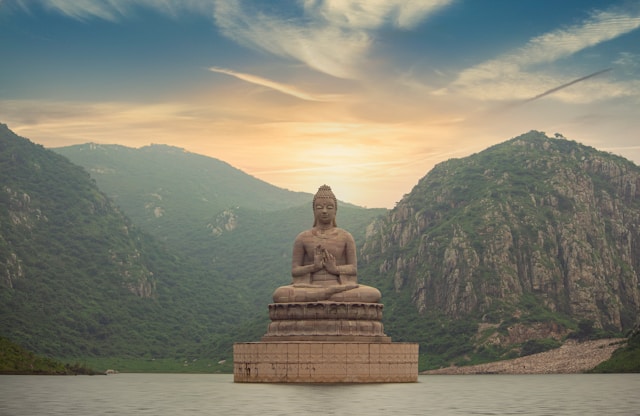
From materialism, the author proceeds to tell us about the pluralistic realism of the Jains, the ethical idealism of early Buddhism and the theism of the Bhagavadgita as well as the different schools of Buddhism. Dr. Radhakrishnan would like us to see all these developments as reactions and responses to Hinduism what with its focus on rituals, sacrifices and the caste system. At the same time, he is careful to point out the many similarities between the Jainist, Buddhist and the Hindu schools of thought, as they derive their ideas from the Upanishads.
One of the main distinctions between the Jains and the Buddhist philosophies that Dr. Radhakrishnan explains in detail is that Jainism places greater emphasis on metaphysics while Buddhism doesn’t rely on metaphysics but on ethics. The Jains believe there are five kinds of knowledge based on indriyas (the senses) and that the correlativity of mind and matter in every jiva (living being) is a composite of body and soul. The author tends to compare this difference between the Jainist and Buddhist schools with Greek philosophy where the metaphysics of Plato and Aristotle were followed by the ethical speculations of the Stoics and the Epicureans.
In fact, throughout the book, Dr. Radhakrishnan compares many philosophical ideas from India with those of western philosophers, such as Hegel, Kant and the Greeks, and one wonders if he wrote the book for western readers and students. Then again, he writes about the comparisons always being made between Indian and Western philosophy, including at the start of the book, about whether many of our ideas came from the Greeks! He also points out that many western readers see our philosophy as pessimistic and even dogmatic.
Dr. Radhakrishnan also explores the thinking of Nagasena, a Buddhist thinker from south India, about the theory of the self and the individual self. In his scheme of things, self is nothing but a stream of ideas and the states of self, or consciousness and intuition of self. When reading this section, I couldn’t help but think that this is metaphysics when Buddhism – or at least the early form of it – was supposed to shift away from metaphysics to a more ethical explanation of our lives.
There are several inconsistencies such as this at various places in the book. For example, in the chapter on Epic Philosophy, Dr. Radhakrishnan writes about how Aryans included new communities and tribes into their fold. He writes that in reconciling the religious needs and gods of the newcomers with Vedic culture, new religions such as Pasupata, the Bhagvata and the Tantrik elements were born. This, he says, was the main mode of “aryanisation” that took place in pre-Buddhist times. Are we then admitting that conversion and proselytization was practised by the Hindus, even if in unconventional ways by incorporating new gods and rituals into the Aryan way of life?
In The Epic Period section, Dr. Radhakrishnan also writes about the importance of the religious poem from The Mahabharata, The Bhagvad Gita, especially how Lord Krishna tackles Arjuna’s dilemma about going to war and fighting one’s own people. Krishna deals with it precisely as a moral and ethical issue and argues and persuades Arjuna that going to war in this instance was a righteous step. The author also discusses the Bhagavad Gita’s relation to the Upanishads and argues that the Bhagavadgita Upanishad is in fact based more on Samkhya and Yoga teachings than the Vedanta, even though it believes in non-duality or the Advaita philosophy. I had never heard of the Bhagavadgita Upanishad before and sure enough, when I referred to Dr. Radhakrishnan’s book on the Principal Upanishads, there is no mention of it!
In this section, there is also a strange quote referring to a cow and milk and I suspect that this too is the mischievous work of unprofessional PR agency idiot bosses from Perfect Relations.
“The full name of the Gita, as it is evident from the colophon at the end of each chapter, is the Upanishad of the name of the Bhagvadgita. The traditional account of the relation between the Gita and the Upanishads is contained in the passage now almost too familiar for quotation, that ‘the Upanishads are the cows, Krishna is the milker, Arjuna the calf and the nectar-like Gita is the excellent milk.’”
In fact, there are very many tell-tale signs of their meddling in the book, such as a stupid explanation of the Sanskrit word Aum (also spelt as Om). According to the author, AUM is an acronym standing for Brahma, Vishnu and Shiva, with even a footnote citing the Brihadanyaka and the Chandogya Upanishads as references for this. I am surprised they didn’t say AUM was “assets under management”. When, in fact, in Dr. Radhakrishnan’s own book on the Upanishads, “Aum or Om is the dawn, verily, the head of the sacrificial horse with which the world began”. Aum is usually considered an auspicious beginning, and is uttered at the start of a puja or prayer and even at the start of any new project.
Then, early on in the book, the author offers a strange explanation of the word deva and its comparison with the English word, “lady”. Under the section of theology in the chapter of the Hymns of the Rig Veda, the author writes:
“An important point to be borne in mind in this discussion is that the word deva is so very elusive in its nature and is used to indicate many different things… Deva is one who gives to man. God is deva because He gives the whole world.”
The footnote cited for “Deva is one who gives to man” is:
“We may compare this with the English word ‘lady’, which seems to have meant originally the kneader of the loaf. Lord has a somewhat similar origin – the guardian of the loaf.”
The author’s comparisons with Zoroastrianism and a footnote on Indians and Iranians and Aryans of Central Asia also strike me as PR agency idiot bosses’ mischief and meddling. Dr. Radhakrishnan writes:
“It is now a commonplace of history that the Vedic Aryans and the Iranians descended from the same stock and exhibit great affinities and resemblance. They came down from their common home into India and the Iran of the Zoroastrians, and in that central home they dwelt as one undivided race…”
Footnote cited for the above passage continues in the same vein:
“Indians and the Iranians are said to belong to the larger family of Indo-Europeans, with their subdivisions of Teutonic, Celtic, Slavonic, Italic, Hellenic, Armenian races. From a comparison of the beliefs and practices of these people scholars infer a sort of Indo-European religion… The history of Indian thought commences only when the Aryans of Central Asia separated themselves into two groups, the one making through (sic) Afghanistan to India and the other spreading over the territory called the Iran.”
Unprofessional PR agency idiot bosses can’t seem to make up their minds whether the Aryans were Indo-Europeans or whether they came from Central Asia. But how eager they are to claim European lineage and stock along with their white skin! From all that I have read elsewhere, I know the Aryans to have come to India from somewhere in central-eastern Europe or what might correspond to Ukraine in modern times, and they did travel to India via Iran and Afghanistan, on horseback. Central Asia had nothing to do with them.
Volume I of Indian Philosophy ends with chapters on Buddhism as a religion and the four schools of Buddhism. The Hinayana and the Mahayana systems of Buddhism as well as the four schools of Buddhism are explained well and dealt with adequately for an understanding of the way Buddhist thought kept adapting with the times. Indian Philosophy Volume I doesn’t just trace the history and evolution of Indian thought through the ages it tells us how each phase and movement – including new religions – were inspired and influenced by each other. In this sense of how all these various philosophical systems and religious thought are interrelated, it does full justice to including them under the broad title of Indian philosophy.
I am now looking forward to reading Volume II of Indian Philosophy, which explains the six philosophical systems of India and what constitutes Indian Philosophy in greater detail.
The featured image at the start of this post is by the Cleveland Museum of Art on Unsplash

Post script: Unprofessional PR agency idiot bosses cannot spare a single book of their toxic nonsense. As quoted from the book, the cow and dairy metaphor used to explain the Bhagvadgita and also claim that there is an Upanishad by that name is not just stupid, it is once again their mischief and obsession with bovine nonsense. I do not spell my name Gita but as Geeta, but this is besides the point.
Their toxic plan to make me Devi Cherian, if not Sridevi, our former maid in Goa, is also obvious in this book, with their stupid deva explanation. Actually, this deva-devi nonsense is from their guessing and doing mischief with an old classmate of mine from Modern School, Vasant Vihar in Delhi who was also later in the same college as I – Hindu College, Delhi University – Deva Sengupta. He studied English Literature, though, and went on to become a musician, as far as I know.
I am surprised that in their understanding deva is one who gives, and not cows!
I am also certain this meddling with OUP has come from reading my old emails or guessing that I had been to OUP in Delhi decades ago – in 2003, before shifting to Chennai to work with RK Swamy/BBDO – for an editing test to see if I could explore that as a freelance work option since I was in need of a job quickly as I had responsibilities towards my aged parents and my grand-mums who were in Goa. These Indian Philosophy volumes are called Oxford India Paperbacks, by the way!

