

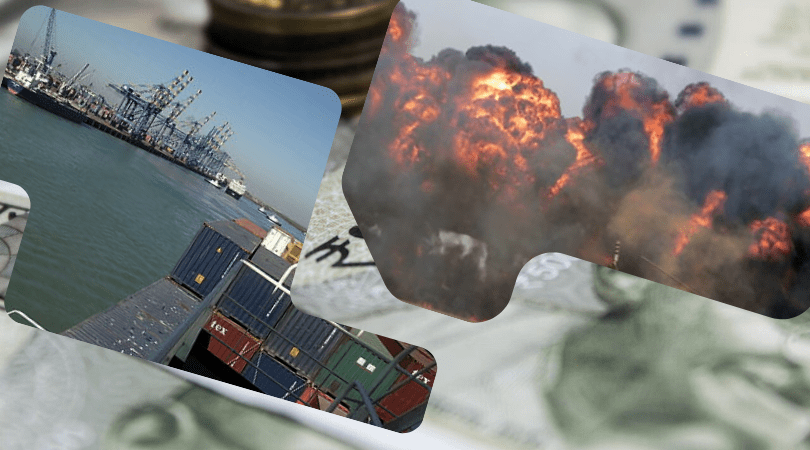
Even as there was relief in India over the long stalemate on tariffs ending and there being a lowering of tariffs to 25% from 50%, there has been no time to celebrate or even sign the final trade agreement with the US. Because, in the meantime, the US has decided to go to war with Iran along with Israel. This puts the entire world in danger from an economic standpoint, as well as increased uncertainty because the Middle-East War has already engulfed many countries around Iran in the region. And none is more vulnerable to these dangers than the Indian economy.
The Indian economy’s greatest vulnerability arises from the energy sector, where our country depends on imports of crude oil to meet 90% of its needs. Most of it comes from the Gulf region, where oil and gas production has been targeted by Iran’s retaliatory strikes against the US, where the Strait of Hormuz has been closed and where countries like Qatar have halted production of LNG temporarily. America has granted us a waiver on oil imports from Russia to tide us over the war period, which is so kind of them, but it also shows to what extent the Indian economy is linked to geopolitics and the external environment.
Resuming oil imports from Russia for the time being might help the Indian economy overcome some of the supply constraints and reduce oil price spikes in the domestic market, but we need to plan and prioritise well and tread cautiously in the weeks and months ahead. As it is, this government is famous for not passing on the benefits of lower international oil prices to consumers for years on end, and for increasing excise and import duties on oil in order to fill government coffers. They would rather pass on tax breaks to companies and to the middle-class, but tax all consumers – including the poor – through higher oil prices. This time around, LPG prices have been increased immediately in the unsubsidized segment, and the government has said that it will not raise petrol and diesel prices right now. Well, no one is fooled by this announcement, because we all know that state elections are round the corner.
Actually, it all depends on how long this war will carry on, and how many countries will be drawn into it. The Indian economy grew at a really good pace of 7.8% in Q3 of FY26, what with GDP base year also having been changed to 2022-23 from 2012 earlier. Q2 FY26 GDP growth has also been revised upwards to 8.4% from 8.2% earlier. All sectors of the economy have grown well in Q3 FY26, except for agriculture which was surprising considering we had a good monsoon and the kharif crop was said to have been good. It could have been a base effect as well, as agriculture growth in Q3 of FY25 was 5.8% before falling to 1.4% in Q3 this year, but as usual I also suspect unprofessional PR agency idiot bosses meddling with economic data and with numbers. Services sector growth has been exceptionally good this quarter with two sub-categories of it – trade, hotels, transport and communication as well as financial, real estate and IT and professional services – growing healthily at 11% and 11.2% respectively. The other big surprise was manufacturing growing at 13.3% and this doesn’t seem to demonstrate any base effects as manufacturing growth in the same quarter of the previous years are also good at 15.2% in FY24 and 10.8% in FY25. This too reeks of unprofessional PR agency idiot bosses’ interference, as they are obsessed with manufacturing which has not been growing as much as desired, despite all the PLIs being announced by the government.
What is encouraging is that private consumption growth and investment growth are both strong for Q3 FY26 at 8.7% and 7.8% respectively. Of course, we don’t know the breakdown of how much private investment CAPEX actually contributed to the growth of gross fixed capital formation, and in all likelihood, it is still weak compared to what the Indian economy needs. The bigger worry is India’s rising imports which are not only higher than exports by around Rs 1.25 trillion for the quarter, but which also grew by 8.6% while exports grew by 5.6%. In the current context of the war with Iran, and with crude oil prices having crossed US$100 per barrel, our import bills are hugely impacted what with a weakening rupee as well.
The Indian Union Budget that was presented just over a month ago might have to also rethink some of the allocations made. This is on account of the fact that some critical imports of food, oil, chemicals and fertilisers might rise and therefore impact the subsidy burden of the central government and social spending. As it is, I must say that once again the central government has spent less on important social schemes especially those on education and healthcare as well as Jal Jeevan rural water in the revised estimates as compared to the budget estimates for FY26. Allocations for FY27 are more or less at the same level, except for MNREGA where the Central Government component as per the tweaked and rebranded MNREGA at a mere Rs 300 billion is lower than what 60% of the past years’ allocations of around Rs 930 billion – Rs 960 billion would have been.
Allocations for defence equipment in FY27 are sharply higher as are those on roads and highways under NHAI, as always. I must also mention that the budget documents that I first saw in early March on the Finance Ministry’s website are not what are available now, as they have almost all been recast in a new format by the ministry, which is also unprofessional PR agency idiot bosses’ doing, I am sure. Depending on how long this war lasts and its economic impact on our economy, some of these allocations might have to be rethought and I think good economic sense would require that social spending including subsidies to the poorer sections of the population receive greater priority and more attention than defence equipment and roads and highways, if it comes to deciding priorities.
Besides oil, there are several other commodities that will also see price rises thanks to supply constraints and higher shipping and freight costs. This is going to have a significant impact on industry in terms of higher input costs and securing supply chains. The impact on consumers will be in higher inflation in the months to come, and this would, of course impact companies’ earnings as well as consumption demand.
In the early days of the US/Israel-Iran war, stock markets across the West seemed to shrug off the impact, perhaps on the leaders’ statements that the war will be a short one. Only in India was the impact negative from the start and investors have seen billions of their wealth wiped out in a matter of days. It is in this context that the Indian economy needs long-term private investment to grow and to create more and better-quality jobs. And we also need long-term FDI to ensure more stable investment and building of our technological capabilities. The Economic Times reported that in Q3FY26, India’s current account deficit widened to 1.3% from 1.1% in the same quarter the previous year and with foreign portfolio investors pulling money out of India, the situation for the full FY26 could be worse than the previous year. The overall balance of payments situation seems to have been negative for two of the past three years, and mostly on account of capital investment, from what I read on RBI’s website.
Even as the Iran war casts its shadow on economic growth, India must continue to attract long term FDI in new technology industries as well as those that are less energy intensive. This augurs well for information technology, pharma and perhaps even some FMCG as well as discretionary goods. We should also seek long term FDI in industries of the future, where our technological capabilities are weak right now and we would benefit from technological collaboration as well as technology transfer, as I wrote in a recent blog post.

India must also increase its focus on growing its MSME industries and use the recent FTAs we have signed with many countries to good advantage. For example, increasing our LNG imports from Australia during the war while Qatar is adversely affected might be a good idea. If the war continues for longer than a couple of months, it will impact global trade as shipping routes remain disrupted and as costs of shipping and freight rise. This would affect India’s exports and imports in the short term, and the government must cushion the impact of the war and energy supply constraints on critical areas, through higher and well-targetted subsidies as well as lowering import duties on certain critical goods.
Inflation, especially core CPI needs to be watched closely, because higher energy prices do work their way through into general inflation. The RBI must keep a close watch on this and avoid hinting at any interest rate cuts in the near term. They are conducting a large OMO (open market operations) bond-buying programme in two tranches to ease liquidity conditions in the banking system and this should ensure that adequate credit is available to the corporate sector and to households in the coming months.
We will be approaching another earnings season soon and it’s worth looking at the financial performance of Indian companies this year. From CMIE’s analysis of all listed companies, it appears that India Inc had the best quarter in Q3 FY26 in terms of revenue growth at 9.9% as well as net profit growth of 16.6%, even as expenses rose more than in the prior quarters at 9.6%. MoneyControl puts the Q3 FY26 revenue growth for all listed companies at 14.11% and net profit growth at 12.42%. From their analysis, it appears that large, medium and small cap companies all saw good revenue and net profit growth, except for small-cap companies showing a decline in net profit of -1.65%.
Anyway, this is not the time for India to be chest-thumping and bragging about its economic growth. This is the time to quietly hunker down and concentrate on prioritizing and planning well in order to mitigate or at least minimize the damage to our economy, especially to the poorest and most economically vulnerable sections of our society. We are in unprecedented times geopolitically, and in challenging times economically, and it is our ability to think and act strategically that will benefit us in the longer-term.

 Peripatetic Perch