


As we conclude 2025, during which my blog at least celebrated 25 years of the 21st century through innovations, it is time to cast our mind to the new year and what it might bring. 2025 will be remembered as the year that unleashed a tariff and trade war between the US and almost every other country in the world, and in which the US President has also tried to dismantle the world economic order, as I have written previously on my blog. This in addition to two major wars that continue to rage in Europe and in the Middle-East.
2026 might already be a milestone year, since it would mark a decade of the rise of far-right politics and populism across the western world. The kind that brought Donald J Trump and Boris Johnson into office in 2016 in the US and UK respectively, and caused the UK to leave the EU. These political leaders honed in on the discontents of globalization and the thousands of people who lost their jobs across a swathe of industries, and appealed to their sense of angst and anger, as well as nationalistic nativism, if I might call it that. Their solutions seemed to be to disengage with the world and focus on setting their own house in order. Nothing wrong with this, except that it manifested itself in the most disruptive and divisive kind of politics in both countries, and similar sentiments were rising across the pond in continental Europe as well.
Globalisation was being blamed and berated, and in a strange queering of the political pitch, far-right political parties across the West were championing the working class. The far-right also raised the levels of their anti-immigration rhetoric and vowed to keep immigrants out as much as possible, whether legal or illegal. They promised to bring back millions of jobs, plenty of investment back to their home countries and plenty of other populist ideas such as lower taxes for the middle-class (read working class in America) and the like.
Ten years later, it is worth examining how effective these far-right movements have been. How much of the promised economic benefits did these far-right political leaders deliver and are the “forgotten” and “left-behind” people actually better off today than earlier?
We can extend the purview of the examination beyond economic benefits to the older working class (which form the core of the MAGA voter base in the US and Brexit in the UK) to also include the political discourse in these countries which are dominated by rising far-right parties, as well as the extreme polarization that has taken place across the West politically, culturally and economically. I would also extend the scope of this piece to include countries in Europe, in addition to US and the UK, because we must recognize that the MAGA movement is itself trying to spread its tentacles and actively promote its toxic identity politics inside Europe.
On the economic front, it appears from what I have been able to read online and the data that I have seen that the older working class in the US and in UK have not benefitted all that much in the past ten years and more. And although there is no data available specific to the MAGA or the Brexiteer constituency, we can approximate for it by looking at the older, non-college educated populations especially those living in the more rural areas of the US and UK. Unfortunately, even when I searched for data on median income in the US by age and educational attainment, there is no data specifically for the 40 or 50 years and older group; they are all lumped together under 25 years and over. According to the US Census, median incomes for full-time year-round workers without a college degree above 25 years and over, grew from US$ 46,550 in 2014 to US$ 50,640 in 2024. This works out to a growth rate of 8.78% over ten years. If we go back another decade, it appears that this set of workers are at the same earnings level in 2024 as they were in 2004, when the median income was US$ 49,050. In fact, there is a footnote to the data for 2017 saying that an updated processing system was put in place and is relevant for 2018 and subsequent years. In all probability then, the growth in earnings post 2017-18 reflects the updated processing system or the method of calculation, and not genuine improvement in earnings.
Next, if we consider the distribution of this income cohort in the US, the percentage of white households in the US$ 35,000 to US$49,999 income category has fallen from 11% to 9.7%. While households in the US$ 50,999 to US$ 74,999 income category have remained static, at around 15%. The median household income for white households overall in America has risen from US$ 73,190 in 2014 to US$ 88,010 in 2024, a growth rate of 20% over 10 years. I would add that this is probably because the higher income categories among white households see better growth in distribution terms, and also because the education filter is not applied in this case. The only other observation I made seeing this data is that the percentage of white households in the lower income categories has declined in the decade 2014-2024, while those in the highest income categories have increased significantly. The middle-income white households have stayed steady.
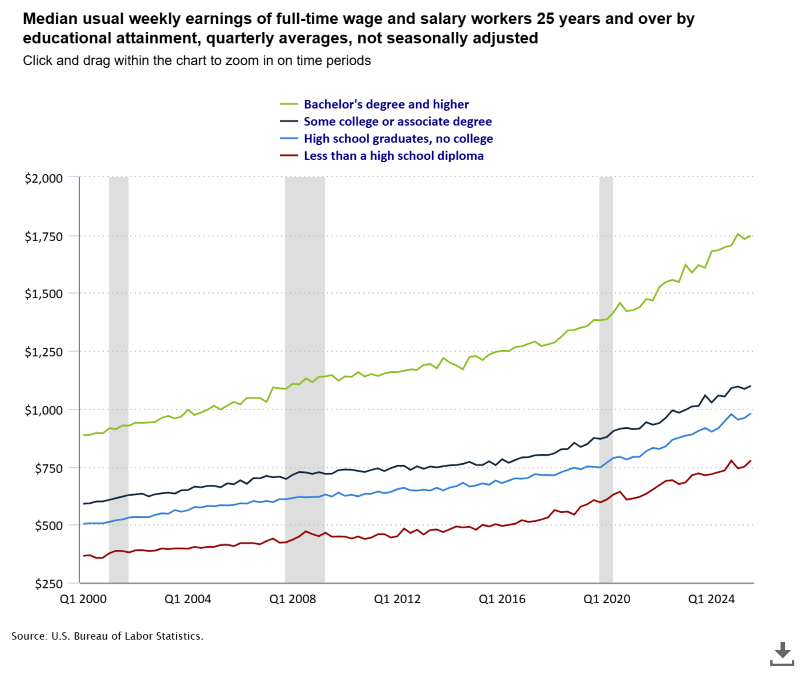
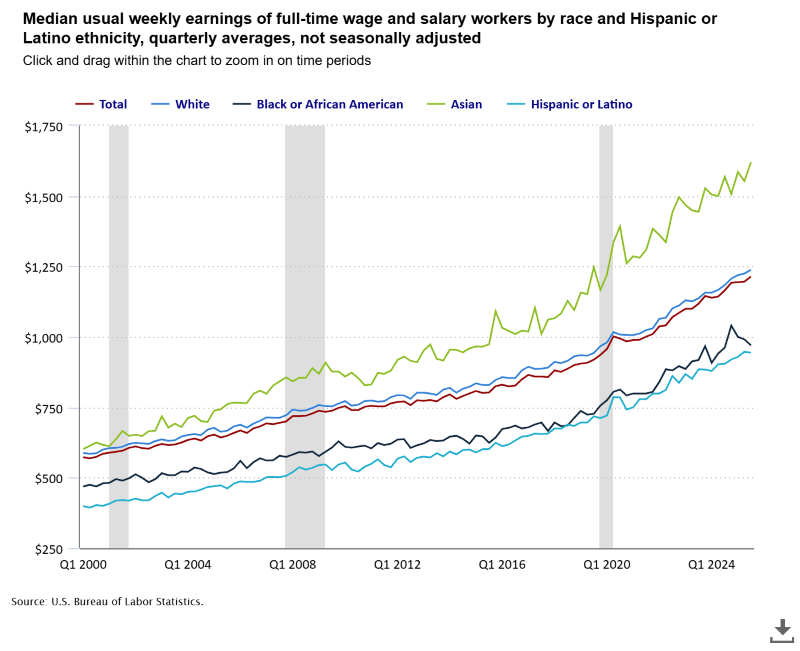
We all know that Trump’s 2017 tax cuts also benefitted corporations and the wealthy, not the MAGA voter base. Now that those tax cuts have been extended, we can expect the MAGA voter base of the white, not-college educated workers to not benefit very much economically. In fact, they are likely to be hit harder by the higher import tariffs that the US has imposed when many more companies begin to pass the tariffs on to consumers in America, and the prices of most goods rise. Therefore, not only are MAGA voters not gaining from Trump’s tax policies, they will be adversely impacted by the higher import tariffs. Already, Trump has had to cushion the blow of food prices spiking in the US by lowering /removing tariffs on many imported foods.
In the UK, I had even more trouble finding relevant data for the Brexiteer constituency who, like the MAGA voter base, also belong to smaller towns and rural areas and are also older, white and not-college educated. From media reporting during the days of the Brexit referendum, it appeared that the Brexiteers were arguing for freedom from EU rules and regulations, and promising their voter base better jobs and economic prospects and the ability to be able to control their own destiny. There are surveys that indicate that Brexit has largely been a disappointment, as I have written previously on my blog. Brexit hasn’t provided the impetus to growth, nor the increase in investment and jobs, and if anything, it has added to cumbersome paperwork and delays in getting business and trade done. Still, parties such as Nigel Farage’s Reform UK keep harping on the same message and the party seems to be gaining seats in parliament as well in local elections.
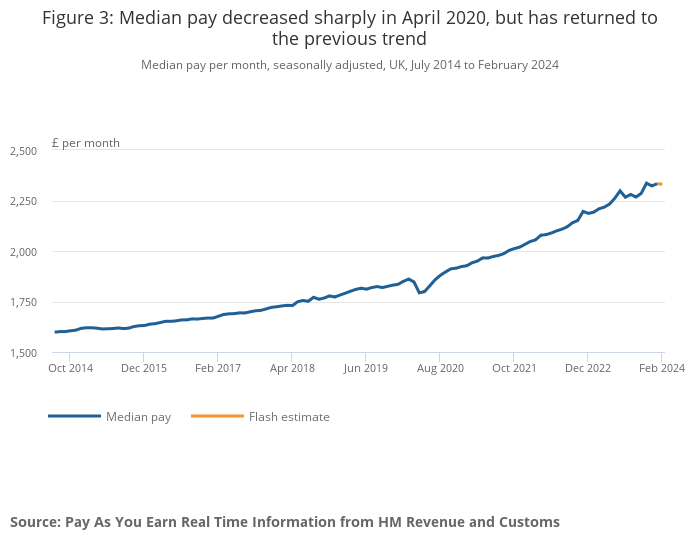
In the UK as in much of Europe, the right-wing gaining popularity is largely a regional feature. Since most of the economic development has been concentrated in London and South-east England, followed by Birmingham Metropolitan Area and Manchester to a smaller extent, the rest of England, Scotland, Wales and Northern Ireland have been economic laggards and not much investment gravitates to these areas. Here too, loss of jobs to globalization and immigration are blamed, when many more jobs were probably lost to technology and automation. If we consider the median monthly pay for payrolled workers in the UK, there are huge regional variations, but this chart below suggests that it has grown between 2014 and 2024. This is not adjusted for inflation, though.
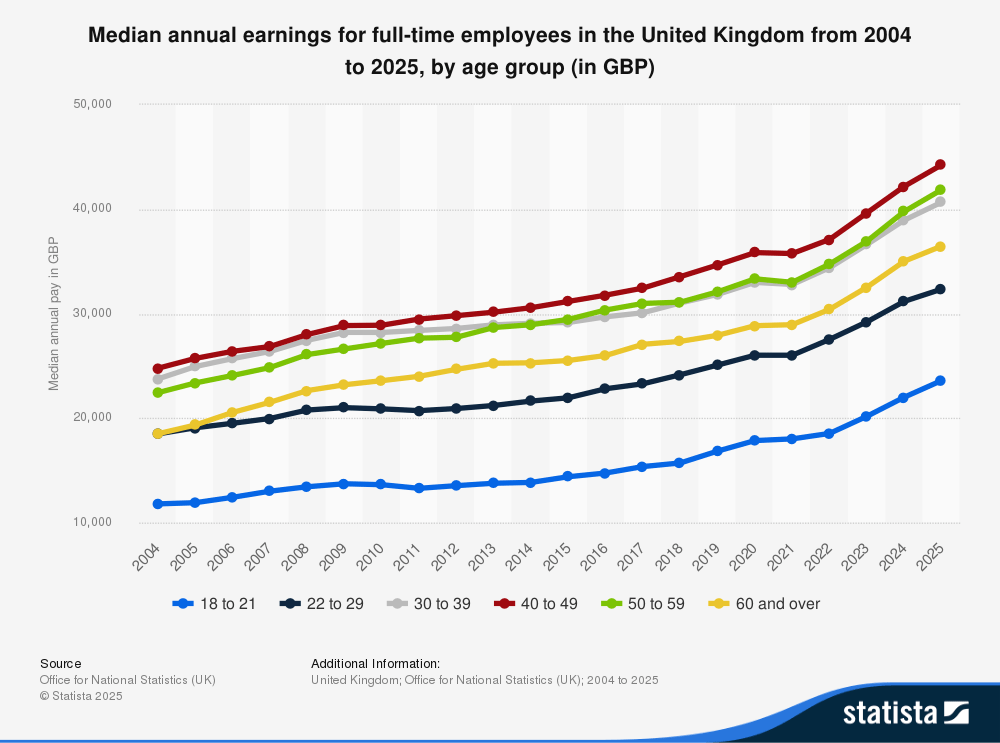
The regional differences are more apparent in this document from the UK Parliament that was served to me by Google, as are the variations by age. It appears that the 40-49 age group has seen the largest increase in weekly median pay in the UK, followed by the 50-59 and 30-39 age groups, as the chart from Statista also reveals. However, one piece of statistic tucked away into the text struck me as curious: when we look at this in real terms over a time horizon of 2008-2025, the document says that 18-20 year-olds saw a real increase of 12% over 2008 and that there was a 27% increase for 16-17 year-olds, while all other age groups merely returned to their 2008 levels in real terms. I wonder if this isn’t unprofessional PR agency idiots from India meddling with economic data even in the UK, not just in India!
Another document from ONS seems to indicate that the regional differences also matter less when adjusted for inflation. When we look at weekly median pay for full-time employees across regions of the UK between 2002 and 2025, adjusted for inflation in 2025 prices, even London and the South-east don’t gain much; on the contrary, Wales, Scotland and Northern Ireland gain the most followed by the North East and North West, which is strange. Perhaps it is housing costs that accounts for the huge regional difference. However, if we consider the growth in median weekly pay between 2008 and 2025, almost all regions suffer, with the exception of Wales, Scotland and Northern Ireland which see an improvement of 3%-6%. I am not sure if this is the effect of the 2008 Financial Crisis!
What is certain is that there are many factors to consider and the nuances of economic data also matter. I think besides age and regional variations, there is also the question of what kind of occupations people are employed in across the UK. And even if people are employed and their earnings are improving, if they do not feel better off with time they are bound to fall prey to right-wing politicians who make political capital out of their fears, disillusionment and misgivings.
Across the pond in Europe, we know that far-right political parties are on the ascendant and in the last European Parliament elections, most right-wing parties gained more seats even if the centre managed to hold. In fact, the stunning gains made by the right-wing parties prompted the French President Macron to call for snap elections, which I thought was a terrible move and wrote about it on my blog as well.
In Europe as well, the rise of the far-right has to do with regional variations in economic development, mostly within countries. The data available from Eurostat is country-specific and pan-EU/pan-Euro Area, and does not provide much information on these regional differences within countries. It says that median income across the EU rose by 33.7% between 2015 and 2024, while that for the Eurozone rose by 34.9% during the same period. At a general level, median income growth for countries in western and northern Europe is quite good. Italy, Spain, Greece and Southern Europe lag, and Central and Eastern Europe are even farther behind. The Netherlands features among the high median income countries – higher than even France and Germany – and has also seen impressive growth of 50.2% in the 2015-2024 period. One wonders what their reason for pursuing right-wing anti-immigration and anti-EU ideas could be; it must be noted though that only recently did Netherlands manage to prevent Geert Wilders’ The Freedom Party from coming to power.
If we look at median income by education attainment, because the less-educated workers are the far-right parties’ constituency, it appears that for Euro-area countries, those with less than primary and lower secondary education are not only earning less than the better educated, their median income gradually decreases after 2008 and dips even further in 2012 (the year of the Euro-crisis), and it actually returns to 2008 levels only in 2017 before growing slightly by 2021. Those with primary and post-secondary non-tertiary education fare better with median incomes higher by a third at the start in 2008 and their incomes too grow more after 2017, ending with a 15% higher income in 2021 than in 2008. Those with tertiary education start even higher in 2008, and their incomes stay steady until about 2016, when they experience better income growth ending up in 2021 with 19% higher incomes than in 2008.
For the wider EU (28 countries), the median incomes for all groups of education attainment start much lower in 2010 and end lower as well than their Euro-area counterparts in 2019. In fact, the median income for the least educated group in EU reaches Euro-area 2008 levels only in 2019. And the highest-educated group in EU doesn’t reach the 2008 income levels of their Euro-area counterparts until 2016.
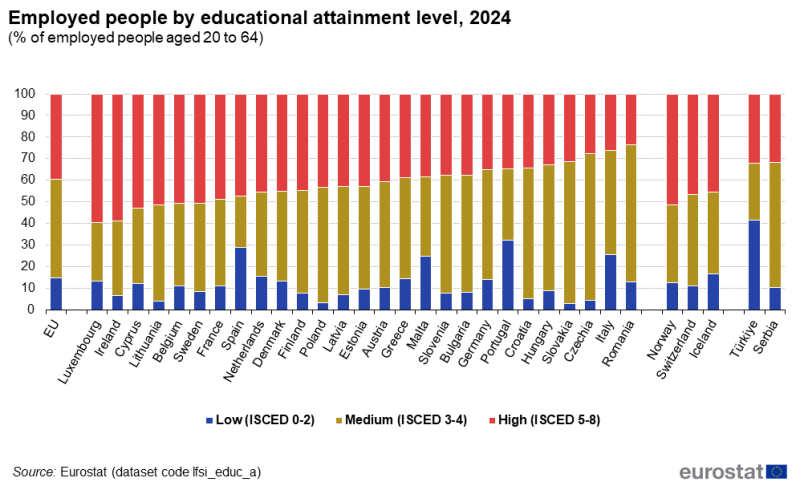
We can see that the less educated – less than primary and lower secondary education are the worst-off, and these are people who are being wooed by far-right political parties, though their policies offer no solutions. What’s more the proportion of less-educated people employed in Europe has only increased between 2015 and 2024. This is true for the Euro-area, the EU and for individual countries. The share of less-educated workers in the workforce is higher in Eastern and Southern Europe, but I could hardly find a single country in Europe that has seen a fall in the share of less-educated workers. I must mention that there is a problem with the data as the distribution of the employed by education attainment doesn’t total to 100, if these are the only three categories of educational attainment.
I must also mention that the Europe median income data is not adjusted for inflation. Besides, the median incomes include social transfers from governments to the extent of 25% on an average which is significant, considering social spending in Europe tends to be high. Europe also tends to suffer from high unemployment – higher than in the UK or US.
In the midst of all this disruptive and divisive politics of the far-right across the western economies, we have the disruptive effect of technology to consider. This is having a different kind of effect on the labour market compared to the information technology and automation of the 1970s and 1980s. The internet and AI are having a profound effect on industries and therefore on work itself. Yet, politicians of all stripes, and especially the right-wing ones, are the biggest cheerleaders for these new technologies. This is because they have realized that power will be wielded by those who have access to these new technologies and that it also matters in the economic competition between countries. Does their politics have an explanation or a solution for how they will deal with the effect of these new technologies on employment?
If in the past decade they have not managed to better the lives of the “forgotten” and “left-behind” people and their earning capacities, what chances are there that their divisive politics can resolve them now. If in the past, they could not prepare their people for new technology, retrain and upskill them, what hope is there that they will do so now. In fact, the far-right will have to confront the realities of digital technology and AI in terms of how it will transform entire industries and replace many jobs. They will have to admit that it was never globalization or China alone that took away their people’s jobs and livelihoods. It is just that the effects of technological progress and automation were more gradual in the past decades. No longer. Now we can already see the swingeing effects that AI is having on the future of work and it is leading to massive layoffs at companies every few months. There will no globalization to blame; in fact, right-wing leaders are doing their best to deglobalize because it suits their nativist ideology and isolationist politics.
Far-right politics has its work cut out. It has plenty of figuring out to do in the months and years to come. And it better have the answers, for the right-wing electorate will no longer be satisfied with mere promises. In this context, it is perplexing why the far-right MAGA cannot see it yet in America. The fact that Trump is chummy with big tech tycoons this time around ought to be reason enough for the working class to ditch him. However, no point blaming the electorate when the Republican Party cannot see for itself what is coming. How they will reconcile their right-wing ideas and embrace of tech with their populist championing of the working class is anybody’s guess.
Meanwhile, right-thinking people all over the world must think about how we can save the world order that has served all of us well for decades. It goes back a century to the end of World War I, when a new world order was born, and was strengthened with the end of World War II, in 1945.
Let 2026 be the year for thinking about how we can save the world order that Trump is trying to destroy.

Post script: Although I have mentioned the possibility of unprofessional PR agency idiot bosses from India meddling with economic statistics in this article, I must stress that their meddling seems to be truly global, as they appear to have interfered with the reporting of economic data by government agencies in all regions from US and UK to Europe.
These unprofessional PR agency idiot bosses are also getting companies and governments to cover for their unprofessional nonsense: I am now seeing economic data by gender being presented as by sex! And their nonsensical colour-coding with red, yellow and blue as can be seen in the Eurostat chart too is obvious; don’t miss the least-educated group being shown in blue, while the highest-educated is in red! When red earlier was for sex workers!
They have taken their meddling with economic data in India truly global and are an embarrassment and a disgrace, as I have said before. Such circus buffoons ought not to be in the industry, as their spreading of their unprofessional work ethic is all-pervasive and corrupting.
 Peripatetic Perch