


While we can expect the trade and tariff wars to get a fresh impetus next year with President Trump in office, what are the chances that we can find a way to end the wars next year and bring peace to the world? From media reports it appears that Trump is himself all for ending the wars, though more important is how he achieves it.
The two major wars raging in the world are taking their toll on millions of people, their lives and livelihoods as well as economies of entire countries and regions. While the Ukraine conflict is said to have begun in 2022, it is actually over 10 years old already, because Russia first launched its attack on Ukraine and also annexed Crimea in 2014. Israel’s war with Hamas in Gaza is over a year old already and because of Israel’s use of disproportionate force, most of Gaza has been razed to the ground it appears from news reports. The people of Gaza and indeed, all Palestinians are in grave danger as there is no safe place to go to, and thousands have already lost their lives.
Israel’s recent ceasefire with Hezbollah came after intense bombing of Beirut in response to Hezbollah’s missiles, and no one can tell how long the ceasefire will last. From all the recent ceasefires between Israel and Hamas, the world ought to know that these are always temporary and fragile. In addition, all such ceasefire agreements so far have been only about allowing humanitarian assistance to go through as well as the release of Israeli hostages and the exchange of Palestinian prisoners. The central issue of the question of Palestine and a state for the Palestinian people has been skirted for decades, and until and unless this is resolved, all else is but an exercise in futility.

At the moment though, we have the Israel-Hezbollah ceasefire and there are media reports of a possible ceasefire agreement with Hamas as well. There seems to be another round of peace talks brokered by Qatar and Egypt to take place in Cairo and Israeli prime minister, Netanyahu is himself said to be attending it along with his delegation. Could it be that we may finally see the end of all this mindless violence and brutal wars sometime in 2025?
It appears to me from all that I am reading and hearing in the news that Israel is flexing its military muscles and talking peace at the same time. This while expecting groups like Hamas and Hezbollah to give up attacks unconditionally, even as Israel continues its relentless bombing of cities and towns in the region. Israel is obviously doing this in order to show who’s boss and to gain the upper hand even in the ceasefire talks if any progress is made in these. We have Israel’s behaviour in Syria at a time when the country has just been freed from the despotic regime of Assad and ordinary Syrians are breathing a sigh of relief, to tell us how serious Israel is about achieving peace in the region. They immediately seized the opportunity to seal off the small border they share with Syria, have taken over Golan Heights which they have been eyeing for decades and are planning more settlements there it appears, while bombing Damascus even if they claim they are targeting only military installations in Syria. Surely, these acts too are violations of international law?
This is the reason I say that the UN should act more firmly and quickly to bring Israel and countries of the Middle-East region to negotiate directly and find a way to end the conflict. The way forward is not merely to go from one ceasefire agreement to another, but to chart a path to larger negotiations on the political settlement which can be no other than a separate state for the Palestinian people and one in which Israel has no jurisdiction or right to interfere. It is the Islamic countries of the region that ought to push this cause more assiduously and prepare a plan for such a state which can be discussed with Israel and the UN.
Hopefully, in pursuing such a goal, these countries will finally abandon their sectarian agenda of Shia vs Sunni and other such divides that have weakened the cause of a separate state for Palestine and the demand for it. These sectarian divides have also been exploited by the western world and other countries to keep the people of the region divided, even leading to terrorist groups being formed, new offshoots being formed all the time, and worse. It is also time, as I have been writing on my blog, that the wealthier nations of the Arab world contribute to rebuilding the Middle-East region country by country, and bring peace and prosperity to everyone there. This would help build confidence and trust in the region’s new regimes and allow economic and financial help from multilateral institutions, as well as foreign investment to flow in. But, of course, first and foremost the requirement is of security and law and order. People must be allowed to live in peace and feel safe in their own lands.

I have written before that of the two wars, the Middle-East one is nearer to resolving, even though peace in the region has been elusive for decades. I say this is closer to resolving, provided the countries of the Middle-East region themselves show a keen interest and resolve in achieving the long-term goal of a separate state for the Palestinian people, and help to bring it about.
The Ukraine-Russia conflict has its seeds in an asymmetry that has developed over the past many decades between Russia and the West. The days of the Cold War, when the USSR and the US could compete with each other economically, militarily and ideologically are long gone. However, this was not entirely replaced by a more liberal democratic regime in Russia as many in the West had hoped; its transition to democracy went awry, and it has very much to do with President Putin’s own ambition and vision for his country. Ukraine is but a pawn in Russia’s powerplay and it is clear in this conflict that Russia as the larger power is the aggressor. There seem to be two critical issues at the heart of the Ukraine-Russia conflict to my mind:
- Putin’s belief that Ukraine has no right to exist as a separate country and that Ukrainians are Russians
- Putin’s view that Russia is threatened by the continuous eastward expansion of NATO, that it sees as an instrument of western military power
I do not think the world ought to waste any more time, energy or lives, debating these views held by Russia; more important is to find a way to quickly move ahead to resolve the conflict. In my opinion, there are areas that can be found for negotiation on both these issues. In the first instance, Russia has not only been fighting a long battle in the eastern Donbas region of Ukraine that it claims is Russian because the local population there speak Russian and strongly identify with Russia culturally, it has even gone so far as to conduct Russian elections in the region.
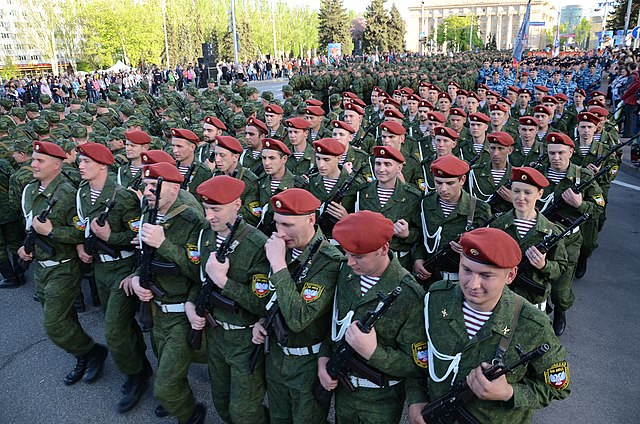
Therefore, one way forward might be to have the UN conduct a plebiscite in the Donbas region of Ukraine and let the people decide if they wish to emigrate to Russia. This way, the people of the region get to make the decision on where and how they wish to live. I suppose this option is already available to residents of Donbas, but a plebiscite would be a more fair, official and legitimate way to settle the issue once and for all.
On the second and more contentious view that the continuous eastward expansion of NATO is a threat to Russia’s security, there are many even in the western world who share this view that perhaps the expansion of NATO has gone too far. This must be seen in the context that many arms agreements between US and Russia governing how their military weapons are to be used – including new ones that were signed by the Obama administration – have also been ripped apart in more recent years. Therefore, the world is operating under a security system that is no longer governed by any common understanding of how arms and nuclear weapons in particular are to be used against each other, and is instead being replaced by only the NATO system which is underwritten by America for the most part.
If we were to try and address this concern, perhaps it would be worthwhile for Ukraine to give up on its NATO ambitions and instead only pursue its membership of the EU. The EU membership, although fast-tracked, will take a few years and will at least help Ukraine rebuild its country and its economy. While President Trump might force Ukraine to concede to all of Putin’s demands if he has his way, it remains to be seen if the rest of the western allies are united in supporting Ukraine in defending itself and in ending the war with a reasonable compromise. If Ukraine can be assured of security guarantees from EU and western allies, there is a path forward to negotiations to end the Ukraine-Russia conflict. There would be a climbdown from their hardened stance on the part of both countries and they and the rest of the world can get on with growing their economies and improving their people’s lives.

2025 might just be the year to improve the kinds of solutions we find to the raging conflicts. It starts with identifying problems correctly. If you ask me, identifying the problem of the Russian-backed separatists in the eastern Donbas region of Ukraine as one of demand for greater autonomy and devolution of power was a mistake. This put the onus of resolving the issue entirely on Ukraine while Russia could stay out of it as a “party” even as it was fuelling the separatist movement. If we had instead recognized the issue correctly as one of people and not of territory, we might have held a plebiscite for the people of the region as a solution, and not dragged the conflict into a full-scale war years later. The Minsk I and Minsk II agreements failed mainly because of the way they were framed and also because neither parties to the agreement kept up their end of the bargain, as the ECFR points out.
Similarly, in the Middle East, we have a chance to improve on all the peace accords and agreements of the past. The most recent Abraham accord which seeks to bring Arab countries and Israel closer is based on improving business ties between the countries. It is good in that it might have created a climate of confidence and trust between Israel and the Arab world, but it ignores non-Arab countries that also happen to be Islamic and profess support for the Palestinian cause. And finally, as long as the political solution of the Palestinian state is not found, long-term peace in the region will always remain elusive. It is time now for an agreement between all Islamic countries in the Middle-East region to frame their own solution for a Palestinian state and negotiate with Israel as equals.
If the political will to end the wars and usher in peace exists, we might just stop them in the New Year. Of course, it will also take the best minds and the right approaches to frame the right solutions.
The featured image at the start of this post is from Pixabay

 Peripatetic Perch