

With large parts of the world going to elections this year, it’s worth looking at some of the political shifts that could signal changes in economic policy as well. India has just concluded a mammoth 7-phase election and I have written about its implications for the Indian economy in my previous blog post. Parliamentary elections have just ended in the European Union and the UK has announced early elections next month and I’d like to examine what effects they might have on these countries and their economies.
As opinion polls seem to be suggesting for a long time, the Tories in UK are set to lose in the upcoming election announced for July 4, 2024, while Labour is set to return after 13 years or more in opposition. The reasons seem to be disenchantment with the economy for the most part, especially the state of public services, as well as with Brexit. The UK economy does need serious attention not merely in terms of fixing public services such as the NHS, energy and water utilities as well as railway infrastructure, but in terms of long-term issues such as ageing demography, low productivity and loss of competitiveness.
Britain is a far cry from the global Britain that was being promised by the Brexiteers some years ago. I have not read what the two main parties are proposing as economic reforms or indeed what their election pledges or manifestoes are, but if Labour is true to form, Britons can expect an increase in public spending, especially on public services as those mentioned earlier, that is funded by increased borrowing as well as raising taxes. Hard to imagine how they can increase spending and investment in these areas without raising taxes, as that would tend to bloat the debt and fiscal deficits which will be inflationary. I am not sure that nationalization is the best solution to resolving problems with utilities and rail infrastructure, as the Labour Party is rumoured to be considering.
Across the English Channel, news of the EU Parliamentary Elections are trickling in. As news reports and polls seemed to suggest, far right parties across many European countries, including France and Germany, have made huge gains. The final results have been announced, and it appears that the centre-right EPP might still be the single largest political bloc, followed by the centre-left S&D alliance of social democrats. This too is along expected lines, though it should not leave the world feeling sanguine about the outcome.
The fact is that for the past two EU parliament elections at least, far right parties have been making gains, while centrist and centre-left parties seem to be losing ground. EPP and S&D still holding their ground is no reason to think that stability and continuity can be taken for granted. There seems to be plenty of discontent and anger simmering beneath over a variety of issues ranging from high unemployment and reduced entitlements and subsidies, to immigration and climate change policies. While many EU countries have generous social welfare and entitlement programmes, these have had to be cut back and reformed after the 2008 Financial Crisis and the Euro Crisis of 2012. Unfortunately, many countries had to offer employment protection programmes during Covid-19 pandemic and then during the Ukraine conflict also offer subsidies on energy prices. France’s much-needed pension reform led to widespread protests across the country and it passed into law despite Macron’s party’s lack of a majority in parliament. And this time, he has called for a snap election since his party suffered major losses in the EU elections.

These are complex and difficult issues for EU countries to grapple with. The surge of the populist far right in Europe is going to have an impact on economic policy. Take climate change, for instance. The EU leads the world in terms of its climate change policies and clean energy transition; yet most of the farmers’ protests across Europe last year were over these very regulations that raise the costs and the prices of their produce and make them uncompetitive. This brings us to the crux of the choices Europe has to make: boosting economic competitiveness and growth while also making structural shifts in terms of climate change, AI and tech disruption as well as defence and security of the region.
Both Britain and the EU are dependent on external demand, and whether they like it or not, they are dependent on the world’s two largest economies and markets, US as well as China. However, geopolitics might put the new Labour government in a spot, especially if Trump returns to office in the US. As far as the EU is concerned, UK under Labour would like to patch-up differences with Europe and improve two-way trade as well as investment between them. Rising conservatism in both the US and the EU would make life harder for UK under Labour, both on international agreements and in business.
That the UK and the EU are both dependent on the US and on China for their economic growth isn’t the most comfortable position to be in, especially when the US has been engaging in a trade and tariff war with China since 2017, in Trump’s first term. It has only become more fiercely competitive in Biden’s regime and has certainly dragged the EU also into it. The EU has its own fears and misgivings about China, which were initially about China’s investments in Europe, but now they seem to have extended to subsidies on Chinese EVs and high-tech products.
You could say that the US and the EU are reading from the same hymn sheet when it comes to Chinese EVs and semiconductors being dumped on their economies because of China’s overcapacity problem. Janet Yellen’s appeal at the G-7 meeting that all member countries should jointly raise this issue with China might make things much worse. For one thing, China will see it as western countries ganging up against it and is likely to retaliate. Second, it doesn’t actually solve the problem and is instead leading to a snowballing of tariffs and restrictive trade practices. Third, it makes it appear that all G-7 countries are in the same boat, when they are clearly not. Biden’s competitive tech and trade war with China is because US feels threatened by China’s rise and they are neck and neck in terms of technological capabilities. Neither the UK nor the EU have the same set of capabilities nor the competitiveness; on the contrary, they are both dependent on US and China economically, as I just said. Which is why they need to tread very carefully in this eco-tech war between the two largest economies in the world.
I will be writing a separate blog post on my thoughts and ideas on how western economies can actually help China overcome its overcapacity problem and boost domestic consumption. Besides, the world still needs China to also be part of the climate change solution, considering it is the world’s largest emitter of greenhouse gases. I am not sure what is the latest on EU’s CBAM or carbon border tariff that was supposed to begin its transition phase in October 2023 before going into full effect in 2026. I had proposed that the CBAM be tweaked and modified to become a carbon tax that is levied on all traded merchandise, globally or at least between all G-20 countries.
Meanwhile, with climate change policies gathering momentum everywhere around the world, I think the Greens need to rethink their strategy for achieving their policy aims. The time has never been more right, or better for pushing for agreement on climate change and decarbonization, yet the Greens run the risk of losing the plot with their all-or-nothing gamble. Whether in the US, UK or Europe, they need to give up their extreme positions and adopt more pragmatic measures to help advance the cause of climate change, since most governments, businesses and public opinion are positively disposed towards decarbonization and mitigating climate change. The fact that the Greens are losing seats significantly in this EU parliament election is emblematic of what I am saying and this isn’t good news at all.
Going forward, in terms of economic policies, it appears that tougher policies on immigration are likely to find favour with EU member countries, while they go slow or relax on tough environment regulations and green energy transition. The latter is not good at all for the EU that has always led on climate change initiatives and neither is it good for the implementation of the Paris Accord commitments. I hope EU leaders are able to come to some sort of compromise solution on decarbonization and green energy transition without having to give up on the commitment entirely; perhaps relaxing the deadlines by a year or two might be better than completely shelving green energy transition goals and action plans. As I have been writing on my blog, working towards a common energy grid ought to be given serious thought in the EU.

Defence or securing countries’ borders not just against immigrants but against adversaries such as Russia ought to get approval easily across the board, I would imagine. The idea of the EU as a fortress is hardly appealing, nor is it a military state or bloc, but defence spending and investments ought to increase. If this can be used as a bargaining chip to secure better policies on climate change and also on entitlement reforms, it would be good for the EU.
Boosting investment, employment and competitiveness of EU economies is where the focus of the next EU parliament ought to be. I notice that central and eastern European economies are growing faster and are also attracting more investment in manufacturing; this must be because of low-cost labour arbitrage within the EU. This is a good development, and perhaps southern European countries need to learn from this. They need to undertake entitlement and labour reforms and grow their manufacturing and industrial capabilities and diversify away from over-dependence on tourism. Western and northern European economies need to strengthen their manufacturing to high-value added and also improve their services sector, again in high-value added industries. As I said in one of my previous blog posts, Europe’s dependence on the strength of the French and German economies is not going to be adequate for the longer term. The four largest economies, including Italy and Spain from southern Europe ought to come together to collaborate, coordinate and cooperate in order to build the competitiveness of the EU.
As is evident from this EU parliamentary elections, France has suffered a shock from the far-right surge and so has Germany, though to a lesser extent. The idea of Europe is itself under threat, and therefore it would make sense for more of the larger economies to work together to secure its future. And the UK as well as EU need to work with both the US and China. In this context, it is worthwhile mentioning that Biden’s IRA plan as well as the latest 100% increase in tariffs on Chinese EVs hurt Europe and its companies as well as its ability to attract foreign investment.
According to an article by Bruegel fellows in the South China Morning Post, the latest hike in US tariffs on Chinese EVs has had them flowing into EU in even larger numbers. Besides, the article says that Chinese EVs form just 2% of EV sales in the US, so why this over-reaction from America. I don’t follow the US or international car industry that closely, but when I checked online, it appears that EV penetration in the US is extremely low, though rising quickly. From 5.9% in 2022, it went up to 7.6% in 2023, and except for the state of California which subsidises and encourages green energy transition to a great extent where it is over 18% of total vehicles, the entire trade confrontation with China seems rather unnecessary. I don’t know how 2% of EV sales in America is a manifestation of China’s overcapacity problem, though it is true that around 60% of global EV sales are now from China.
The UK and EU need to formulate a response to such trade policies by an ally country, though I don’t think they should follow suit and raise tariffs in a similar manner because they could be jeopardizing their own economic growth and future. A lot of this reaction from the US could also be election-time posturing, in addition to coping with China’s rise.
Besides, western countries ganging up against China is also driving Russia and China closer together, which is the last thing the world needs. The EU in particular is better off keeping one of them – China in this case – on their side, by maintaining trade and economic ties with the Middle Kingdom. And of course, both UK and the EU ought to increase their engagement with India, that is also one of the faster growing economies in the world and has just elected a new government into power, albeit as a coalition government.
More in my blog post next month on helping China with its overcapacity problem. Meanwhile the wheels of the EU and the UK will be busy electing their new parliaments to office and so will France that has just announced a snap parliamentary election.
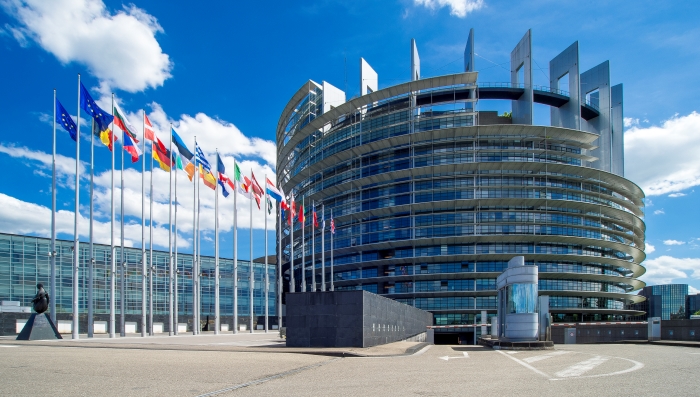
The featured image at the start of this post of the European Parliament building at Strasbourg is from the European Parliament website

 Peripatetic Perch