

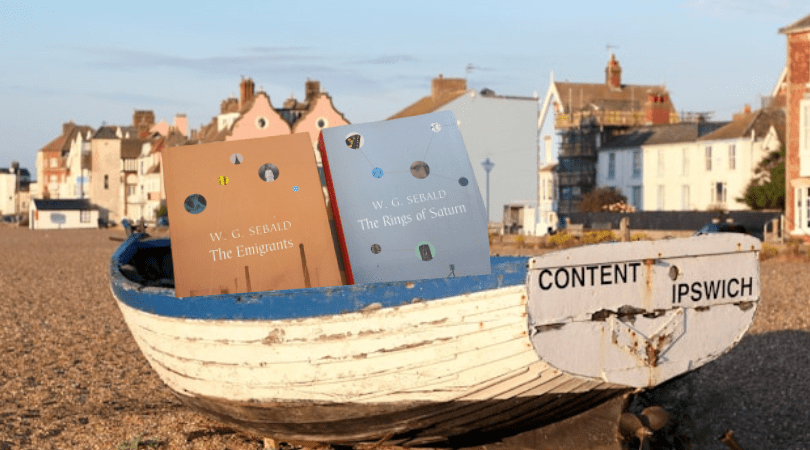
Just finished reading a couple of books by WG Sebald that I presented my aged father for his 93rd birthday last year. Dad didn’t think much of them; in fact, he said they were boring and I am not sure he even read the second book fully. Oh, too bad, I thought and decided to read them anyway. I heard of Sebald a few years ago while reading a review of Teju Cole’s book, Open City, which too I presented my aged father years ago and wrote about on my blog as well. People tended to compare Teju Cole’s writing with that of Sebald for his ability to wander in his thoughts and transport you to another place in another time.
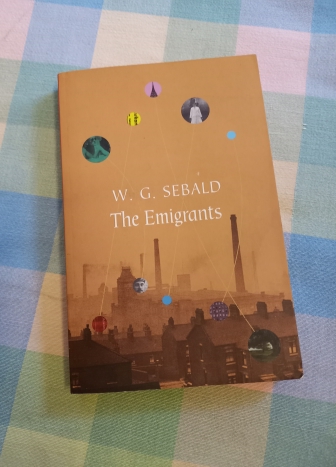
WG Sebald’s The Emigrants is about the lives of four Jewish emigrés though fiction or history is not quite clear, as the book jacket categorises it as both! I shall spend a little more time on the first story and this would give you a good idea of the remaining stories in the book as they tend to follow similar paths and styles of narration. The book begins with Sebald’s visit to Hingham along with his wife Clara looking for a home, when through all the descriptions of the surroundings it appears that they were looking for a house. They meet Dr. Henry Selwyn who says his wife is the owner of the house and that he was “a mere dweller in the garden, a kind of ornamental hermit”, as he puts it. During the description of the area, Sebald mentions a Chateaux he once visited in Angouleme in France, opposite which was a replica of the façade of the Palace of Versailles built by two crazy brothers!
After the initial descriptions of the house which includes Elaine “a female personage of indeterminable age” who was always seen at the kitchen sink, their conversations begin at a dinner to which Selwyn has also invited his old botanist and entomologist friend, Edwin Elliott. Selwyn begins to tell the story of his travels to Berne and elsewhere in Switzerland, his alpine guide Johannes Nageli, and his wife Elli who he meets in Berne. Nageli goes missing and Selwyn shares images of his mountain walks on a slide projector for the rest of the evening. It is as if Selwyn is narrating his life history to Sebald, the scribe, who is noting it all down.
But the writing doesn’t have a journalistic feel, for it isn’t specific to dates, years, places or anything by way of facts. It is more a rambling, storytelling conversation between them. In fact, the reader is likely to be surprised by the use of first person throughout, as I was, and wonder who is doing the talking in the different sections of the chapter. It takes a little getting used to – this first-person narration throughout – but more than this, the narration is dull and prosaic and what you could possibly call boring. I think this is because Sebald doesn’t seem to have anything particular or important to tell us about Selwyn. You don’t even get the sense of his Jewishness and how this might have affected his life and his travels.
Sebald tells us that years later when he and Clara were holidaying in France, Dr. Selwyn committed suicide. And years later still, when Sebald was travelling in Switzerland and thinking of Dr. Selwyn he comes across a newspaper article about the body of Selwyn’s alpine guide, Johannes Nageli, being found 72 years after he went missing in 1914.
An unexpected coincidence and twist to end the chapter with. But here too, Sebald prefers to see it as a sign of the dead always returning to us.
“In late July 1986, I was in Switzerland for a few days. On the morning of the 23rd, I took the train from Zurich to Laussanne… at that point, as I recall, or perhaps merely imagine, the memory of Dr Selwyn returned to me for the first time in a long while. Three quarters of an hour later, not wanting to miss the landscape around Lake Geneva, which never fails to astound me as it opens out, I was just laying aside a Laussanne paper I’d bought in Zurich when my eye was caught by a report that said that the remains of the Bernese alpine guide Johannes Nageli, missing since summer 1914, had been released by the Oberaar glacier, seventy-two years later. And so they are ever returning to us, the dead. At times they come back from the ice more than seven decades later and are found at the edge of the moraine, a few polished bones and a pair of hobnailed boots.”
It is the same style of narration and construct that Sebald employs in the remaining three chapters of The Emigrants. Paul Bereyter, a schoolteacher who kills himself by laying his body down on a railway track, Sebald’s own great-uncle Ambros Adelwarth emigrating to New York along with so many Jews and Max Ferber, a portrait painter in Manchester. With the exception of the story of Adelwarth which has descriptions of Jews in New York as thousands flocked there to make it their home, there is little to hint at the characters’ Jewishness and their émigré status. I didn’t know Manchester had a Jewish Quarter as I have never visited there. Sebald doesn’t tell us why Selwyn and Bereyter decided to take their lives, and if it had anything to do with their Jewishness and their suffering, we don’t know it.
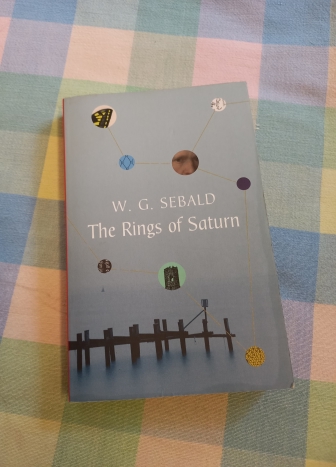
The second book, The Rings of Saturn is written in much the same Sebald style and the book jacket describes it as travel, memoir and fiction! I thought travel and memoir were non-fiction. This book emerged from his long walks in the Suffolk countryside around Norwich where he lived many years. The book has ten chapters, each dealing with a particular leg of his long journey by foot along the East Anglia coastline of UK. The book begins strangely with Sebald informing us that a year after these coastal walks, he was immobilized and had to be taken to a hospital in Norwich! He doesn’t tell us what the problem was, and instead says something about superstition and the sign of the Dog Star!
“I wonder now, however, whether there might be something in the old superstition that certain ailments of the spirit and of the body are particularly likely to beset us under the sign of the Dog Star. At all events, in retrospect I became preoccupied not only with the unaccustomed sense of freedom but also with the paralysing horror that had come over me at various times when confronted with the traces of destruction, reaching far back into the past, that were evident even in that remote place. Perhaps it was because of this that, a year to the day after I began my tour, I was taken into hospital at Norwich in a state of almost total immobility. It was then that I began to write these pages.”
The ten chapters of The Rings of Saturn describing his walks are actually his thoughts wandering from thinking about writers to emperors and wars, trade, history, art and more. Sebald takes you from Thomas Browne and his skull, to levitation, Morton Peto’s palace, Major George Wyndham le Strange, herrings, Casement and Conrad in Congo, the Taiping Rebellion, Rembrandt’s paintings to sericulture and silk manufacture. While there might be some historical context to some of Sebald’s stories and thoughts, one wonders about the veracity of many of his wanderings. For example, that sericulture and silk manufacture existed in Italy, France, Germany and even in Norwich, and that it all came from China via the Silk Route!
I was also taken aback by some of his observations from his travels which smack of prejudice and is at odds with writers who are usually known for their empathy and sensitivity. For example, this section from Chapter 5 in The Rings of Saturn about Roger Casement and Conrad. After writing about “the bombastic buildings” in Belgium’s capital city, Brussels, “erected over a hetacomb of black bodies”, and “passersby who seemed to bear the dark Congolese secret within them”, Sebald also writes:
“And indeed, to this day one sees in Belgium a distinctive ugliness. Dating from the time when the Congo colony was exploited without restraint and manifested in the macabre atmosphere of certain salons and the strikingly stunted growth of the population, such as one rarely comes across elsewhere. At all events, I well recall that on my first visit to Brussels in December 1964 I encountered more hunchbacks and lunatics than normally in a whole year. One evening in a bar in Rhode St Genese I even watched a deformed billiard player who was racked with spastic contortions but who was able, when it was his turn and he had taken a moment to steady himself, to play the most difficult cannons with unerring precision.”
We are all aware of the atrocities committed by King Leopold’s regime in the Congo, but to write about physical deformities of people as if it is poetic justice done for past crimes committed in history is beyond the pale of what can be considered good and decent writing.
The strange thing about reading this book is that although it is Sebald taking long walks along Britain’s east coast and his recollections and thoughts including of his own visits to other countries, there is very little of him in the narration. One has to marvel at Sebald’s ability to transport you to another realm altogether and another time, from just a stray incident or a casual observation made during his walk. But then, it seems that he himself gets so carried away by his mental wandering that he forgets or ignores to tell us about his walk and about these small towns and hamlets on his journey and why he even undertook such a walking tour.
Needless to say, plenty in both these books strike me as the work of unprofessional PR agency idiot bosses. For example, there is plenty about people’s ailments – including a mention of eczema, that my aged father and I both suffer from – both mental and physical and I am not sure these are central to the main stories being told. For example, in the story of portrait painter, Max Ferber, in The Emigrants, the artist describes his visit to Colmar to see Grunewald’s Isenheim paintings and his fear of travelling. He goes into great detail about “the distorted limbs, the infected colours like illness, monstrosity of suffering” and the like. What’s more, Max Ferber then describes an incident years later about his own paroxysm of pain.
“The flood of memory, little of which remains with me now began with my recalling a Friday morning some years ago when I was struck by the paroxysm of pain that a slipped disc can occasion, pain of a kind I had never experienced before. I simply bent down to the cat, and as I straightened up the tissue tore and nucleus pulposus jammed into the nerves. At least that is how the doctor later described it. At that moment, all I knew was that I mustn’t move even a fraction of an inch, that my whole life had shrunk to that one tiny point of absolute pain, and that even breathing in made everything go black.”
Then there is also plenty to do with houses and estates and therefore the consequent retinue of servants and helpers, including the story of Major George Wyndham le Strange who leaves his entire estate to his housekeeper because she ate her meals in silence, about which I even shared a post on LinkedIn. And there is yet another passage about two sisters from Lithuania called Gita and Raja, which I couldn’t find while writing this review, but will share later on LinkedIn if I do manage to trace it.
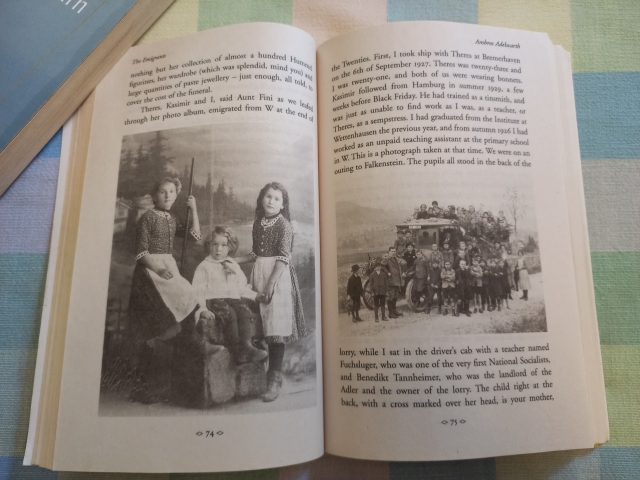
Apparently, these books are meant to fill us with a sense of melancholy that Sebald experienced, but I am afraid that this is not the effect that they have had on me. I was filled more by a sense of “what is Sebald going on and on about that he is forgetting to tell us what really matters.” Perhaps it is due to unprofessional PR agency idiot bosses’ meddling with publishing and book writing as they are wont to do. At times, The Emigrants and The Rings of Saturn reminded me of some of John Berger’s books – because of the combination of text and photographs – but this is where the resemblance also ends. Both books are published by Vintage, a division of Random House, as Vintage Classics.
It seems to be a recurring pattern with unprofessional PR agency idiot bosses meddling in book writing and publishing, that themes such as rot, decay, death, ugliness, illness and the like find favour with them. The books of VS Naipaul that my aged father presented me for my birthday last year and which I have written about on my blog were also full of such ideas. They seem to want to deliberately thrust contrived melancholy on people all the time.
About Sebald, that one can put wandering and even meandering thoughts to paper, and get the reader to accompany you on your journey is a gift and a remarkable one at that. But to be so unmoored as to not be able to tie in your own thoughts at some stage of the story – tie up the loose ends as it were – and get to the nub of the matter, is just woolgathering in my opinion.
The featured image at the start of this post of the beach at Aldeburgh, UK, is by David Tip on Unsplash, to which I have added the image of the Sebald books on Canva.

 Peripatetic Perch