


Finished reading the second book that my aged father gifted me in Goa for my birthday this year. I hadn’t heard of the author or any of her books, even though she is supposed to be a Pulitzer Prize winner. Right from the start, Caste: The Origins of Our Discontents by Isabel Wilkerson struck me as a strange title for a book that is presumably about the race problem in America – especially as the author herself seems African American from her photo on the back cover. I even shared a post about this on social media, remarking that it ought to have been race and not caste, in the American context.
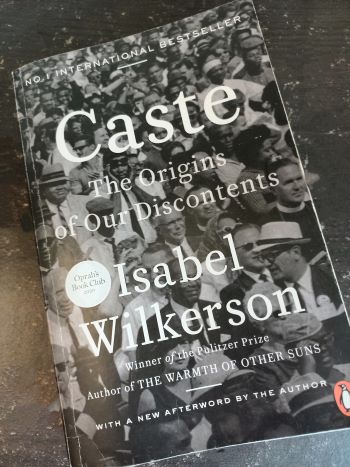
However, to my surprise and horror, the author justifies using the term caste throughout the book, and the book in a sense contains her arguments for why the race problem in America ought to be considered one of caste. Isabel Wilkerson seems to think that by insisting that the race issue is actually caste, it becomes a caste problem. While reading the book, you get the sense that the author has already decided that America’s race problem is a caste system and is now trying to find and fit arguments to prove her theory.
“Caste and race are neither synonymous nor mutually exclusive. They can and do coexist in the same culture and serve to reinforce each other. Race, in the United States, is the visible agent of the unseen force of caste. Caste is the bones, race the skin. Race is what we can see, the physical traits that have been given arbitrary meaning and become shorthand for who a person is. Caste is the powerful infrastructure that holds it in place.”
Worse, to justify her main argument, she makes the book one of comparisons between America’s race problem, India’s caste system and Nazi’s treatment of Jews. She even goes to the extent of saying that Blacks or African Americans take the position of the Shudras, while Asians and Hispanics are the “middle castes” and whites are the Brahmins of American society.
“Caste can be seen as a universal form of human division that could be applied to many hierarchies in the world, but, throughout human history, across time and space, three caste systems have stood out to this day. The tragically accelerated, chilling and officially vanquished caste system of Nazi Germany. The lingering, millennia-long caste system of India. And the shape-shifting, unspoken, race-based caste pyramid in the United States. Each version relied on stigmatising those deemed inferior to justify the dehumanisation necessary to keep the lowest ranked people at the bottom and to rationalise the protocols of enforcement.”
To further bolster her arguments, the author also quotes well-known authors and economists, such as Edward Du Bois and Gunnar Myrdal who, she insists, use the term caste to describe the race problem in America in their writings. I have read Gunnar Myrdal’s The Asian Drama but not his An American Dilemma, and I would like to read Edward duBois whenever I get the chance to do so. Not having read the books she is citing, one is not able to contest her claim more strongly, though I would be very surprised if Gunnar Myrdal or duBois termed the negro problem in America as one of caste.

“In 1944, the Swedish social economist Gunnar Myrdal and a team of the most talented researchers in the country produced a 2800-page, two-volume work that is still considered perhaps the most comprehensive study of race in America, An American Dilemma. Myrdal’s investigation into race led him to the realization that the most accurate term to describe the workings of American society was not race, but caste, that perhaps it was the only term that addresses what seemed a stubbornly fixed ranking of human value.” (italics, Wilkerson’s)
Caste: The Origins of our Discontents is divided into seven parts. The author deals with the physical appearances dimension of the race problem in the first hundred pages or so, and then proceeds to dissect the caste problem for the reader. In the chapter, The Measure of Humanity, she quotes the German professor of medicine, Johann Friedrich Blumenbach, J Craig Venter the geneticist who ran Celera Genomics and anthropologist, Ashley Montagu, to build her argument that race is a social concept, not a scientific one! In fact, she quotes Venter as saying these very words. Why should something social, not be scientific, I wondered. I suppose she and Venter mean to say that race is a social concept, not a biological one. Either way, we all know that this is patently incorrect and wrong.
This is the most important part of the book, for it is here that she constructs her argument that race is actually a problem of caste. Ironically, Part II of the book is titled Arbitrary Construction of Human Divisions, when it is Wilkerson’s construct that is artificial and false.
Part III of the book, The Eight Pillars of Caste, has eight small chapters totalling 60 pages or so; each chapter deals with a particular dimension of caste. And although she begins each chapter discussing an aspect of India’s caste system, she also tries to compare it with its counterpart in the American and Jewish-Nazi contexts. For an Indian reader like me who is familiar with India’s caste system and does not subscribe to it, despite being a Tam-Bram (Tamil Brahmin) from Kerala, her arguments come across as flimsy and the comparisons are forced as well as superficial.
For example, in the first chapter on pillars of caste, Divine Will and Laws of Nature, Isabel Wilkerson begins with the laws of Manu in India and with the help of a divider, manages to cross over to the western world and the Old Testament from the Bible. She claims that the Bible too was interpreted as having people of differing skin colours and that Ham – being dark-skinned – and all his descendants were cursed on account of dark skin. This, when she begins the chapter with the Indian caste system having evolved from different parts of the body of the Supreme One – Brahmins from his head and mouth, Kshatriyas from his arms, the Vaishyas from his thighs and the Shudras from his feet. She doesn’t care to mention that the four varnas were established in order to organize society through people’s callings or occupations.
The eight pillars of caste according to Wilkerson are divine will and the laws of nature, heritability, endogamy and control of marriage and mating, purity vs pollution, occupational hierarchy, dehumanization and stigma, terror as enforcement, and inherent superiority vs inherent inferiority. Through each of these dimensions of caste, the author constructs an edifice of caste, race and religion, each confused and conflated with the other. It is an artificial construct that doesn’t stand the weight of her own light and flimsy arguments and comparisons.
For the author doesn’t recognize the fact that the Jews are unique in that they are a race as well as a religion at the same time. And that it was through the purity of the Aryan race theory, that the Nazis exercised their authority over the Jews and even tried exterminating them. Not just in Nazi Germany, but across many countries in Europe, including the UK, Jews were discriminated against and even driven out of empires and countries. Isabel Wilkerson also doesn’t recognize that the caste system in India was one devised by the Aryans when they came to India and is therefore peculiar only to Hindus, not to all Indians living in India. She doesn’t seem to consider any of the historical facts that might have a bearing on caste or race discrimination, nor the economic and social factors that contribute to it. It is enough for her to select and use incidents to argue and make simplistic comparisons, where there are none at all.
There is plenty of this in Part IV titled, The Tentacles of Caste in which she writes about the various ways ‘caste’ manifests itself. Here, she relies on her own experiences, along with other incidents including those that make news headlines to tell us how caste operates. In this section, there are chapters on the insecurity of the dominant caste, the need for a scapegoat, the necessity of various rungs to further entrench the dominant caste, and the like.
In the next section, Part V, Wilkerson deals with the consequences of caste, such as feeding narcissism, subordination of lower castes, creating inequality and fault-lines, etc. However, because her basic premise is flawed and is an imagined construct, she is unable to convince or persuade the reader of her theories and ideas. A lesser reader might be easily swayed by her beguiling arguments and comparisons. Not I.
Through the course of the book, she also tries to convince us that “there was little confusion among some of the leading white supremacists of the previous century as to the connections between India’s caste system and that of the American South.” She quotes Madison Grant who she says was a popular eugenicist to make her case that the idea of the American caste system came from India. In his 1916 bestseller, The Passing of the Great Race, Grant is supposed to have written:
“A record of the desperate efforts of the conquering upper classes in India to preserve the purity of their blood persists until this very day in their carefully regulated system of castes… In our Southern States, Jim Crow cars and social discriminations have exactly the same purpose.”
What’s more, in the chapter, The Nazis and the Acceleration of Caste, Wilkerson argues that the Nazis developed their purity of race theory by studying the Americans! She even quotes a Yale legal historian James Q Whitman who in his 2017 book, Hitler’s American Model: The United States and the Making of Nazi Race Law, published by Princeton University Press, is believed to have written that seventeen legal scholars and functionaries in Nazi Germany were going back and forth over American purity laws. In debating “how to institutionalise racism in the Third Reich, they began by asking how the Americans did it.”
Not only is Wilkerson’s entire argument and premise of race being caste deeply flawed, she would even have us believe that the Americans learnt it from India’s caste system and that Nazi Germany in turn learnt it from the Americans. Wow, what a fantastic legacy India has been bequeathing, all over the world! Leaving such yarns aside, though, what is a fact is that some Hindus, namely the RSS, developed their militant form of Hindu nationalism in contemporary times by studying Nazi ideology and following their inspiration.
Caste: The Origins of Our Discontents is also not enjoyable to read, because of the way it is written. The author uses too many metaphors in various places in the book, all forced into the narrative, as if she needs them as crutches to make her points. From toxins in the permafrost, pathogens and climate change, to the building of a house and infra-red light, flooded basements and other construction metaphors, Isabel seems to latch on to anything that will serve the purpose of her argument.
That race is caste. Why? She has a simple rationale for that as well: because racial hatred or discrimination is based on a structure and a hierarchy, it becomes caste. “Oh, you mean class” flashed through my mind on more than one occasion when I came across passages that referred to structure and hierarchy. Strangely, there isn’t a single reference to a class-related problem in the entire book.
Caste: The Origins of Our Discontents is supposed to be a book on sociology, published by Penguin. I can see how unprofessional PR agency idiot bosses have meddled once again in book-writing and publishing. Just as they did by getting Francis Fukuyama to write a book called Identity – if he indeed wrote it – which I bought on Amazon years ago and reviewed on my blog. In fact, many of the ideas for this book and what it contains seem to have come from a deliberate and mischievous misreading of that article of mine.
From years of watching these same unprofessional PR agency idiot bosses operate – and from being a victim of it – I have always maintained that they are a terrible influence on everyone and everything they come into contact with. This book on sociology has been written and published to try and make me my younger sister, Bhavani, I suspect, who long ago tried to study sociology in Mumbai but never completed her studies in college. Or to make me my old colleague in Ogilvy Delhi, Sarada, which they have been trying for years. They think in such narrow silos that if one reads sociology, I become my sister; if I read history, I become my old friend, Priya Christian; if I read literature, I will become my other old friend and former sister-in-law, Gargi. What if I read books on economics, business or politics, or anything else? Take a guess – I’ll become one of them – a PR agency idiot. They have even got Wilkerson to refer to Gunnar Myrdal as a social economist; why, haven’t they heard of welfare economics or development economics?
And so the circus goes round and round, making a fool of everyone all the time. For almost two decades now, I – and my aged parents in Goa who have nothing whatsoever to do with PR or advertising agencies – have had to endure this unprofessional rubbish.
Let me end by saying that such a book on sociology is dangerous, because it promotes false narratives, fuelled by equating race with caste, and even with religion. What are young, impressionable readers to make of this? The blame is as much the unprofessional PR agency idiot bosses’, as the writer’s and the publishers’, for propagating nonsense as new sociology theories.

Post script: I must add that I also suspect PR agency mischief in this book from having guessed or meddled through Ogilvy, what I had written ages ago while working in the Delhi office of Ogilvy in my treatment note for the Passport Scotch Whisky TV commercial that I had scripted while working there. The mention of the German professor of medicine in this book is curious; during the course of his studies of various races, he apparently named the Caucasian skull as the most beautiful and almost perfect.
In my treatment note and casting note for the TV advert to be shot and produced in London, I had mentioned that the chief lady character in the film, ought to be Caucasian in appearance, by which I meant dark-eyed and with dark-hair – as also for the two male characters. I don’t think I need to be explaining my reasons for doing so here, so many years later, but my reasoning at the time was that more of the world is dark-eyed and with dark hair than blue-eyed and blonde. Since Seagram was spending a considerable amount in producing this film they ought to be able to air it in as many countries as possible without a problem.
I cannot believe the extent of meddling and interference by unprofessional bosses who ought not to be in the corporate world in the first place. I might mention that there are also references to Boston Brahmins, a la the film of the same name based on Henry James’ novel, and a chapter titled The German Girl with Dark Wavy Hair, in which people are trying to guess the ancestry of a girl, as from the Middle East and possibly even Jewish.
In my entire career in the advertising and brand communications industry in India, I have not met people more obsessed with women’s physical appearances than these Perfect Relations chiefs.
 Peripatetic Perch