

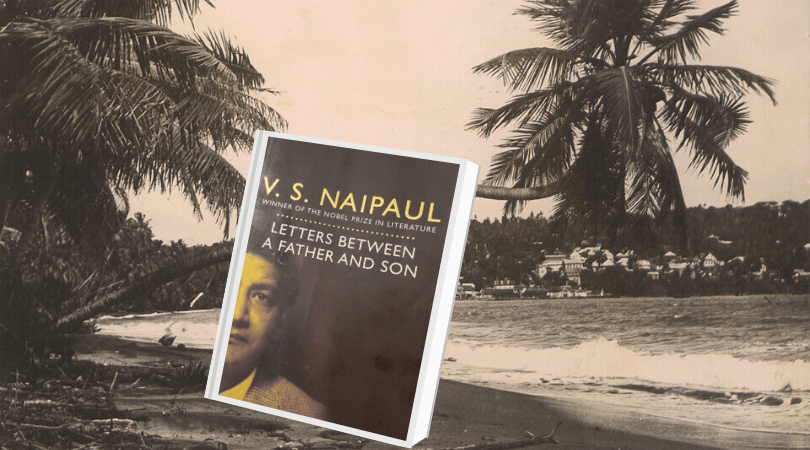
I just finished reading the second of VS Naipaul’s books that my aged father presented me for my birthday this year along with Sam Dalrymple’s Shattered Lands. I have already written about The Enigma of Arrival and Shattered Lands on my blog, and if I thought that Letters Between a Father and Son would be spared the meddling of unprofessional PR agency idiot bosses I would, of course, be very mistaken. In fact, it is a book completely prompted and motivated by the same idiots who have been meddling in book writing and publishing for decades!

Letters Between a Father and Son is a compilation of a selection of letters between VS Naipaul and his father, Seepersad Naipaul, from the time VS leaves for England to study at Oxford University in 1950 to 1957 when he becomes a writer. The book is divided into ten sections, chronologically arranged, but they don’t actually suggest any distinct stages in their lives or in their correspondence. You would think that most letters would be father encouraging son to be a writer which was his ambition right from the start, but in this book, we have the reverse. It is VS who is encouraging his father most of the time with his writing, both of the journalistic kind and of fiction. This, even as VS is himself busy studying at Oxford and writing his own stories in England.
Other than letters between father and son, the book has quite a few letters between VS and his elder sister, Kamla, to whom he appears very close. I suppose it helps because both are away from home pursuing higher studies in England and in India respectively. VS’s first letter to Kamla is about a dinner that he attended in Port of Spain before even leaving for England. He says he went to an Old Boys’ Association Dinner – without saying of what kind – and goes on to say how disappointed he was with the food served at the dinner.
“I had bread and water for the first two eating rounds. The menu was in French. What you would call stewed chicken they called ‘Poulet Sauté Renaissance’. Coffee was ‘moka’. I had rather expected that to be some kind of exotic Russian dish. Dessert included something called ‘Pomme Surprise’. This literally means ‘surprised apple’ and the younger Hannays (a fellow student), who was next to me, told me that it was an apple pudding done in a surprise manner. The thing came. I ate it. It was fine. But I tasted no apple. ‘That,’ Hannays told me, ‘Is the surprise.’”
VS also writes to Kamla about intellectualism and the world dying. In the same letter, VS also writes about Nehru’s autobiography and Aldous Huxley’s views on India, warning Kamla not to be drawn into that kind of India.
“From Nehru’s autobiography, I think the Premier of India is a first-class showman using his saintliness as a weapon of rule. But I am sure it has a certain basis in fact. Huxley may have degenerated of late into an invalid crippled by a malady that has received enormous approval by the intellectuals – mysticism – but what he said in his book (Jesting Pilate) about India twenty years or so ago is true. He said that it was their half-diets that produced ascetics and people who spend all their time in meditation. You will be right at the heart of the whole cranky thing. Please don’t get contaminated; I will be glad when your three years will be finished; then you could breathe the invigorating air of atheism. (I don’t like that word. It seems to suggest that the person is interested in religion; it doesn’t suggest one who ignores it completely…)”
This, because his sister Kamla went to India to study at Banaras Hindu University. The book tries to reconfirm and explain certain aspects of Naipaul’s travel to England as narrated in The Enigma of Arrival, which I have already written about on my blog. In a letter to Sati, his younger sister, VS writes about having to travel to UK via Puerto Rico and NYC, because of issues to do with his scholarship from the Trinidadian government. Strangely, in the first few letters between father and son, there is no mention of his journey to England and life at Oxford. Only when his father enquires in a letter, does VS write about a tutorial that he attended, where he wrote an essay on King Lear, which his tutor said was “pleasantly written and trenchantly argued”. Reeks of unprofessional PR agency idiot bosses and Devi Cherian’s website, for those of you who might be interested.
VS writes home that he is writing for Isis, the literary magazine of Oxford University and sends them a copy of it. Father, Seepersad, in turn writes about his writing for the Guardian in Trinidad and he keeps sending VS his stories which he would like published in the UK and thinks his son can help. He also writes about shifting to sub-editing and page-making, which he seems to enjoy.
“Since last Monday – today is Thursday – I have been shifted to Guardian Weekly, to sub. And write stories and make up pages. The page-making is quite interesting work – almost as thrilling as writing an article; but up to now, I am just learning. I seldom come home before 5.30 or later in the evening. It is stiff work, but if I get to use my initiative in doing the make-ups without too much interference I am sure I won’t mind the hard part of the hours at all. Fact is you get so absorbed in the work that time passes before you realise it is time to go home.”
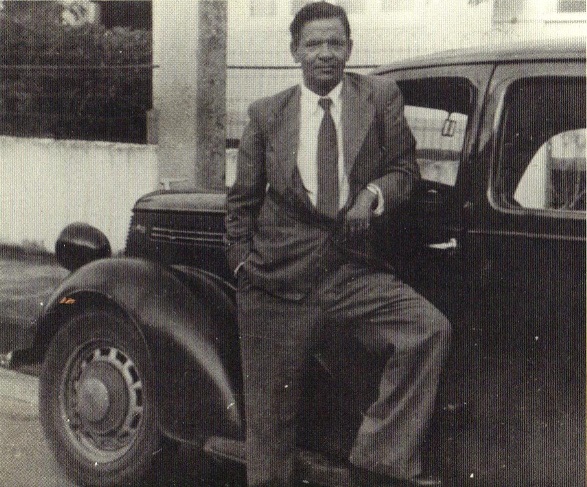
In the preface to the book, VS Naipaul writes that his father’s stories were placed in BBC’s Caribbean Voices programme. Naipaul himself wrote and read for BBC London in the Caribbean Voices programme and this is how he supported himself financially even while studying at Oxford University on a Trinidad Government Scholarship. When I checked online about VS Naipaul’s Caribbean Voices work, I was served a link by Google to this page on BBC’s website. As you would expect, most letters between father and son are about their writing, the articles, stories and attempts at getting them published. Unfortunately, they are all of a very prosaic kind. They do not reveal very much about their writing interests, their thought process, or what they observe around them and their views on anything in particular. Essential elements in any writer’s life.
Other than this, many letters are about family matters, relations – including a Capo R and a Capo S, both maternal uncles of VS who live in England – as well as cheering and encouraging each other along. As part of the family gossip exchanged between father and son, here is Seepersad writing to VS about his cousins, Deo and Phoolo who appear to be sisters:
“I never realized until about three weeks ago, how shockingly ‘advanced’ these girls have become. You know they live with us; and I found myself – and still do find myself – in a position of not knowing what to do: whether to tell them to go away or to let them go on with their lamentable perversity. These girls have become so ultra-modern that they make no distinction between Negros, Mussalmans or any other people…
But it is not with Phoolo that I have been having any trouble, but with Deo. The girl has gone head-over-heels, as they say, in love with a Mussalman named Isaac Mohammed, a drummer in the Indian orchestra that plays for Radio Trinidad.”
This reeks of nothing but unprofessional PR agency idiot bosses who have been doing a lot of mischief for decades now with their two women narrative, including getting nonsense written about sisters, etc, when in fact, this is nonsense with trying to make me my younger sister, Bhavani Sundaram, Devi Cherian or some other idiot in their PR circus!
VS Naipaul writes about the difficulty in making new friends at Oxford, so he joins several societies and groups in college and finds that this helps to some extent. Soon, he writes about going with friends to their homes for weekend breaks and the like. His views on Oxford students display his intellectual arrogance even in his younger days. His father chides him discreetly and gently, without so much as acknowledging the particular section of his son’s letter.
“I have sent along a copy of the Isis – one that has my name in it in small type. It is an absurd little magazine, as you will see. Because the undergraduates in this place are not all dazzlingly intellectual, as you probably think. There are asses in droves here. The reason why so many of them get ahead is that England offers just that scope for getting ahead… Nearly everyone comes to Oxford on a state grant… If you want to find superficial young women, and even more superficial young women, Oxford is the place.”
Father, in his reply:
“I wish you the best of luck in your examination. Do not allow yourself to become a prey to anxiety, but take it cool; just aim to do the best you can, without show-off; that is, aim not to beat everybody, but just do the best you can.”
In a separate letter, Seepersad Naipaul takes up the issue of “shallow-minded” people at Oxford with his son, advising him to be objective because one is likely to meet such people everywhere.
Most letters are about family matters and about writing, as well as about parcels and money being sent to each other, as they try to help each other out. In fact, VS keeps writing home and to Kamla asking for cigarettes to be sent to him as they are frightfully expensive in England, until he realises the futility of it. The letters that feature later in the book also discuss thoughts on future plans, getting a job, wanting to be a writer, etc. VS Naipaul also writes to his father wanting to bring him over to England at least for a stay, if not for good. However, from his letters, he seems quite decided not to return to Trinidad and settle there. In fact, it is apparent from one of his earlier letters in the book. Kamla does return to Trinidad and takes up a schoolteacher’s job, and the family seems thrilled to have her back in their midst.

Some of the later letters are also to do with his father, Seepersad, passing on and issues of what the rest of VS’s siblings want to do with their education and life. VS reaches out to Kamla to send him some money even as he writes and asks about father’s debts and financial position on his demise.
In a letter to his mother – the few that there are in this selection – after his father’s demise, whose funeral VS couldn’t attend, he writes trying to explain his decision to stay on in England.
“Nothing is going to give me greater pleasure than the return home. I fully intend to return home this summer, but I can give no definite date…
The fact is this: I don’t see myself fitting into the Trinidad way of life. I think I shall die if I had to spend the rest of my life in Trinidad. The place is too small, the values are all wrong, and the people are petty. Besides, there is little for me to do there. Ideally, I would like first of all to arrange for some sort of job in India or elsewhere, and then come home for a vacation, which I do desperately need.”
This, even as VS has told his parents about meeting Patricia Hale at Oxford and wishing to marry her later. Strangely, VS hardly writes about Patricia to his parents or Kamla. He seems totally absorbed in himself, his work and in thinking about his family back home.
There are some letters between VS and Kamla in which they discuss how they will look after and care for the rest of the family, after they get jobs. Especially now that they hear of a new arrival in the family: a little girl, Nalini, who is born to Seepersad in 1952 even as he and his wife Droapatie already have six children and he is in his late forties. As it turns out Seepersad dies the very next year, in 1953.
Finally, a word about the way they address each other. VS is almost always Vido, through most of the letters, both written by him and those addressed to him. Occasionally, he is addressed as Vidia which is how even his friends later in life such as Paul Theroux referred to him. VS’s younger brother, Shiva Naipaul, the only other male child in the family, who also grew into a good writer although he died young is referred to as Siva in this collection of letters. In one letter to his father, VS laments not being able to send Sewan anything for his eighth birthday. In the reference notes, Sewan is explained as ‘another form (likewise Sivan) of Shiva, Vidia’s younger and only brother.’
Knowing unprofessional PR agency idiot bosses’ dirty tricks by now, I won’t be surprised if this has come from my email address which has 08 in it, and turning me into an eight-year-old boy as well!! After all, the CEO of Perfect Relations said something to me in their Delhi office about Shibu way back in 2007-08, did he not?! I thought he was even insinuating that I was in some kind of relationship with my driver in Delhi whose name is Shiv Paswan, I wrote in a blog post log ago. The sick and unprofessional fellows that these guys are, they ought not to be in the industry along with their cronies in RK Swamy/BBDO Chennai. Instead, they seem intent on interfering and meddling in my work and life to this day, what with their “business-starting” nonsense!
This selection of letters doesn’t shed any light on the other, younger, son, but it appears that writing is what father and both his sons had in common.

 Peripatetic Perch