


With the latest and the 15th season of the Indian Premier League having just concluded end of last month, I decided to give some thought to the IPL and the opportunities it presents for brand-building, at various levels. You could say that the game of cricket itself is something of a religion in India, and the Indian Premier League takes it to a whole new level. What with many of the players in the tournament being celebrities at par with film stars.
It’s another matter that film stars too are part of this cricket extravaganza that takes place every year in summer across venues in India. Their role here is that of team owners, and along with big businesses, they own some of the biggest cricket league teams in the country. Of course, all this is relatively new in a country raised on a diet of test cricket and one-day internationals that came later. However, it has been 15 years since Indian Premier League was launched, so why is it that it is not the mega-brand it ought to be by now? And why aren’t the league teams brands as well, with massive followings in their home city and across the country?
If we look at state, or region-based cricket in India, we always had the Ranji Trophy which helped groom new players to play first class international cricket for team India. It was followed closely only by hard-core cricket enthusiasts, and even the media didn’t pay enough attention to it. In the case of Indian Premier League that is not the case; it has garnered too much media attention and sometimes for the wrong reasons as well. Mired by scandals of all sorts right from the start, Indian Premier League was the brainchild of Lalit Modi, who himself had to flee to London to escape the enquiry that was initiated in the early years of the IPL of all kinds of irregularities. Besides, with big businesses and film stars owning teams, and with players from all over the world competing, how could IPL not attract the maximum attention from media and from cricket lovers?
There might be many who think that Indian Premier League is a brand, and so are the league teams, as they also happen to enjoy fantastic brand valuations. I beg to differ, and in this piece I shall argue for what is required to make brands of each one of them. After the initial few years of hiccups, things stabilized in the Indian Premier League when the BCCI (Board for Control of Cricket in India) took the entire tournament over and laid down the rules for how the game will be governed. It is now completely under BCCI control, to the extent that they control team franchise revenues, including from central sponsorships and endorsements as well as media rights, which are distributed equally to all league teams, according to this article in Forbes. This ensures that the business model of Indian Premier League is sound, and every team is guaranteed to be profitable, no matter its success on the cricket ground.

The Indian Premier League rakes in big money for the team franchises as well as BCCI, which also controls media rights. And every year, the bidding or asking price for star players who are chosen through an auction mechanism keeps climbing higher and higher into the stratosphere! Brand valuation companies too have gotten into the act, valuing the IPL and the teams at unbelievable sums, all in millions and billions of dollars, of course! I do not know the basis for how they arrive at these valuations, and so will not comment on them. Better to concentrate first on whether these are even brands yet, and if not, what does it take to make them brands in the real and true sense of the word.
In the corporate world of business and brands, what we understand a brand to be, is determined by the underlying product or service and its value to consumers. It has to be a product or service that is in great demand and to which consumers flock in large numbers, repeatedly over several years. In this time, consumers and other stakeholders would have built a relationship with the product or service, strong enough for it to now be called a brand. In the case of Indian Premier League, it is a unique cricket tournament of the short T-20 format, that allows Indian and international cricketers to play shoulder to shoulder, and to compete at the highest levels of the sport.
Although many of the individual league team players are stars in their own right, what they bring to the tournament and to each team is what ought to matter. Unfortunately, in recent years I notice that so much of the discourse around brands is focused on the personal brand – and I suspect mischievously so by unprofessional elements who have no idea what brands really are – that their celebrity status overshadows everything else. And in the case of Indian Premier League, such an approach can blindside us to the real issue at the core. Because we do have celebrities playing the game, and celebrities owning teams as well. Yet, for all that star value hoopla, the Indian Premier League falls short of the brand it can be, and so do all the teams.

Returning to what the IPL really represents, it is a tournament in 20 overs of the best of Indian and international cricket talent. Yet it is called the Indian Premier League, so the greatest benefits must flow to Indian cricket and to our players. Although I am not such a regular viewer of the IPL because I think it drags on for too long, I have observed over the years that it has given many young and new cricketers a chance to shine on the cricket pitch. It is in that sense, a happy recruiting and grooming ground for the Indian cricket stars of tomorrow. Were the Indian Premier League to be positioned along these lines, it would acquire a genuine and well-meaning purpose, a goal to achieve and constantly strive for, year after year. Such a brand positioning for IPL would also strike a chord with spectators and followers of the game, who would always cheer for new Indian cricketers to be discovered in an international arena.
Similarly, the individual team franchises need to work on their own individual team strategies for building brands, besides the strategies that they put to work on the cricket field. Each league franchise is named after a city or state, and to that extent, their brand-building journey will have to begin by creating a large local following first. With a few new teams being added to the IPL tournament, there are now 10 teams competing for the trophy, each belonging to a particular city or state in the country. There are many branding strategies that the team franchises can explore, but whatever they pursue must differentiate them from the other teams and must be capable of building a local fan following. To that extent, the local city or state element in the branding and brand strategy is extremely important.
Great examples of such team franchise brand-building already exist in the world of international soccer, both in the English Premier League and in European football clubs. Each of these clubs have managed to build strong brand identity and fan following, especially locally and then internationally. There are differences to the extent that club league football is professional football, and each club signs on star players from across the world, as well as star managers. In fact, the managers are often the bigger stars and the actual bosses who have great responsibility for their teams to perform. I will return to this aspect of the need to professionalise the Indian Premier League and the teams as well a little later.
Let us look at how these football clubs build their brands. If the Forbes article is anything to go by, it appears that the Indian Premier League teams raise most of their revenue through BCCI, as sponsorships and endorsements, with ticket sales contributing less to the revenue, and merchandising contributing the least, unlike international teams that earn a considerable part of their revenue through merchandising, licensing and rights. However, one needs to be a team that has a significant fan following and brand image, in order for the merchandising and licensing to be sought after.
Therefore, I think that each Indian Premier League team ought to build a brand strategy for itself that combines a distinctive aspect of the city/region, with the team vision as well as the star players. This would also require that they don’t change their team players often and take the trouble to retain the great stars. As it stands, each IPL team has a brand identity in the form of a team brand name, a logo and team colours. It might sound like it’s too late in the day to try and change or fit a new brand strategy to what already exists. I would say that if the Indian Premier League tournament is willing to modify its strategy to a more sharply focused one along the lines I have just recommended and relaunch itself next year with a new vision and focus, individual teams too can relaunch their brands with a more clear and distinctive brand strategy. And it ought to be possible without altering their brand identity too much.
I visited some of the IPL team websites, and I must say that they are certainly making an attempt to build a brand through customer and fan engagement online. However, once you have visited a few, you realise that there is little to differentiate them as brands; they all have videos clips, interviews, fan contests and merchandising as well. What is missing is a brand strategy and an idea around which the team can coalesce.
To build a brand with fans and customers, the teams will also have to focus on communication through social media. I am not sure what exactly the teams are doing on social media to connect with their viewers and fans. And finally, building a cricket league team brand would also require you to engage in activities on the ground, right in the city where you belong. Most international soccer club teams have entire stadia to themselves, but a good place for IPL teams to start would be to create a gallery space/small museum dedicated to their team’s performances and stars. This could be within the main city stadium premises, where they would probably have to rent space from the local cricket authority, or it could be somewhere close to the main cricket stadium. A gallery/museum along with a café and merchandising store attached to it would be a great hang-out place for young cricket fans. These spaces could also be venues for fan-engagement events with the cricketers, from time to time.
Returning to the need to professionalise the Indian Premier League, I would suggest that along with the new, more focused strategy on discovering and grooming Indian cricket stars of tomorrow, the tournament also find a better and more professional way to hire players on long-term contracts. Instead of an auction, which can sometimes send a player’s price soaring to astronomical levels, there ought to be a more professional way to recruit players. And since Indian Premier League is about providing an international arena to groom Indian cricketers, perhaps there needs to be a cap on the number of foreign players in each team franchise. And finally, perhaps it’s also time for teams to have professional managers as well; Sachin Tendulkar is a mentor for Mumbai Indians, but what all teams need is a hands-on professional manager, vested with all the authority and independence he needs to be able to make the right decisions for his team.
We have discussed brand-building at both the tournament and the team franchise level. The Indian Premier League also provides opportunities for brand-building to corporate sponsors at all levels. I was always of the view that the IPL was right up Pepsi’s alley when it took up sponsorship of the tournament for five years. Unfortunately, the company and brand did nothing to capitalize on the opportunity, considering that this was a T-20 format, and was being followed by millions of Indian youth, who are Pepsi’s target audience. More recently, Tata has taken up the Indian Premier League title sponsorship, and I am not sure for how long. But in the first year, I can tell that they too have missed the opportunity of building a connect with Tata, the corporate brand that ought to stand for maximizing human capital.
Perhaps the problem lies equally with the Indian Premier League itself, which lacked a clear strategy and brand positioning right from the start. I visited the IPL website and am shocked that they have nothing to say about the tournament in the About Us section. Take a look at the About Us section of the English Premier League for reference. I am not sure about DLF and Vivo’s sponsorship of the Indian Premier League but I would like to think that had IPL always stood for building the cricket stars of tomorrow, both Pepsico and Tata might have derived greater value from their sponsorships.
What better way to end this piece on the Indian Premier League than with the Women’s Premier League that was inaugurated just this year. Short and sweet, the WPL ushers in a new era in women’s cricket and will hopefully avoid all the mistakes that IPL made. That said, WPL too needs a strategy. And given that many of the WPL teams are branded the same as the men’s IPL teams and owned by the same people, perhaps that’s another good reason now to rethink brand strategy.
Howzaat!
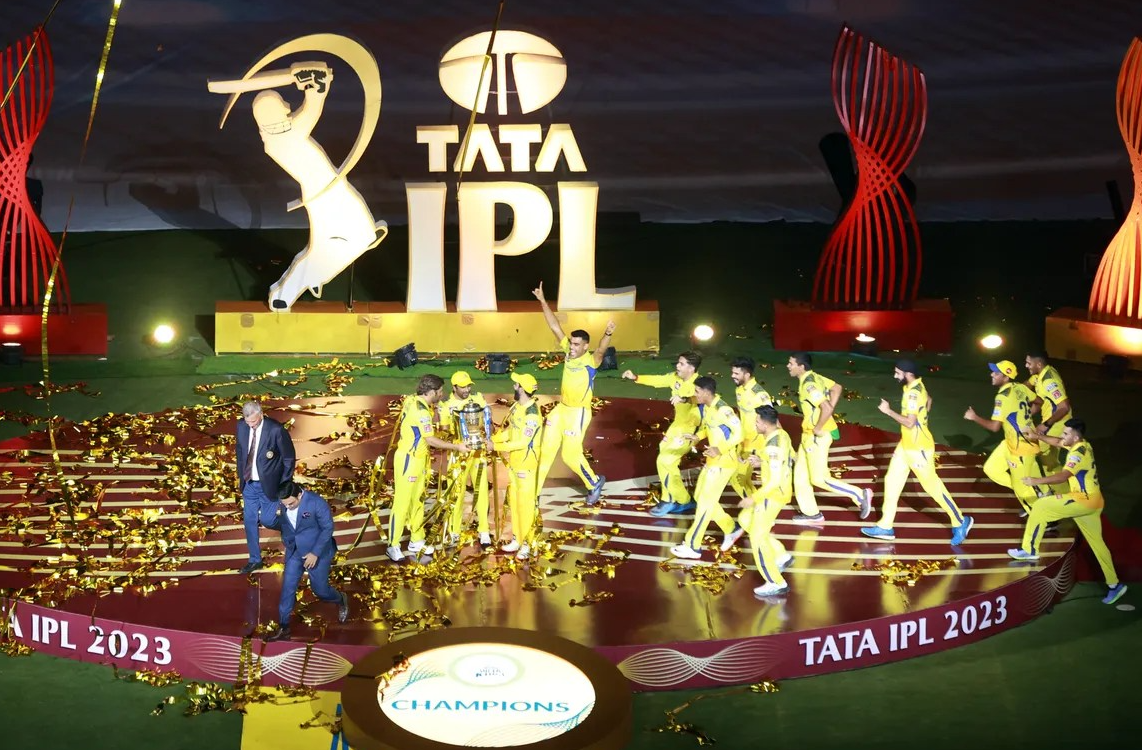
The featured image at the start of this post is of the celebration post the grand finale match of Tata IPL 2023 between Chennai Super Kings and Gujarat Titans, and is from IPLT20.com

 Peripatetic Perch